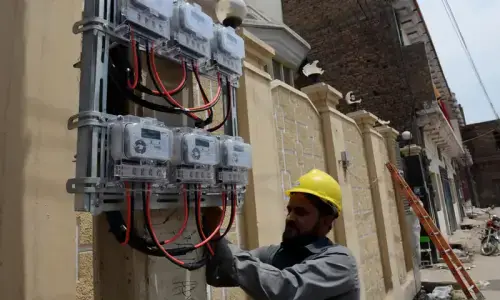
ISLAMABAD: The National Electric Power Regulatory Authority (Nepra) on Friday notified an additional burden of Rs9.8 billion on electricity consumers for the August billing period due to a fuel cost adjustment (FCA) of 75 paisa per unit.
The net average fuel cost in August would be around 41 paisa per unit higher than in July, when the FCA stood at Rs0.34 per unit.
In its notification, Nepra said it had decided that the positive FCA for June 2026, amounting to Rs0.7503 per kWh, would apply to all consumer categories that opted for prepaid tariffs, except lifeline consumers, electric vehicle charging stations and prepaid electricity consumers.
The adjustment applies to K-Electric (KE) as well as power distribution companies (Discos) that originated from Wapda.
The regulator said the adjustment would also apply to consumers under the incremental consumption package. Discos and KE are required to reflect the fuel charges adjustment for June 2026 in the billing month of August 2026.
The FCA is reviewed every month as per the tariff regime applicable across the country and is usually applicable to the consumer’s bills for one month only.
The Central Power Purchasing Agency (CPPA) had reported that the actual average fuel charges component for June 2026 was Rs8.9138/kWh, compared with the reference fuel charges component of Rs7.7138/kWh approved in the applicable notified consumer-end tariff.
Accordingly, it had demanded Rs1.20 per unit additional FCA for June 2026.
After certain adjustments, Nepra worked out the actual fuel component of the tariff at Rs8.4641, thereby allowing a lower FCA of Rs0.75 per unit in August instead of Rs1.20.
The power division and its entities had reported a 5.6 per cent decline in overall generation in June compared to the projected level.
Nepra expressed concern over partial loading charges amounting to Rs4.9 billion.
CPPA, however, argued that these charges were not due to operational inefficiencies but resulted from reduced daytime demand caused by rooftop solar generation.
Power plants were operated at partial load during solar hours and ramped up later to meet the evening increase in grid demand.
The power division warned that renewable power sources, such as wind and solar, may need to be curtailed in the future if daytime demand declines significantly in the coming years.
Under the tariff mechanism, changes in fuel cost are passed on to consumers only on a monthly basis through the automatic mechanism.
On the other hand, quarterly tariff adjustments — based on variation in power purchase price, capacity charges, variable operation and maintenance costs, use of system charges and impact of transmission and distribution losses — are built in the base tariff by the federal government.
Last week, the government indicated that it was working on another power tariff package as it sought about Rs1.20 per unit additional fuel cost from consumers to collect Rs15.7 billion in August for electricity consumed in June.