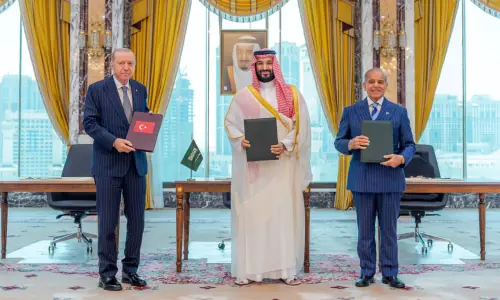
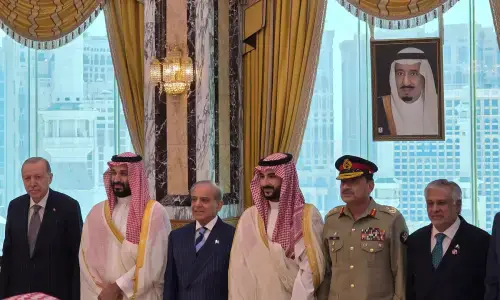
IN the midst of a gruelling war between the US and Iran — currently at a stalemate — the signing of the Makkah Joint Defence Agreement between Pakistan, Saudi Arabia and Turkiye on Friday is a highly symbolic development.
It comes at a time when the American defence umbrella has proved of little help in protecting Saudi Arabia and the other Gulf Arab states. Rather, the presence of US military assets in these states has pulled them into the war, as the Iranians and their regional armed allies target these facilities.
Seen in this context, many questions swirl around the new defence agreement, specifically the fact that it considers an attack against one signatory to be an attack against all.
The prime minister, the Saudi crown prince and the Turkish president were all upbeat about the new pact. PM Shehbaz Sharif termed it “historic”, while President Recep Tayyip Erdogan said it is open to “friendly nations”.
This is not an ‘Islamic Nato’. Moreover, similar alliances have been attempted before, such as the Islamic Military Counter Terrorism Coalition founded in 2015 and headed by former army chief Gen Raheel Sharif. The latter alliance is not linked to any major operations.
Pakistani-Saudi defence collaboration goes back decades, and the current pact only solidifies the arrangement, while also bringing Turkiye on board. But the question in many minds is what role the pact will play vis-à-vis Iran.
A Saudi deputy minister has said the agreement “does not represent an effort to establish a military axis or a sectarian bloc”. This clarification is welcome. On the other hand, an adviser to Iran’s supreme leader has said that more cooperation among regional states “can secure its security”.
If the US-Iran war remains unresolved and major hostilities erupt again, the new alliance will be put to the test, especially if Tehran resumes attacks on the pro-America GCC states.
Suffice it to say, such alliances should work to reduce tensions between Muslims states, and not be used against any Muslim country.
The US has shown it is uninterested in protecting its Gulf allies, even though the latter have purchased billions of dollars’ worth of weaponry from it. Instead of depending on the US or other foreign powers for security, regional states — indeed all OIC members — should pledge to refrain from aggression against each other.
Iran should stop attacking the GCC states, while the Gulf sheikhdoms should stop foreign forces from using their soil against Iran. The Arabs and the Iranians cannot change their geography; they have to live side by side; hence it would be best if they worked out a modus vivendi for mutual security.
Hopefully, the new defence agreement can promote unity within the Muslim world, instead of adding to the existing fissures.
Published in Dawn, August 9th, 2026