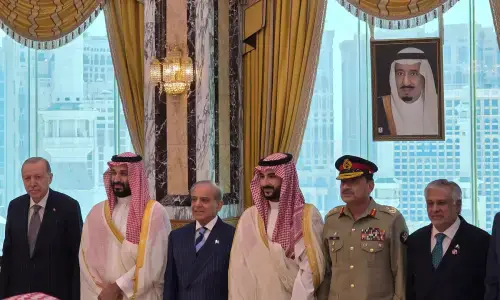
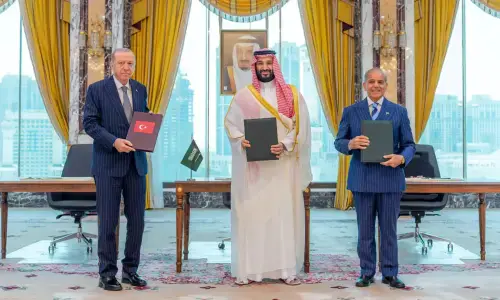
OVER the past few days, Pakistan has been going the extra mile to assure Iran that the Makkah Joint Defence Agreement it signed last week with Saudi Arabia and Turkiye poses no threat to Tehran.
In a recent telephone call, Foreign Minister Ishaq Dar told his Iranian counterpart Abbas Araghchi that the pact is “not an instrument of confrontation”. Moreover, Prime Minister Shehbaz Sharif told the cabinet that the agreement is “entirely for defence purposes”.
Tehran seems to have understood the messaging, as the Iranian foreign ministry spokesman said his country had no reason to believe the pact was aimed at encircling it, and that it showed that countries of the region could not depend on the American security umbrella.
Perhaps the reason for speculation surrounding the deal was the mutual defence component, which says that an attack on one signatory is an attack on all. Considering the targeting of US military assets in Saudi Arabia and other Gulf states by Iran during the active phase of hostilities with America, observers have debated whether the signatories of the deal could step in militarily. However, the clarifications regarding Iran are welcome. In fact, what is needed is a new regional security architecture that binds the Arabs, Iranians and other states together.
Achieving this would be difficult, considering the pro-America stance of the GCC states. However, the American military footprint in the Gulf and larger Middle East may eventually shrink, which means that regional states will have to eventually work out a security framework amongst themselves. The Makkah pact could provide a blueprint for such defence cooperation. The Turkish president has already said that the pact is open to other countries.
If Iran were to be brought on board, it could significantly alter the regional security landscape. For this to happen, the existing high levels of mistrust between the Arabs, particularly Saudi Arabia, and the Iranians, would need to be reduced. But states such as Pakistan and Turkiye, which maintain cordial ties with both sides, can attempt to bridge the gap. As a CBM, Iran should open up the Strait of Hormuz, as its continued closure is battering Gulf economies. The Arab states should also pledge to disallow outsiders from staging aggression against Iran from their soil.
Instead of depending on extra-regional powers, the states of the Gulf and Middle East must themselves create a new security architecture. Not only would this reduce the tensions that exist between them, it could also serve as an expanded defence pact to deter Israel from attacking regional states. Tel Aviv has attacked Iran and its allies, as well as pro-America states like Qatar, hence an effective regional defensive bloc could make Israel think twice about its violent adventurism.
Published in Dawn, August 12th, 2026