After death of 3 Pakistani sailors, FO says Islamabad will implement maritime coalition 'in full earnest'
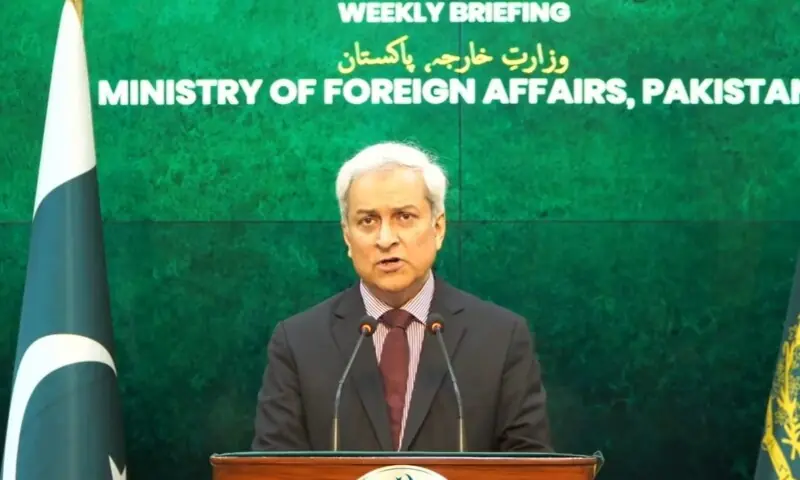

The Foreign Office (FO) said on Wednesday that Pakistan, as a signatory to the recently announced multinational maritime defence coalition, would implement its commitments “in full earnest”.
The statement comes following the deaths of three Pakistani sailors in Houthi strikes on a Saudi cargo ship on Tuesday.
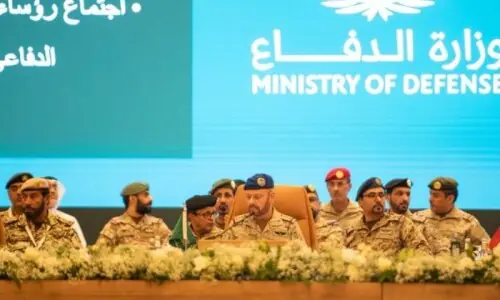
Last month, Riyadh unveiled plans for a multinational maritime defence coalition to protect shipping and energy supply routes in the Red Sea region. Fourteen countries, including Pakistan, Turkiye and Egypt, backed the coalition in a joint statement.
Answering questions at a weekly press briefing, FO spokesperson Tahir Andrabi elaborated that Pakistan was a signatory of the recent joint statement supporting a multinational maritime defence coalition, led by Saudi Arabia, to protect shipping and energy supply routes.
“Pakistan is a signatory to this maritime coalition communique and we will implement it with full earnest,” Andrabi said, adding that the country was engaged with the Saudi authorities in this regard.
Andrabi further said that on the directions of Deputy Prime Minister and Foreign Minister Ishaq Dar, Pakistan was ascertaining the details of the agreement.
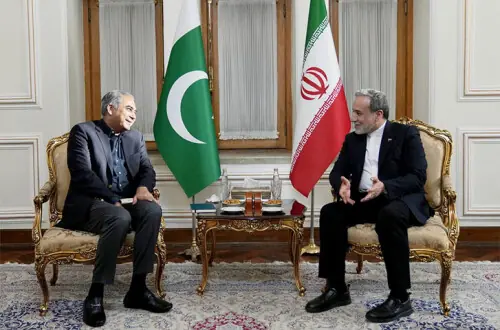
In his opening statement, the FO also said that Interior Minister Mohsin Naqvi’s visit to Iran was aimed at discussing bilateral relations, security-related matters and regional developments, particularly peace and stability in the region.
He said Naqvi — who arrived in Tehran on Tuesday — was holding meetings with senior Iranian officials.
He added that the visit provides the two countries the opportunity to discuss “bilateral relations, security-related matters, and regional development, with a particular focus on efforts to promote peace, stability, and constructive engagement amongst the parties in the region and regional developments”.
Naqvi was received in Tehran by his Iranian counterpart, Eskandar Momeni, and later held talks with Iranian Foreign Minister Abbas Araghchi and Iranian President Masoud Pezeshkian, Iranian media reported.
A diplomatic source had told Dawn from Tehran that the principal objective of Naqvi’s visit was to follow up on the Islamabad Memorandum of Understanding and Pakistan’s mediation between Iran and the US.
Speaking further on Pakistan’s mediation efforts between the US and Iran, Andrabi reiterated that Pakistan remained engaged alongside “brotherly states” in “sincere efforts” to work towards a resolution to the crisis.
“Pakistan is making all-out efforts to bring the two parties to the negotiating table and the Islamabad MoU and pave the way for peace and stability in the region,” he said.
He also warned that Pakistan would continue to “offset spoilers using direct and indirect channels” and ensure the continuation of constructive dialogue to resolve outstanding issues.
During the Q&A session, responding to a question regarding the status of the Islamabad MoU, the spokesperson said, “Whenever the rationality for dialogue will overcome the logic of escalation, the template for peace is provided in the Islamabad MoU and Pakistan-Qatar joint statement.”
The current deadline for the 60-day period for US-Iran negotiations under the Islamabad MoU is Aug 17. Andrabi, however, noted that this deadline “can always be extended” if there is the intention to hold dialogue.
“Even then, five days still remain, so we are not closing the chapter,” he added. “But we hope that even if the deadline is not implemented, the extension will take place eventually and the parties will revert to dialogue.”
Asked about the basis for Pakistan’s continued optimism amid the US-Iran conflict, the spokesperson said, “As a mediator and facilitator of talks, we remain optimistic that a solution is in sight.”
He pointed out that during the conflict, the countries had cycled through periods of heightened escalation followed by relative calm and eventual dialogue. He termed this “the natural progression of any armed conflict of international significance”.
“We are not discouraged by escalations, as much as we do not get overly optimistic when there is a period of calm,” he said, while highlighting Pakistan’s sustained engagement with the parties to resolve the conflict.
The country would continue its engagement with optimism “that ought to be there in any credible facilitator and mediator”, he added.
Makkah pact reflects ‘resolve for sharing burden of regional peace’
The FO spokesperson also spoke of the defence pact signed last week between Pakistan, Saudi Arabia and Turkiye, which he said was “highlight of the week”.
The joint defence agreement, signed in Makkah on Friday, aims to strengthen collective deterrence and empowers its signatory states to treat an attack against one of them as an attack against all of them.
He said the agreement reflected the three nations’ “commitment to further strengthen their collective security, promoting peace security and promoting peace security and stability in the region and beyond”.
He said the agreement reflected the “long-standing brotherly relations” among the three countries and “displays our resolve for sharing the burden of regional peace and security”.
“The agreement is purely defensive in nature and allows unified efforts to confront threats and security challenges to the member states,” Andrabi added, recalling Deputy Prime Minister and Foreign Minister Ishaq Dar’s statement congratulating the nation on the agreement on August 10, wherein he held the agreement was defensive in nature and not against any country.
Responding to a question, he noted that while the agreement was open to other countries, he was not “particularly aware” of which specific countries may join it in the future. He also said that he was not aware of any consultations with the US and China regarding the agreement, calling this “a matter of diplomatic exchange”, but noted that channels of communication with both countries remained open.
FO rejects Indian MEA’s ‘baseless’ remarks on AJK
When asked about the Indian Ministry of External Affairs’ recent remarks regarding alleged human rights abuses in Azad Jammu and Kashmir (AJK), the FO spokesperson rejected the “baseless” statement. The region has been gripped by unrest since early June as elections are also being held.
“India’s professed concerns for human rights in AJK are disingenuous given its own well-documented record for repression in Indian Illegally Occupied Jammu and Kashmir, including excessive use of force, arbitrary detention, suppression of political freedom and sweeping powers under the draconian laws enacted there.”
He added that India’s “politicisation” of developments in AJK was “misleading and cannot divert attention from the stark realities in Indian illegally occupied Kashmir”.
“Pakistan remains fully committed to the protection of fundamental rights and the democratic freedom of AJK,” he said.
He added that rather than making such statements over AJK, India would be “well advised to honour commitments made by its founding fathers and uphold the right of the people of Indian illegally occupied Jammu and Kashmir to freely determine their future through a United Nations plebiscite in accordance with relevant UN Security Council resolutions”.