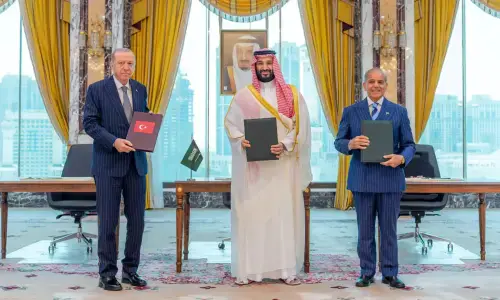
'We aspire for it to grow': Turkiye's Erdogan eyes expansion of Makkah Joint Defence Agreement
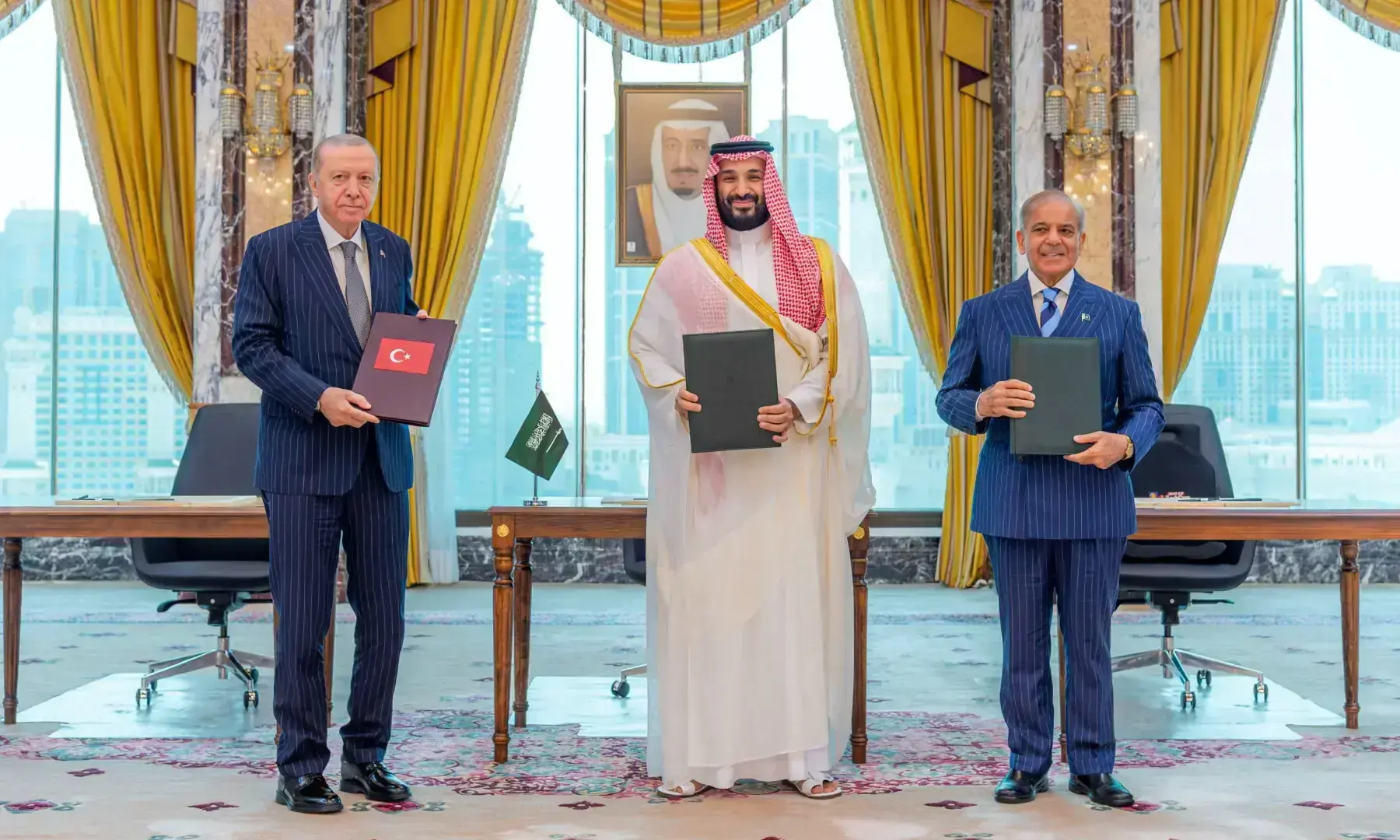

Turkish President Recep Tayyip Erdogan said on Wednesday that he hoped more countries would join a defence agreement signed last week between Turkiye, Saudi Arabia and Pakistan, aimed at stabilising a region wracked by conflict.
The Makkah Joint Defence Agreement was signed last week as the Middle East grapples with fallout from the US-Iran war, which has dragged in regional players and disrupted shipping through the Strait of Hormuz and the Red Sea.
“Our vision for it is not limited to the three countries,” the Turkish leader told the London-based Asharq Al-Awsat daily.
“Rather we aspire for it to grow, and perhaps appropriate conditions will emerge one day for all countries of the region to gather under its umbrella.”
Turkish Foreign Minister Hakan Fidan on Saturday said Turkiye expected Egypt to join the pact “in the next stage”, telling the Anadolu state news agency only “a few technical issues” stood in the way.
Egypt has not commented on the agreement nor on the remarks by Fidan, who will visit Cairo on Thursday and Friday.
Cairo has robust military cooperation with Ankara, but has given no indication it intends to sign up to the new security alliance, which contains a Nato-style clause saying any attack on one would be seen as an attack on all.
The five-month US-Iran war has upended the security architecture in the region and forced a rethink of decades of conventional wisdom rooted in US military supremacy.
Erdogan said the pact emerged out of the “new circumstances” in the Middle East with regional players seeking to assume greater responsibility for their own security and stability.
“Regional issues should be resolved by regional actors, and with this action, we consider that we have taken a first step toward achieving that goal,” he told the Saudi-owned newspaper.
“Resolving regional issues must be carried out away from formulas imposed from the outside. We know very well that solutions imported from abroad only bring disasters.”
The Makkah Joint Defence Agreement has been hailed by the 57-member Organisation of Islamic Cooperation (OIC) as an “important strategic step”.
Kuwait, Bahrain and Somalia are among the countries that have welcomed it. Iran’s comments also took a rather positive tone, stressing its stance of pursuing “security mechanisms based on cooperation between regional countries”.
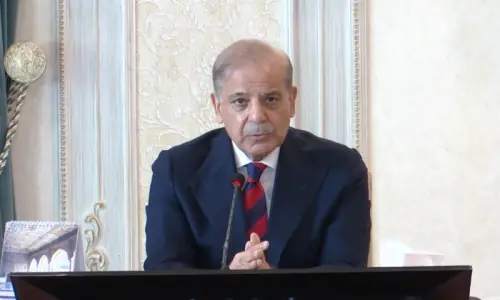
On Monday, Prime Minister Shehbaz Sharif affirmed that the defence pact was “entirely for defensive purposes”, and not for any aggression.
Addressing the federal cabinet on Monday, PM Shehbaz stressed that the objective of the pact is to “promote peace, progress, and prosperity in the region”.
While the pact comes in the backdrop of the US-Israel war on Iran, Bloomberg had reported in January — before the conflict began — that Ankara was seeking to join a separate mutual defence pact between Islamabad and Riyadh.
Pakistan and Saudi Arabia had already signed the “Strategic Mutual Defence Agreement” in Riyadh last September, pledging that any attack on either nation would be treated as an act of aggression against both.
In January, Reuters quoted Defence Production Minister Raza Hayat Harraj as saying that a draft had been prepared after 10 months of talks. Turkish FM Hakan Fidan had said Ankara favoured an “inclusive platform that creates wider, bigger cooperation and stability”.
Pakistan has also sought to mediate efforts to end the US-Iran war, while Turkiye has played a diplomatic role in negotiations aimed at ending the war in Gaza.
Israel ‘removing Palestine’ from world agenda
Erdogan also accused the Israeli government of Benjamin Netanyahu of seeking to “remove Palestine” from the world’s agenda.
“The aim of the Netanyahu government is to remove Palestine from the common agenda of humanity by profiting from chaos and new conflicts in the region,” Erdogan said at a joint news conference with his Palestinian counterpart, Mahmoud Abbas.
“No matter what they do, they will not succeed. The Palestinian cause will continue to grow in people’s hearts as they try to destroy it,” he stressed, vowing Turkiye would fight for the establishment of a Palestinian state.
A strong advocate of the Palestinian cause, Erdogan has repeatedly lambasted Netanyahu’s government, accusing the Israeli prime minister of committing “genocide” in Gaza and of pursuing expansionist policies in the West Bank, Lebanon, Syria and beyond.
Abbas arrived in Ankara on Tuesday accompanied by his diplomatic adviser Majdi Khalidi, intelligence chief Majed Faraj and senior Palestinian official Ziad Abu Amr.
He met Erdogan on Wednesday with the pair discussing developments in the region in talks the Palestinian leader described as “important and fruitful”.
“I hope the decision to hold legislative and presidential elections in Palestine after a long time will bring good fortune … [and] will advance the reconciliation process,” Erdogan said, in a nod to the historic rivalry between Abbas’ Fatah movement and Gaza’s Hamas rulers.
Abbas also hailed the defence pact between Ankara, Riyadh and Islamabad, saying it was “of utmost importance” and expressing hope it would help enhance security and stability in the region.