Govt remains committed to Balochistan’s flood-hit people

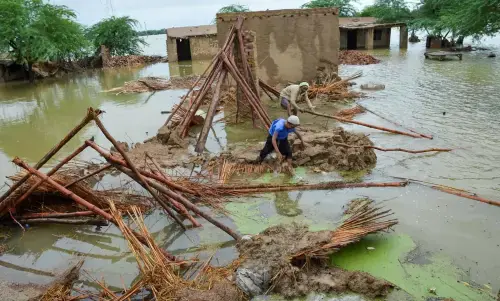
ISLAMABAD: The government remains committed to the rehabilitation of every eligible family affected by the devastating floods of 2022, the Ministry of Planning and Development has said.
The commitment comes in the wake of reports that the provincial and federal governments had restructured a World Bank-funded flood rehabilitation project, depriving a large number of affected families in Balochistan of the resilient homes they were promised.
In a statement, the planning ministry maintained that 68,992 fully damaged or destroyed houses in Balochistan were identified as eligible for reconstruction assistance by the Post-Disaster Needs Assessment (PDNA). Each one of them remains entitled to the housing assistance committed under the Integrated Flood Resilience and Adaptation Programme (IFRAP).
In addition, the ministry said, the project provides self-recovery support for 58,016 partially damaged houses.
Planning ministry says work has commenced on 74,988 houses, of which 26,357 have already been completed under owner-driven construction model
According to the statement, as of August 10, construction had commenced on 74,988 houses, of which 26,357 had already been completed under the project’s owner-driven reconstruction model.
The ministry maintained that since IFRAP was conceived as a multi-sectoral recovery and resilience programme, it does not simply mean rebuilding houses while leaving communities without schools, healthcare, irrigation, roads, water, livelihoods and protection against the next disaster.
It said that the decision to redirect WB funding from one sector to another was taken by the project steering committee — led by Chief Minister Sarfraz Bugti and Planning Minister Ahsan Iqbal — and that the resources were allocated within Balochistan.
“A family whose house has been rebuilt still needs a functioning school for its children, a health facility for its elderly and sick, irrigation water for its crops, a road to reach the market and opportunities for its young people to earn a livelihood,” the statement said.
The statement said that housing is the only major IFRAP component financed above its originally authorised cost, with financing for housing standing at approximately $161 million against an approved PC-1 cost of $155m.
The ministry, however, said that it takes concerns about project implementation and performance seriously, which is why the Project Steering Committee has already ordered an independent high-level inquiry. Its purpose is to establish the facts transparently, examine any shortcomings in implementation and fix responsibility wherever warranted.
Our Staff Reporter adds: According to World Bank project documents and minutes of meetings, IFRAP’s dedicated Housing Reconstruction Unit identified 231,749 eligible beneficiaries, and provided additional financing in 2025 to increase the project funding to $161m to support a total of 97,000 eligible beneficiaries.
It was the IFRAP project steering committee which decided that housing support may be capped at the 62,966 first-tranche beneficiaries approved as of June 22, 2026, while housing subsidy support would remain capped at 97,000.
WB Country Director Bolormaa Amgaabazar noted in a July 30 letter that this decision leaves 119,049 verified and eligible households without financing support, and expressed concern that making this decision public means that households that completed verification and signed the project undertakings may continue to expect assistance. She highlighted that 66,120 exclusion-related grievances had already been registered in the project grievance management system on or before the agreed cut-off date and that such an exclusion could aggravate poverty situation in the provinces.
Published in Dawn, August 14th, 2026