US, Iran play ‘claim game’ over Hormuz

• Tehran warns no tanker can pass safely without approval from its armed forces; demands compensation for damage from Qeshm oil spill
• Hegseth says US can maintain naval blockade of Iran indefinitely
• Pakistan urges UN to protect seafarers from attacks in Red Sea
DUBAI: The Strait of Hormuz is “under Iran’s control and management”, the recently appointed head of Iran’s Basij paramilitary unit said on Thursday, rejecting claims by US President Donald Trump that the United States had “total control” of the strategic waterway.
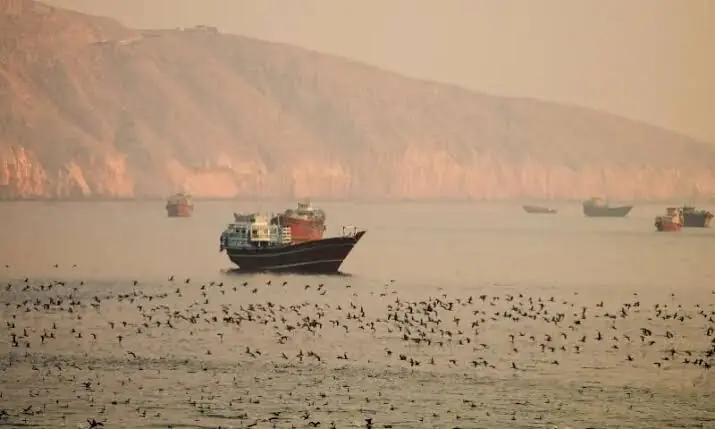
The competing claims follow the breakdown of a ceasefire in a war that began Feb 28 with US-Israeli strikes on Iran. Following the conflict’s outbreak, Tehran effectively shut the strait, through which a fifth of the world’s oil and liquefied natural gas previously shipped.
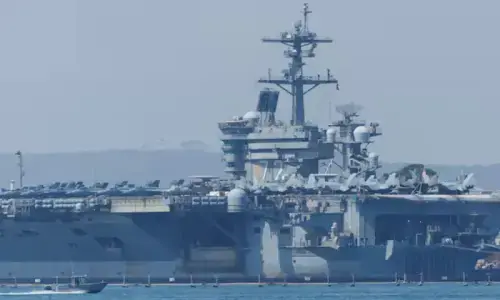
The US subsequently imposed a naval blockade on Iranian shipping and ports, stating it would protect freedom of navigation for vessels travelling to non-Iranian ports.
In a Wednesday post on his Truth Social platform, Trump claimed the US “has total control over the Strait of Hormuz. I THINK WE WILL KEEP IT!”
“Our naval blockade is being called, by everyone, ‘A WALL OF STEEL,’ and there is nothing Iran can do about it,” he added.
Iranian officials firmly denied the assertion. Hossein Taeb, head of the Basij forces under the Revolutionary Guard, told the semi-official Fars news agency that the US sought to disrupt the Islamic Republic’s popularity in the region by launching another war but had been defeated.
“Today you see that the Strait of Hormuz is under the management and control of the Islamic Republic, and our country continues on its path in complete security,” Taeb said on state television.
Iran’s military command also issued denials. “The false claims of the United States that ships are passing through the Strait of Hormuz normally … are nothing more than lies and fabrications,” Iran’s central military command spokeperson Ebrahim Zolfaghari said.
He added that no commercial ship or tanker will have the possibility of safe passage “without the permission and supervision of the powerful Iranian armed forces”.
Since the war began, Iran has controlled the vital energy route, hindering passage from US allies and imposing fees.
Senior military official Rasoul Sanaei-Rad warned Iran would not reopen the strait unilaterally unless the US fulfilled its commitments.
Iran’s top diplomat, Abbas Araghchi, wrote on X Thursday that the US has “long miscalculated due to intelligence failures”, pointing to its stance on the waterway as an “even bigger miscalculation”.
Despite Iran’s assertive stance, US Defence Secretary Pete Hegseth reinforced the president’s assertion on Thursday. “Indefinitely the United States Navy can maintain a blockade like that because we’ll rotate ships in and out, as we have, and we’ll continue to,” Hegseth told reporters in Panama.
Compensation for environmental damage
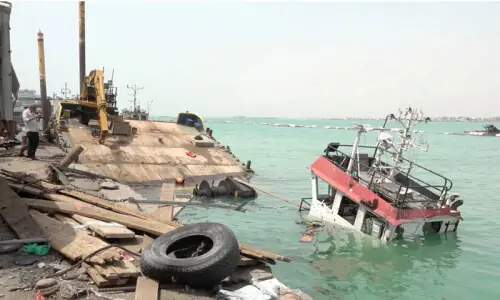
Amid the military standoff, Iran warned of environmental degradation in the strait after an oil spill reached its southern Qeshm island.
Foreign Ministry spokesperson Esmaeil Baqaei said preliminary evidence pointed to a foreign bulk carrier, arguing that countries benefiting from the strait had a legal and moral duty to help remedy the damage.
The spill comes after another slick in recent days near neighbouring Oman from a tanker that ran aground. An AFP investigation previously found the ship had been stranded for weeks near Oman’s Al-Qibliyyah island after it was damaged by explosions.
Pakistan urges the UN to protect seafarers
Meanwhile, Pakistan urged the UN Security Council on Thursday to protect international shipping and seafarers from deadly attacks and keep Yemen’s worsening humanitarian crisis at the forefront of its attention.
Ambassador Asim Iftikhar Ahmad condemned attacks on commercial shipping in the Red Sea, Gulf of Aden and Bab-el-Mandeb Strait, including an Aug 11 attack that killed three Pakistani crew members and one Indonesian.
“The safety and security of international maritime shipping and protection of seafarers must be respected in accordance with international law,” Mr Ahmad stressed.
Pakistan also condemned Houthi missile and drone attacks against Saudi Arabia, describing them as a grave threat to regional stability, while expressing unwavering support for the Kingdom’s sovereignty.
The Pakistani envoy warned that Yemen’s acute humanitarian needs must not be overshadowed by the wider regional confrontation, noting renewed fighting and economic disruption could aggravate an already fragile situation.
The Council held an open debate on Yemen as tensions triggered by the US-Iran war continued to ripple across the Middle East.
Members discussed renewed Houthi military activity and the growing risk that the escalation could undermine the UN-mediated truce that has kept large-scale fighting in Yemen at bay since 2022.
Mr Ahmad emphasised that a peaceful resolution hinges on dialogue. “A Yemeni-led and Yemeni-owned political process … remains the only viable path towards a comprehensive and sustainable settlement,” he said.
Anwar Iqbal in Washington also contributed to this report
Published in Dawn, August 14th, 2026