

11 killed in deadliest Israeli strikes on Lebanon since June

• Three children among the dead
• Lebanese PM Salam says slain women, children were not ‘military infrastructure’; President Aoun calls strikes a ‘clear message’ ahead of Rome talks
• Hezbollah vows ‘appropriate’ response, rejects direct negotiations
BEIRUT: At least 11 people were killed in Israeli strikes in southern Lebanon on Saturday, including three children, Lebanon’s health ministry said, marking the deadliest raids since deals in June eased hostilities between Israel and Hezbollah.
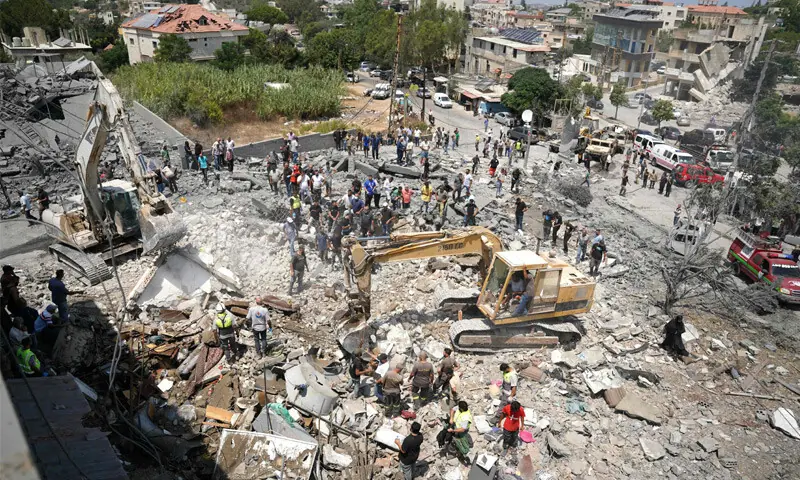
Seven people were killed when Israeli warplanes struck a house in the southern village of Ansar. Four others were killed and 17 were wounded in a strike on the village of Deir Zahrani, raising an earlier toll, Lebanon’s official National News Agency said. The attacks wounded a total of 19 people.
The strikes came as Israel and Lebanon were set to hold an eighth round of US-sponsored direct negotiations early next month in Rome. Lebanese President Joseph Aoun said Saturday’s strikes were a “clear message” aimed at the negotiations and American efforts to implement the framework agreement.
Aoun condemned the “ongoing Israeli attacks” on the south and “repeated violations of the framework agreement … and international law on protecting civilians, which led to the death of an entire family in the village of Ansar,” according to a statement from his office.
Lebanese Prime Minister Nawaf Salam echoed the condemnation, urging Israel to halt the “extremely dangerous” escalation.
“The martyrs of the Israeli raid on the village of Ansar are not ‘military infrastructure’, and the women and children killed in it are not military targets,” Salam said in a post on X.
Hezbollah said the Israeli attacks on Lebanon would be met with an “appropriate” response, urging authorities to halt “humiliating” negotiations with Israel.
Israel “must clearly understand that its attacks, violations and attempts to impose a fait accompli cannot continue and will be met with an appropriate response,” the group said in a statement.
Hezbollah added that Lebanese authorities “must not insist on continuing along the humiliating path of direct negotiations and providing the enemy with free concessions.”
The group said the escalation reflected a desire by Israeli Prime Minister Benjamin Netanyahu “to escalate the war in order to strengthen his domestic political position”.
The Israeli military said the early morning strikes in the areas of Nabatieh and Ansar were in retaliation for an attack by Hezbollah on its troops inside an agreed security zone, which resulted in three injuries. The zone is a strip of territory about 10 kilometres deep inside Lebanon where Israeli forces operate.
In a statement on X, Netanyahu’s office appeared to acknowledge that civilians were hit.
The military said it killed Ali Samir Al-Haj Hassan, a commander in Hezbollah’s elite Radwan Force, and others when it struck a central headquarters in Ansar. “At the time of the strike, Hassan’s family was also present with him inside the military headquarters and, according to the claim, was harmed in the strike,” the statement added.
The National News Agency reported the strike near Ansar, roughly 20 kilometres from the border, was the deepest into Lebanon in two months. The agency also reported a series of airstrikes targeting the Ali al-Taher ridge, a strategic hill overlooking the Nabatieh area.
The Israel-Lebanon framework deal includes the disarmament of Hezbollah, a gradual withdrawal of Israeli forces from south Lebanon and the deployment of the Lebanese army to the region.
At least 4,300 people have been killed in Lebanon since the latest round of hostilities began in March.
Published in Dawn, August 16th, 2026


























