Supreme Court acquits remaining 3 accused in 2014 Kot Radha Kishan case


ISLAMABAD: The Supreme Court has acquitted three individuals who had been sentenced to death in a 2014 case in which a Christian couple was burned alive in a brick kiln in Kasur’s Kot Radha Kishan over blasphemy allegations.
The court overturned the death sentences of the three men and acquitted them after giving them the “benefit of doubt”, the 26-page detailed judgement issued on Thursday said. The court also rejected a state appeal against the acquittal of 102 other individuals in the case.
The appeals were taken up by a three-judge bench led by Justice Shahzad Ahmad Khan and comprising Justices Aqeel Ahmed Abbasi and Justice Shakeel Ahmed.
The pleas challenged a May 16, 2019 Lahore High Court verdict upholding the death sentence handed to the now-acquitted three men. They were sentenced by an Anti-Terrorism Court on November 23, 2016.
Authored by Justice Khan, the Supreme Court’s judgement said the prosecution had failed to prove the case against the petitioners beyond a shadow of doubt and, therefore, they should be released from jail forthwith if not required in any other case.
The court, however, also acknowledged the “shocking and brutal” nature of the crime that the appeals stemmed from.
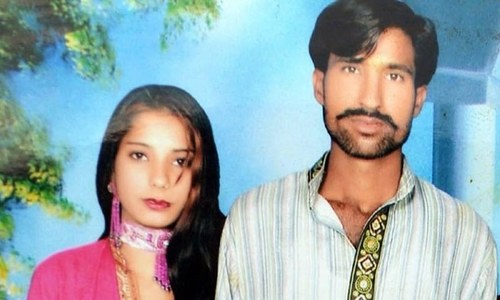
On Nov 4, 2014, a frenzied mob of 400 to 1,000 people, incited by announcements from local mosques, had attacked a Christian couple who worked as bonded labourers at a brick kiln in Kot Radha Kishan. They were accused of blasphemy.
According to the first information report (FIR) of the incident, the mob tore the roof off the office where the couple had taken shelter, dragged them out, and after torturing them, threw them into the furnace of the kiln. Both were burned to ashes.
The police party that arrived at the scene was outnumbered and attacked, and the witnesses — many of them relatives of the deceased — were unable to intervene.
Terming the incident “brutal”, the court also emphasised its duty to ensure justice and observed that an innocent person should not be executed in the absence of reliable evidence.
The judgement highlighted contradictions in the prosecution’s case as the primary reason for the acquittal.
“Though there is no compulsion that an FIR should be lodged only by the legal heir/relative of the deceased, usually in our society, the legal heirs/relatives of the deceased become the complainant,” the judgement said, adding that none of the relatives of the deceased had become complainants in the case.
Moreover, the relatives of the deceased had not signed any memo of this case as a witness, the court noted.
“These facts suggest that, in fact, eye-witnesses related to the deceased were not present at the spot at the time of occurrence,” the judgement said.
The Supreme Court also pointed out that the name of one of the men it had acquitted, whom the witnesses identified as the sole person to throw the victims into the fire, was not mentioned in the FIR.
The court found it “unbelievable” that the witnesses would have told the police his name, but it would not have been recorded.
The judgement also highlighted a “lack of independent corroboration” for the claims against the petitioners. It referred to established legal precedents that when witnesses falsely implicate several accused, the conviction of the remaining ones on the same evidence was unreliable without independent proof.
The judgement also highlighted that none of the petitioners received burn injuries or were found wearing the protective wooden shoes and wet clothes necessary to be near the furnace, creating a “reasonable doubt about their involvement”.
It reiterated the established principle that the “benefit of doubt” was a right, not a concession. It stated that if a single circumstance creates reasonable doubt about an accused’s guilt, they were entitled to acquittal, regardless of the heinousness of the crime.
Consequently, the Supreme Court converted the jail petition into an appeal, allowed it, and set aside the judgments of the lower courts.
The three petitioners were acquitted of all charges and ordered to be released immediately.
In addition, the Supreme Court also dismissed the state’s petition against the acquittal of the 102 other individuals in the case.
The Supreme Court “found no material illegality or misreading of evidence in the lower courts’ decisions to acquit them” and noted that no appeal had been filed by the legal heirs of the deceased against these acquittals.