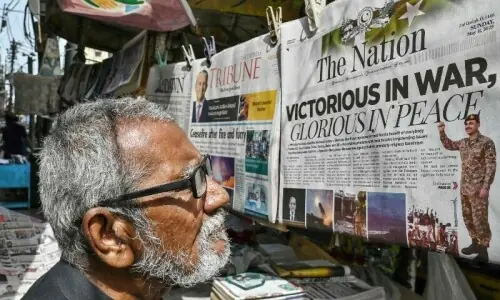
UNABLE to come to terms with both its military and narrative failures during and after the May 2025 hostilities with Pakistan, the Indian state continues to flog a dead horse by trying to depict loss as success.
The latest example of this is a new documentary released in India titled Declassified: Operation Sindoor. The film tries to paint the clash as an Indian victory, relying more on revisionism and fantasy than what actually transpired across the battlespace. Pakistan’s military spokesman has termed it a “Bollywood-style” production and a “mutilation of history”.
It should be remembered that the majority of Indian media outlets during the conflict had resorted to high-pitched jingoism, reporting that key cities in Pakistan had been ‘conquered’ and ‘devastated’ by the Indians. It mattered little that these preposterous claims had nothing to do with reality. The new documentary appears to me a more ‘polished’ attempt at regurgitating the same narrative.
Instead of pouring its energies into demonising Pakistan and conjuring up phantom victories, the Indian state would be better off trying to mend fences for a secure future for all of South Asia. Very few outside India’s corridors of power are buying the narrative about an Indian ‘victory’ during last year’s clash, just as there have been few takers for the spurious claim peddled by New Delhi that Pakistan was responsible for the Pahalgam atrocity.
Neutral observers paint a more nuanced picture of the confrontation, pointing to Pakistan’s clear successes in countering Indian air attacks. No respectable third party has endorsed claims of an Indian ‘victory’. But facts, it seems, matter little to the BJP-led government in New Delhi, which insists on manufacturing fantastical accounts of the May war. It forgets that many Indian politicians themselves have questioned their government’s tall claims regarding the clash.
There is a need for India to move beyond such narrow perspectives and look to the future. The fires of war are raging not very far from South Asia, and both states, particularly India, should redouble their efforts to bring calm to the subcontinent, instead of stoking tensions. New Delhi’s toxic jingoism and military misadventures have backfired. It is time for India to return to the diplomatic track, and approach Pakistan with respect.
Tens of millions in South Asia continue to suffer from poverty, disease and illiteracy. Climate change is a common enemy — smog and natural disasters do not respect borders. While it would be simplistic to assume that both states will bury the hatchet immediately, at least the first steps can be taken towards normalisation. These should include the return of high commissioners to both capitals, and a pledge to restart the dialogue process to address all outstanding irritants standing in the way of better ties.
Published in Dawn, August 20th, 2026