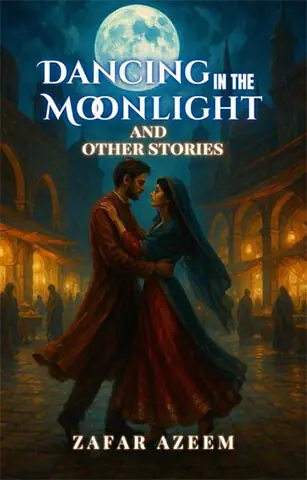
Dancing in the Moonlight and Other Stories
By Zafar Azeem
Self-published
ISBN: 978-9699192296
216pp.
Zafar Azeem, the author of Dancing in the Moonlight and Other Stories, is a graduate of Punjab University and practises law in the USA. He has written two other short story collections: As Luck Would Have It and Other Stories in 2005 and And the Cab Moved On and Other Stories in 2025.
There are 15 stories in Dancing in the Moonlight and Other Stories. They are all short and easy to read. In many cases there is no story as such, no yarn being woven. Instead, the ideas of the great thinkers of the East, such as Bulleh Shah, Kabir and Rumi are discussed or juxtaposed. The collection is, in fact, also dedicated to these very philosophers. The stories also feature the Greek philosopher Socrates and the ideas of Florentine Niccolo Machiavelli and the 4th-3rd BCE Mauryan empire adviser Chanakya.
‘Dancing in the Moonlight’, the title story which is also the first story of the anthology, is a nod to Rumi. Four friends, some old disciples and some new to the game, are attempting to participate in the Sama Raqs, the dance of the whirling dervishes. Their experience is discussed the next day and, in the process, Rumi’s ideology is presented to the reader. Contradictions and contrasts are used in elucidating Rumi’s wisdom to very good effect.
‘The Mystery She Was: A Secret Unveiled’ is a story that needs to be properly fleshed out to make it work. Even the country it is set in is unclear. A fortune-teller who works with a parrot picking out the card with the client’s future sets her price at 50 cents and is paid in two quarters by the heroine. Yet the names of the characters in the story belong to the Subcontinent and the protagonist gets in trouble with the law for smuggling contraband to Dubai. There are many other unexplained occurrences in this short story. It reads more like an outline of a story rather than the finished product.
A collection of 15 short stories is a mixed bag, reflecting the author’s preoccupations with philosophies across time and geography and, sometimes, undeveloped ideas
In ‘I Expected This From You’ and ‘A World Upto Itself’, Azeem is sharing with his readers ancient stories which bear lessons for the modern world. In the first one, we come across Emperor Chandragupta Maurya and see how his Jain principles help him to deal with rebellion. In the second one, it is made clear that giving a pledge can often bring trouble. Since the future is unknown, to fulfil a promise can become a burden.
The story called ‘A Dialogue Between Machiavelli and Chanakya’ is exactly that. The two political thinkers, from different eras and different cultures, agree on how best to keep a state safe and stable. Their advice to the rulers is always pragmatic, and expediency is favoured over traditional morality.
In ‘The Garden is Now Brighter’, Azeem brings together his four favourite sages — Bulleh Shah, Socrates, Rumi and Kabir. As they converse, it is seen that their outlooks are not dissimilar but the methods to attain their goals differ.
One of the tropes in the stories is the benefit of travel. Travellers are praised, even revered. The author submits that travel broadens the vision and opens the mind to new ideas and unfamiliar vistas, which leads to the proper development of the personality. In ‘Expedition of Discovery’, the protagonist Rohan travels on his motorcycle and meets various people from different walks of life and professions. His quest beckons them too and they join him on his journey. In ‘He Just Stood There in Awe’, an unnamed traveller returns to his village after many years and what he finds there strikes him with wonder. The story has depth and wisdom and forces the reader to think.
‘Of a Cab Ride on a Humid Evening’ talks of two people in an unnamed city. Their first serendipitous meeting progresses to liking and friendship. Both characters have the self-awareness to know that their relationship cannot progress any further, as they are too different. An excellent depiction of a bazaar, its stalls and the milling buyers and sellers, makes up the body of ‘Silence in a Place That Feared It.’ The intensity of the ending of this tale seems a little forced.
‘She Fought For Her Rights’ and ‘The Cat’s Unexpected Detour’ leave the reader underwhelmed. The topic of discrimination, injustice and misuse of power is explored in the first story. Yet the prejudice of the teacher is not sufficiently explained and even the central problem gets resolved without any real conflict. ‘The Cat’s Unexpected Detour’ is really short. Two characters are angry with each other. According to one of them, it is because of the bad luck brought about by a cat of ill omen.
A sweet and gentle story, ‘Wildflower’s Whispers’, is set in a co-educational boarding school, somewhere in India, where two young souls meet and resonate with familiarity. In the second to last story, ‘Taste of the Tropics’, an ice cream vendor flavours his wares with just the correct ingredients to fit his clients’ moods. And the last story of the collection, ‘Whispers at Delphi’, talks not of the oracle but of Ashoka, whose merits and reputation of greatness are debated.
Dancing in the Moonlight can be read in a single sitting. The meaning and purpose of many of the stories in this collection are not easy to nail down. The writing itself is straightforward, but the simplicity of vocabulary often encapsulates profundities which need to be pondered and understood.
It is a shame that the book has typos, lack of clarity, missing words, errors in punctuation and even inconsistencies in the text. The names of some characters suddenly change mid-story. Curiously, almost all of Azeem’s characters have Hindu names and his settings are either ambiguous geographically or seem to be located in India. At the beginning of the book, the author has written a review of his own stories. His motive in doing so is unclear.
The stories in Dancing in the Moonlight are of varying merit. Some are excellent but several need to be fleshed out and polished while all of them require more meticulous editing.
The reviewer is a freelance writer, author of the novel The Tea Trolley and the translator of Toofan Se Pehlay: Safar-i-Europe Ki Diary
Published in Dawn, Books & Authors, August 23rd, 2026