If there is one constant in the natural world, it is its inherent unpredictability.
In a matter of minutes, our surroundings can be transformed by sudden change. A clear blue sky can turn an ominous grey and no two sunsets hold quite the same spectrum of hues in their brief, theatrical passage from day into night. To grasp these subtle occurrences requires a heightened level of sensitivity, an attentiveness to the world that allows one to recognise the miraculous in the seemingly ordinary.
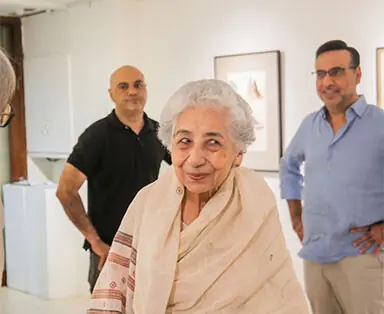
A person sensitive enough to perceive these fleeting wonders is almost incapable of keeping the feelings they evoke contained. It is this heightened sensitivity to the fleeting and the ordinary that lies at the heart of Siddiqua Bilgrami’s artistic creations. For Bilgrami, movement is intrinsic to life, and space is what makes movement possible, so nature and space become both her tools and her subjects. According to her, “Colour reflects feeling, while line reflects thought. They are ways of putting passing thoughts and feelings into my work over the years.”
That same sense of movement has carried through Bilgrami’s own life. Born into a Deccani family, she studied at the Government College of Arts and Architecture in Hyderabad Deccan before travelling to Rome on an Italian government scholarship. There, she studied at the Accademia di Belle Arti di Roma, trained in ceramics at Centro CALAL and worked in the studio of the Italian artist Guido La Regina, after being introduced to him by the art historian Lionello Venturi.
Her first solo exhibition in Rome in 1960 was followed by shows across Italy and India, which also featured a visit by M.F. Husain, who signed the guest book. She moved to Karachi in 1964, continuing her career here through painting, teaching, jewellery design and exhibitions.
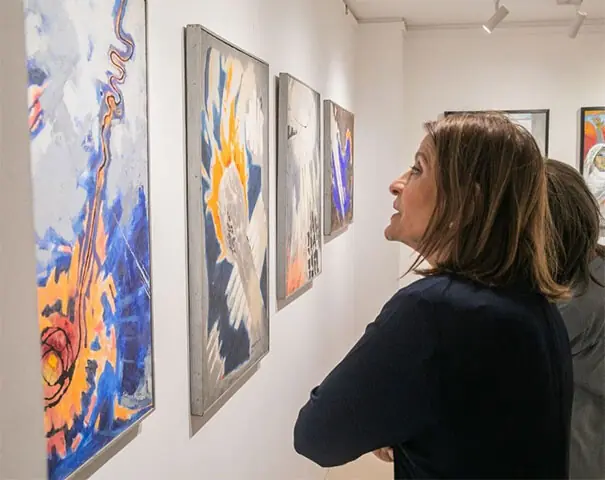
Recently, Karachi’s Chawkandi Art Gallery held a retrospective of Bilgrami’s work, alongside the launch of her book of poetry and paintings. Twenty-eight works were brought together, spanning more than six decades and going as far back as the 1960s. For viewers more accustomed to impressionist or narrative art, where an image often provides an immediate point of entry, abstraction can initially feel more elusive.
Yet, Bilgrami’s work invites attention through its sheer range. This is not the work of an artist who spent six decades refining a single visual formula, but of one whose practice remained open to experimentation and change. Despite the shifts in style and subject across the different periods, a certain familiarity runs through the exhibition, connecting the works across time.
A retrospective at Chawkandi Art Gallery revealed an artist who has resisted a single style, allowing experimentation, memory and lived experience to shape more than six decades of her work
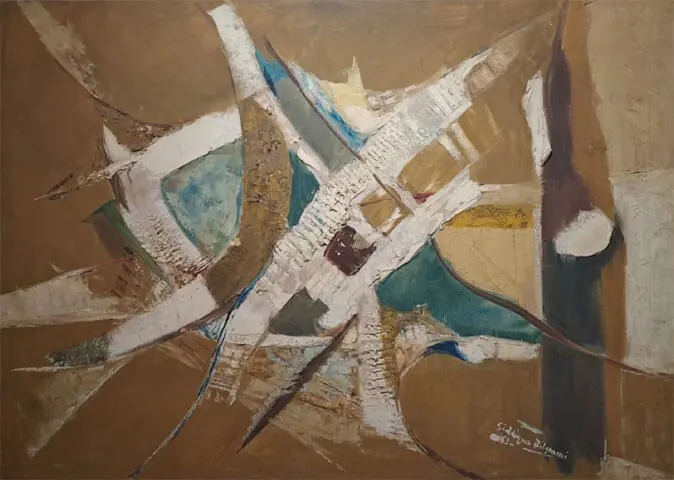
One work that particularly invites contemplation is Crossroads, an oil on canvas from 1963. Its ochres, blues and yellows establish a subtle emotional balance, while intersecting lines suggest a moment of decision. The title evokes the uncertainty of being caught between what has been and what lies ahead, but the painting does not impose a particular narrative. Instead, it leaves the viewer with enough space to locate their own meaning within that crossing point.
Reaching for Light, from her Spiritual series, operates differently. Its jagged lines initially appear disruptive, but with sustained looking, they begin to settle into a kind of harmony. The association between light and the divine is apparent, yet the painting never becomes merely illustrative. Its spirituality seems to emerge instead from the composition itself, from the movement and tension of the painted lines.
That same movement between the visible and the intangible appears in Bilgrami’s Eyes series, a group of small drawings, no larger than an A-4 sheet, made entirely in black pen. Each eye conveys a distinct emotional state — distress, curiosity, concern and quiet joy — while recalling a South Asian portrait tradition in which the face is reduced to a few defining lines and the eyes carry much of the expression. The simplicity of the drawings draws the viewer into a more sustained act of looking. The longer one studies them, the more the eyes seem to return that gaze.
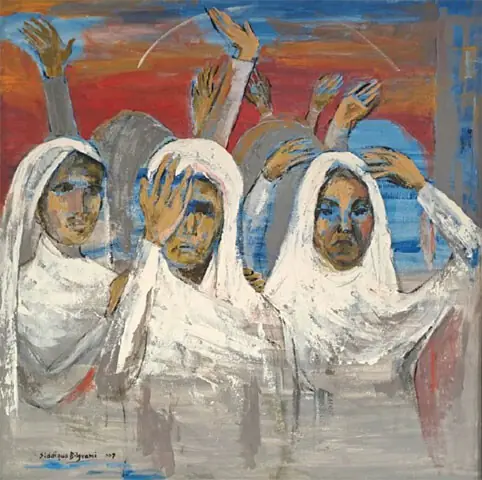
If the Eyes series creates intimacy, The Big Divide, from her War series, brings history into view. When I ask Bilgrami about the painting, her eyes fill with tears as she recalls the violence and atrocities of the 1971 war in East Pakistan: “I wasn’t there directly, but I would hear about the violence, the atrocities and the things people were going through. It was extremely distressing to imagine and hear about what was happening.” Her response offers me a deeper understanding of the work, allowing me to connect more closely with what I am seeing.
Bilgrami had witnessed Partition in 1947 but by the time of the separation of East Pakistan in 1971, she was an established artist with a greater awareness of the political and human consequences unfolding around her. The two events carry their own distinct histories and significance, yet both became experiences she witnessed closely, prompting her to confront, understand and express the sense of rupture, violence and loss that war can produce.
Speaking to Bilgrami about her poetry offers further insight into her creative imagination. She speaks of poetry with the same sensitivity that marks her paintings, as she traces her relationship with language back to childhood. “I remember writing poetry in English even when I was a young girl,” she says. “Urdu poetry came into my life much later. A family friend encouraged me to read and write in Urdu and so I began experimenting with the language, adapting English poetic forms into Urdu and writing in free verse.” Today, she says, “I write more and paint less,” finding in poetry another way to express what cannot always be contained on a canvas.
Some artists become known through one recurring symbol: Jamil Naqsh had his pigeons, M.F. Husain his horses. Bilgrami resists that kind of reduction. Her subjects are too varied for any single signature to sum up. What stays constant instead is a way of looking: an attention to colour, line, space and the emotional life within abstraction.
That, in the end, is what makes this retrospective so engaging. In Bilgrami’s work, lived experience, personal expression and close observation converge, inviting the viewer to look with the same sensitivity that shaped the work. It is an invitation to pause, look closely and remain open to what reveals itself.
‘Siddiqua Bilgrami: A Peek into Creativity — Spanning 65 Years’ was on display at Chawkandi Art Gallery, Karachi from August 8-13, 2026
The writer is a university student with an interest in art, culture and urban history. He can be contacted at pakistaniumer04@gmail.com
Published in Dawn, EOS, August 23rd, 2026