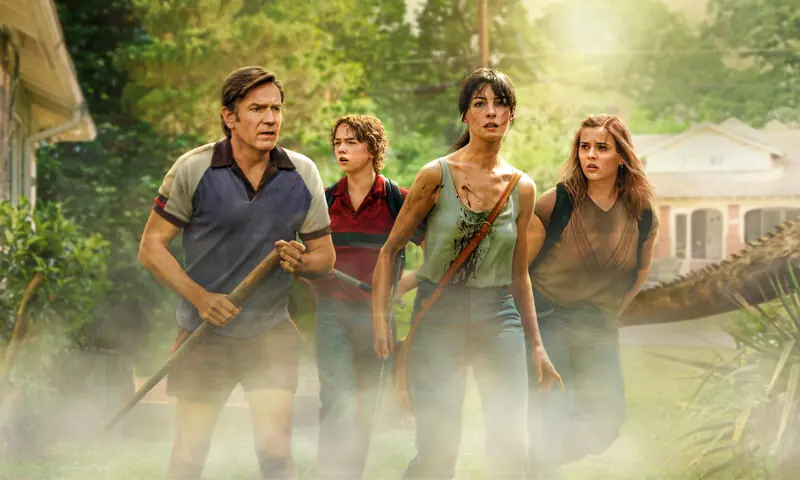

A family surviving by barricading themselves in their house to hide from hostile creatures — sounds like a familiar plot, doesn’t it? Last week, the premise found a home on Netflix’s The Last House, and this week, the bubble — literally and figuratively — expands to The End of Oak Street.
Now, it is not uncommon for films with similar concepts to release mere weeks and months apart — cases in point: Armageddon and Deep Impact in 1998, Antz and A Bug’s Life in the same year, Dante’s Peak and Volcano a year earlier, Olympus Has Fallen and White House Down in 2013. The end result, however, banks largely on what the writer, director, producer and studio have in mind for the story in question. The underlying question, therefore, is: how big do they want to go?
For The End of Oak Street — whose writer-director is David Robert Mitchell (It Follows) and producers include J.J. Abrams (Star Trek, Star Wars) — the answer is obvious: as big as they can go, while keeping nostalgia strictly within sight.
Oak Street is set in its titular neighbourhood in Flowervale, Michigan. The year is 1982, a time when families weren’t plagued much by modern technology. The most they had, as we see time and again, were Walkmans (portable audio cassette players) that ran on standard AA batteries.
Despite some fine performances and a good enough story and pacing, at the end, there seems to be something missing from The End of Oak Street
The Platt family, like all of their quiet suburban neighbours, lives a seemingly happy life, partaking in sack races and eating Frosties together while watching the morning broadcast on their 16-inch CRT television. However, their contentment hides issues that can be easily overcome with a few days of heart-to-heart conversations.
Denise (Anne Hathaway) feels trapped in her marriage, and secretly writes an autobiographical novel as a means of escape. Greg (Ewan McGregor), braving a severe blow to his pride after losing his job, hides a pizza delivery gig and a drinking problem from his family. Their daughter, Audrey (Maisey Stella), feels the heavy weight of her parents’ failing marriage, and stresses over her future and college aspirations. Brian (Christian Convery), her younger brother, deals with typical kid anxieties: neighbourhood bullies and a tendency to run away from responsibilities. Their dog, Starbuck, does what dogs typically do: runs away to poop on the neighbour’s yard. The excrement, however, is five feet high and four feet wide!
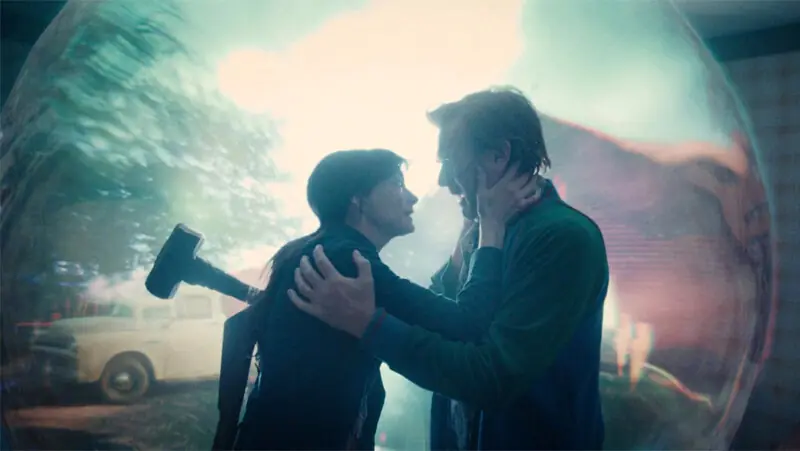
Amidst Michael Giacchino’s unrelenting background score — which takes you back to Steven Spielberg’s fantastical 1980s Americana — we see flashes of light and big bubbles that first bring dinosaurs to Oak Street, and then teleport the whole neighbourhood to the prehistoric age. This is where the balancing act tilts in favour of a survival film and out goes most depth.
Though David Robert Mitchell’s film does feign some measure of intelligence, the payoff, especially the climax — which I will not spoil here — takes the story, and Denise’s character, to a very dark place. The ending is meant to give her a sense of peace, though at what cost? Neither the characters nor the filmmakers are bothered by the matter-of-fact way the film ends — everything is just hunky-dory, yet it shouldn’t be.
I’ve always maintained that the opening and ending are the most important aspects of a film. The start introduces the characters, their world, and their dilemmas, while the end — no matter how badly or brilliantly it is handled — leaves the audience with a lasting, encapsulating feeling of the experience. In simpler terms: the ending stays with you and impacts your view of the film itself — especially when, in hindsight, you ask yourself what you actually saw.
Sure, the performances turned out fine (Hathaway and McGregor are fine actors, the youngsters, not so much), the director made smart creative and technical decisions, and the pace and story were good enough — yet why doesn’t the film feel that good, especially if the sum of its parts were on point?
Because somewhere along the line, the filmmaker took the easy way out. In retrospect, it wasn’t the dinosaurs, but a creative choice, that ended The End of Oak Street.
Playing in cinemas worldwide, The End of Oak Street is rated PG-13 and features an intimate scene between dinosaurs amidst the usual snapping and off-screen decapitations of people
The writer is Icon’s primary film reviewer
Published in Dawn, ICON, August 23rd, 2026