Pakistan’s budgeted interest payments have declined by Rs1.72 trillion, or 17.6 per cent, between FY25 and FY27. More significantly, the share of interest payments in total federal expenditure has fallen from 51.8pc to 42.9pc — a decline of 8.9 percentage points. At first glance, these figures appear to signal a significant improvement in Pakistan’s fiscal position. But does this decline represent genuine fiscal recovery, or is it merely temporary relief achieved by cutting development expenditure and improving the headline fiscal numbers?
This analysis compares Pakistan’s fiscal position in FY25, the first full fiscal year following the 2024 general election, with the current fiscal year FY27, focusing on revenue mobilisation, interest payments, and development expenditure to determine whether the improvement reflects genuine fiscal recovery or temporary fiscal relief.
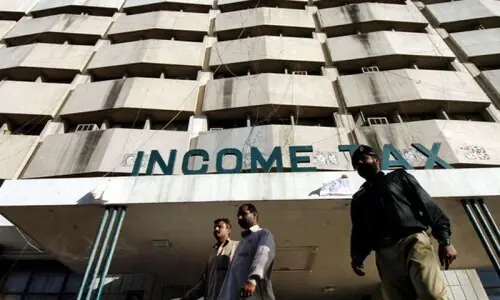
An analysis of Pakistan’s tax revenue in FY25 presents a more encouraging picture. Against the budgeted Federal Board of Revenue tax revenue target of Rs12.97tr, the FBR collected Rs11.74tr, achieving approximately 90.5pc of the target. Despite falling short of the original target, FBR revenue grew by 26.3pc compared with the previous fiscal year.
More importantly, Pakistan’s FBR tax-to-GDP ratio increased to 10.3pc in FY25, compared with 8.8pc in FY24, marking a significant shift from the historically stagnant tax-to-GDP ratio of around 8.7pc. FBR attributes this improvement to policy interventions, enhanced enforcement, and stronger oversight, with enforcement measures recovering Rs874 billion during the year.
Genuine economic recovery will depend on whether the country can reduce its debt burden and strengthen revenue generation without sacrificing investments in development
FBR tax collection of Rs11.74tr was also equivalent to approximately 62.2pc of the federal government’s total expenditure of Rs18.9tr. However, this ratio should be interpreted cautiously, as FBR collections form part of gross federal revenues from which the provinces receive their share under the National Finance Commission arrangement.
Nevertheless, FY25 can reasonably be viewed as a year of fiscal relief and stabilisation after several years of severe economic disruptions, including the Covid-19 pandemic, the global commodity and energy shocks following the Russia-Ukraine war, and the devastating 2022 floods.
The achievability and sustainability of the non-tax revenue target remains open to debate, particularly given the political and social sensitivity surrounding petroleum prices
The improvement in tax collection is particularly significant when viewed alongside the declining interest burden, indicating that Pakistan’s fiscal position is being supported not only by lower debt-servicing costs but also by stronger revenue generation.
Non-Tax Revenue(NTR) is targeted at Rs5.34tr in FY27, compared with Rs4.85tr in FY25, representing an increase of approximately 10.1pc. A significant component of this revenue is the petroleum levy, which is projected at Rs1.68tr, accounting for approximately 31.4pc of total NTR.
However, the achievability and sustainability of this target remain open to debate, particularly given the political and social sensitivity surrounding petroleum prices and the additional burden they place on households.
Critics argue that repeated increases in the petroleum levy may not be a sustainable long-term fiscal solution, as they can raise transportation and production costs and contribute to broader price pressures, particularly for food and other essential goods. For vulnerable households living close to the poverty line, higher fuel and food prices can reduce disposable income and purchasing power, forcing families to reduce spending on essential areas such as education and healthcare.
Therefore, while the declining interest bill is undoubtedly a positive development for Pakistan’s fiscal position, the government must consider the distributional consequences of raising revenue through petroleum levies. Fiscal consolidation that reduces debt-servicing costs but simultaneously places greater pressure on vulnerable households may provide short-term fiscal relief without necessarily producing broad-based economic welfare.
The decline in Pakistan’s interest burden should therefore not be interpreted in isolation. Between FY25 and FY27, the Public Sector Development Programme (PSDP) allocation declined from Rs1.4tr to Rs1tr, representing a reduction of Rs400bn, or approximately 28.6pc.
Similarly, the Higher Education Commission’s (HEC) development allocation fell from Rs66.32bn in FY25 to Rs46bn in FY27, a decrease of Rs20.32bn or approximately 30.6pc. These reductions suggest that part of the improvement in the federal expenditure profile has occurred alongside significant compression of development-oriented spending.
Moreover, the budgetary allocations for important sectors, including the Climate Change and Environmental Coordination Division, the Water Resources Division, and the Science and Technological Research Division, have also declined significantly. Such reductions in development spending may provide short-term fiscal relief, but they could create substantial long-term challenges.
Pakistan’s declining interest burden certainly represents fiscal relief, but genuine fiscal recovery will ultimately depend on whether the country can reduce its debt burden and strengthen revenue generation without sacrificing the development investments needed to achieve sustainable economic growth.
The writer teaches economics at the government educational institutions
Published in Dawn, The Business and Finance Weekly, August 24th, 2026