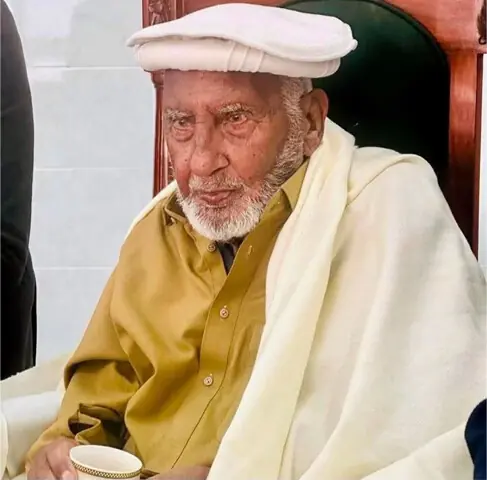
PESHAWAR: In the quiet nooks of Pakistan’s historic northern belt, where ancient Gandhara civilisation once flourished and mountain tracks wind into pristine valleys, few chroniclers have captured the region’s soul with the depth of Mohammad Pervaish Shaheen.
He was recently in Peshawar for recording a podcast on the origin and history of Pakhtuns when he caught up with this scribe to reflect on his lifelong journey as a scholar and guardian of regional heritage.
A scholar, prolific historian and author of nearly 60 landmark books in Pashto and Urdu, Mr Shaheen has spent over six decades documenting the linguistic, cultural, and archaeological heritage of Khyber Pakhtunkhwa, Swat and Northern Pakistan.
Reflecting on his podcast session, he emphasised the imperative of historical literacy for the younger generation.
Pervaish Shaheen will continue to write as long as his health permits
He said that his primary objective was to trace his historical and linguistic roots accurately.
“The history of Pakhtuns is deeply intertwined with ancient trade routes, tribal migrations and rich oral traditions across Northern Pakistan.
Today’s youth often rely on fragmented digital snippets; I wanted to offer them a grounded, evidence- based perspective on how our language, culture, and social fabric evolved across centuries,” he said.
Born on October 12, 1944, in the historic village of Manglawar in Swat, Mr Shaheen displayed an early passion for letters.
His academic journey began at Government Primary School Manglawar.
He eventually earned four master degrees in Pashto, History, Urdu, and Education, earning a gold medal from the University of Peshawar.
Alongside his scholarly pursuits, he led a distinguished career in education, retiring as principal of Government Higher Secondary School, Peshawar, in BPS-19.
His literary odyssey began in 1958 when he penned his first article for daily ‘Shahbaz’ Peshawar.
Over six decades, he has published more than 1,000 research articles and 500 newspaper columns.
“Writing for me is a civic duty.
When I started writing in 1958, I realised that vast swathes of our regional history– particularly northern languages like Kohistani and Gandhara archaeology – remained undocumented.
Writing nearly 60 books in Pashto and Urdu has been my contribution toward ensuring our history is preserved,” he said.
Beyond his writing, Mr Shaheen’s devotion to local history faced its ultimate trial during the height of militant insurgency in Swat.
When extremists targeted the region’s archaeological tapestry, he physically buried priceless ancient relics underground to save them from destruction.
Recalling the assault on Swat’s cultural treasures, including the 7th-century Jahanabad Buddha, he shared his profound anguish: “It felt like they killed my father.
They attacked my culture, my history.
A monument like Buddha is a symbol of peace, symbol of love and symbol of brotherhood.
We don’t hate anybody, any religion.
What is this nonsense to hate somebody,” he questioned.
Following restoration of peace in Swat, Mr Shaheen volunteered alongside international missions to restore damaged Buddhist relics, insisting that heritage belonged to humanity.
His home in Swat houses a legendary personal sanctuary containing over 30,000 rare books and manuscripts, attracting research scholars from across the globe.
“It is a sanctuary of knowledge open to all.
Preserving these 30,000 books ensures our past remains accessible to anyone seeking truth,” he said.
Today, two of his books grace the curricula of Allama Iqbal Open University and Central Superior Services (CSS) examinations.
Reflecting on a lifetime of service and regional recognition, Mr Shaheen expressed deep gratitude.
“I feel it is my second birth.
I feel a real pride to be acknowledged by my people.
Today I am short of words to express my gratitude,” he said.
As long as his health permits, Mr Shaheen’s pen will continue writing the history of this land for generations to come.
Published in Dawn, August 24th, 2026