
Arshad felt a strange knot in his stomach as his name was called for the next speaker to come on stage. His throat suddenly went dry and sweat broke out on his forehead. Although he was a good student and had rehearsed his speech well, he felt a bout of nervousness.
Luckily for him, as he proceeded towards the stage with shaky legs, he caught his teacher’s eye. She nodded and smiled encouragingly, lifting her fingers in a victory sign. A surge of adrenaline brought back his self-confidence, and he walked to the dais without showing any sign of tension.
The topic of the speech competition was “How social media has changed our lives”. Arshad had ten minutes to give his views. He spoke without a stammer and his body language showed that he knew what he was talking about. When he finished his speech, he received a big round of applause from the teachers and students.
Arshad recalls his first experience of talking in public with a smile. After that shaky start, he took part in many speech competitions and debates throughout his student life and bagged many trophies.
Stage fright can make even the most prepared speaker nervous. But with practice, preparation and a few simple tricks, you can learn to speak with confidence
I don’t feel ashamed to share with you all my first experience of speaking in public, though the audience was my classmates, around the same age as me. I was in Class Two when, on a fateful day, our English teacher asked me to read aloud a story she had chosen from our textbook.
Feeling butterflies in my stomach due to nervousness, I started to read in a high-pitched tone without even realising it. After a few minutes, the teacher from the upper floor — our school had an old architecture with wooden floors and a staircase — popped in to check if everything was okay and also to complain that my loud oration was disturbing her class. To this day, I feel amused when I think of that incident, although at the moment, I felt totally embarrassed because both the teachers and the students were trying to hide their smiles.
During my school and college life, I got a number of chances to participate in speech competitions and speak before larger audiences, and I fared much better. After I started my career as an author, I got the honour of visiting schools as a guest speaker, and I spoke with confidence on whichever topic was given to me. It was with time and experience that I learnt that stage fright was something normal for most people and could be overcome by following the right steps.
I am sure most of my young friends must have had an experience of talking in public. Have you ever wondered why you feel nervous when it is time to deliver your speech? It may be due to a shy or timid nature, a lack of self-confidence, fear that you will be laughed at by the audience if you get stuck in your narration, a lack of experience in public speaking, or, most importantly, because you haven’t worked hard enough to gather knowledge about what you are going to talk about.
Today, let me share with you some basic tips about talking before a gathering. Today, it may be a school debate or speech competition, but tomorrow, when you step into practical life, you will experience many occasions when you will have to speak without stammering, sweating palms or shaky legs.
Remember that whatever you do in life, there is always a first time, and improvement only comes from trying again and again.
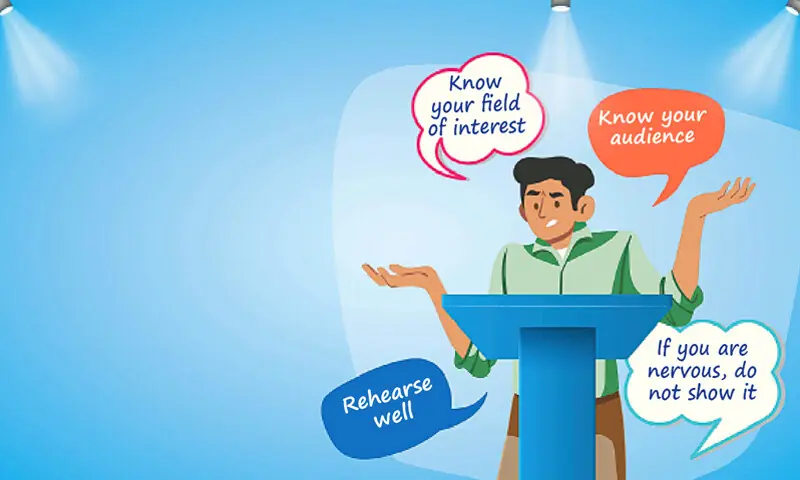
Know your field of interest
My dear young friends, unless you have an interest in a given topic, you are bound to make a poor show. Let me explain with an example. Suppose you have a keen interest in fine arts, like painting, sculpture or sketching, but you take part in a speech competition about the effects of climate change on the economy. When you have no interest in the topic you are talking about, you will fail to impress your audience. No matter how much you rehearse or learn the points by heart, chances are you will forget or mix them up because the less interested you are, the more prone you are to forgetting.
On the contrary, if your subject is related to your area of interest, you will have a double advantage. You will already be well-informed about it; also, if you search for further information, you will have a better idea of where to gather more knowledge about your topic.

Know your audience
There will be occasions when you will have to make a speech or take part in a debate on your school premises. You will feel confident because you are well aware of your surroundings, and the faces of the teachers and students are familiar and friendly. You will also have the advantage of your friends applauding you to boost your confidence.
But what if you are in a similar competition, only the venue is new and the faces are those of strangers?
First of all, you must be well-prepared to speak in unfamiliar surroundings. The students of the institute where you are making a speech may be hostile or unfriendly because, naturally, they will be more supportive of their school fellows.
You must have a clear idea about what to do if they hoot or boo you. Hold your ground and keep your smile intact; look the audience straight in the eyes. If you feel anger or frustration, do not show it. Gain a few moments by reaching for a glass of water or walking a few steps on the stage. Continue speaking when the din subsides.
Rehearse well
A speech is not well-delivered if you just collect a lot of data or write long pages. The trick is to rehearse what you intend to say in front of an audience. What you say is as important as how you say it.
You should know your strongest facts and stress them by using the pitch and tone of your voice, which should not be monotonous. Your mode of speaking must convey your thoughts, your preferences and, at times, your emotions. Be sure to read out your speech many times in front of friends and family, and note down the suggestions or advice they give.
Another important tip is to be your own audience. Rehearse a number of times in front of a mirror to check your body language, pronunciation and facial expressions. Identify the areas where you can improve and work on them. When you feel you have rehearsed enough, rehearse some more.
If you are nervous, do not show it
There are times when you are unable to control your nerves. Your legs shake and your palms sweat. Before hitting the stage, try breathing exercises to calm yourself down.
Inhale deeply while counting to four, hold your breath and then exhale for the same amount of time. Repeat these steps a number of times. When your nerves relax, the signs of nervousness will gradually disappear.
Once you start your speech, remember to keep the speed of your words slow. When your body panics, you start to speak faster, jumbling up your thoughts and stumbling over your words. Speaking while stressing your words not only controls your nervousness, but also gives the message to your audience that you know what you are talking about.
A minute of silence may feel like a lifetime when you are on stage, but calming your nerves will bring you back to your point and put you in a better position to convince your listeners.
Never carry a written speech to the stage
A mistake most students make is taking a pile of papers to the stage. Not only does this give a bad impression to your audience, but if you are unlucky enough to mix up the pages, you will find yourself totally confused.
It is better to note down your points in bold words and only glance at the piece of paper to make sure you have covered all the data you have collected and want to share. Even if you miss the order of your points, it will not make much difference to the listeners for they don’t know how you had planned it.
I wish you all success, wherever and whenever you have to speak in public. Today, it may be an event at your educational institute, but tomorrow it may be a job interview, a presentation or a request at a social gathering to give your opinion on a current issue.
Published in Dawn, Young World, August 29th, 2026