• Rescue teams search through thick layers of mud, debris
• Glacial collapse triggers ‘inland tsunami’ of ice, water, rubble; wipes out entire villages
• Nepal, China warn of fresh floods as debris-blocked lakes could burst; heavy rainfall forecast raises concerns
• 178 Indians, 90 US citizens among missing as international toll continues to climb
• Roads, bridges, power networks destroyed; UN launches emergency aid as thousands seek immediate relief
BIDUR: Rescue teams on Thursday were searching through thick layers of mud and debris along the Nepal-Tibet border as the death toll from devastating flash floods and landslides climbed to 392, with more than 1,400 people still missing.
Emergency workers, soldiers and local volunteers have been battling treacherous conditions to find survivors and recover bodies from villages that were swept away by a sudden torrent of water, ice and rock. Nepali troops have deployed sniffer dogs to search for victims buried beneath the mud.
“It is a giant graveyard,” said Omkar Joshi, a 35-year-old customs agent rescued from a hillside in the border town of Timure. “All that is left are sand and pebbles, soaked red by human blood.”
Nepal police said they had recovered 389 bodies, although officials warned that numbers remained uncertain as rescue operations continued across remote and badly damaged areas.
The disaster has also raised fears of a second catastrophe, with authorities warning that newly formed lakes created by landslides and debris could burst, sending another wave of flooding through already devastated valleys.
Nepal’s disaster management authorities urged residents, rescue workers and travellers near riverbanks to move to safer areas after a lake formed by a debris blockage began rising.
“Residents of the lower banks, passengers, rescuers engaged in rescue operations, and all concerned are requested to exercise special caution and stay in safe places away from the river banks and risky areas,” officials said.
Across the border, Chinese authorities issued a similar warning, saying around 3 million cubic metres of water could flow into a blocked lake within days, increasing the possibility of a breach.
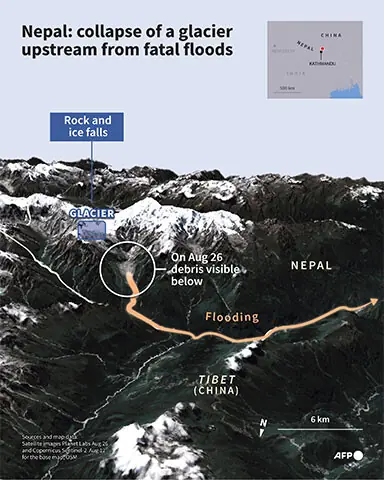
The US Geological Survey said the disaster was triggered by a glacial collapse, which unleashed a massive flow of frozen debris and water through mountain valleys.
Experts described the event as resembling an inland tsunami, with a wall of mud and ice travelling almost 170 kilometres south into Nepal.
Environmental historian Ruth Gamble of Australia’s La Trobe University said the sudden surge was “like an inland tsunami”, as it destroyed homes, bridges, roads and vital infrastructure.
Among those missing are hundreds of foreign visitors, including trekkers and Hindu pilgrims travelling towards Tibet’s sacred Mount Kailash. Officials said at least 1,468 people remained unaccounted for across Nepal and China, including 910 in Nepal and 558 in China.
Indian citizens represent the largest group of missing foreigners, with Nepal’s tourism authorities reporting 178 Indians unaccounted for.
Meanwhile, the US State Department said 90 Americans were missing, with three rescued and no confirmed US deaths reported.
Other missing nationals include 127 Nepalis, nearly 100 Chinese citizens, 55 Ukrainians, 51 Malaysians, 34 Australians, 33 British citizens and 25 Canadians.
Indian spiritual leader Sadhguru described the situation as a “terrible and extraordinary event”, saying devotees were caught in the disaster while gathered at an immigration checkpoint.
International aid efforts have begun as the scale of the destruction becomes clearer. United Nations agencies said emergency assistance was being mobilised, with around 10,000 households in Nepal requiring immediate support.
The floods have destroyed or damaged settlements, markets, roads, bridges and hydropower facilities, cutting off communities and disrupting electricity supplies.
Nepal’s prime minister, Balendra Shah, visited some of the worst-hit areas on Thursday and called on the country to “stand together”, while instructing local authorities to provide urgent assistance to displaced families.
But with more rainfall expected in the coming days, officials warned that the danger is far from over.
Chinese state media reported that water levels were continuing to rise, with Zhu Jinfeng, a researcher at China’s water resources ministry, warning that the increasing volume of water was raising the risk of another disaster.
In response, rescue teams in Nepal began moving towards higher ground. Pawan Koirala, who was leading a 13-member rescue team, said his group was withdrawing from the riverbed to avoid being caught in another surge.
“We are here for rescue and don’t want to be near the danger zone,” he said.
Published in Dawn, August 28th, 2026