In Italo Calvino’s novel Invisible Cities, the intrepid traveller Marco Polo narrates to Emperor Kublai Khan accounts of phantasmagorical cities he has seen. At one point, Polo dismisses the intriguing architectural elements — the zinc scales covering the rooftops, the high bastions et al — and says: “The city does not consist of this, but of relationships between the measurements of its space and the events of its past.”
That is the sadness of Karachi, now a teeming celestial paradise for every mafioso ever created by capitalist greed. The city lives in purgatory between the history and memory of what was brilliant about this multi-ethnic, multi-cultural, harmonious, thriving terrain and the blood of a million violent acts that slowly washed away all its goodness over 40 years.
The artist Seher Naveed has brought to the fore one of the most imperative concerns of every citizen of Karachi — urban precarity. The lurking insecurity and the belief that constant danger skulks in the shadows of everyday life has become indelible amongst the citizens of Karachi. The apprehension is exacerbated by the surfeit of street barriers, fortifications, barricades and the deluge of security vehicles and armed personnel (belonging to both administrative and private agencies), transforming the landscape of the city from one of liveability to one of snarling hostility.
Naveed calls the body of work D.H.I. (Drawing Hostile Infrastructure), a tongue-in-cheek reference to the forces that deepen unease and fearfulness rather than reduce it. But Naveed takes the fear out of the fearmongering in her work to make the bitter pill easier to swallow. She adds a drizzle of humour, a pinch of fascination with the abstraction and a dash of distraction, especially with the wooden frames that then become thematic tropes — defined, restrictive spatial perimeters. Looking at the works, we almost let up on the persistent, dense, immersive and oppressive fog of disquiet that has become second nature to people living in Karachi. Almost.
In Seher Naveed’s latest artworks, Karachi’s barricades, armoured vehicles and security apparatus become markers of a city shaped by insecurity
There are two sets of works bound by a single thematic inference within the show. One is the set of drawings and the other paintings on a high-density fibreboard (HDF). Architectural in their clean lines, the drawings are cartographical and visually engaging, portraying
ad hoc security barriers — upturned charpoys, a broken red plastic chair, street cones with a bamboo stick — demonstrating the hope on the part of security personnel that such items would look intimidating enough to keep civilians at bay.
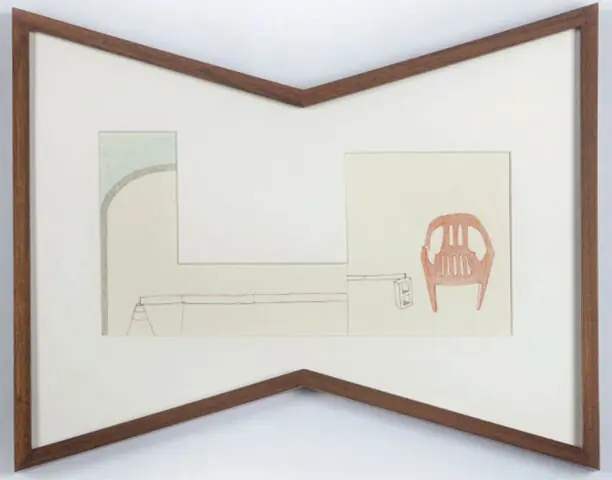
The effect is of a stand-up comedian trying to keep a straight face at a funeral. The drawings are intense in the simplicity of their pictorial power and, while Naveed makes no real effort to adhere to rules of geometry and other architectural projection techniques, there is an amazing unification between representation and reality that draws in the viewer to the sheer ‘fun’ of the works.
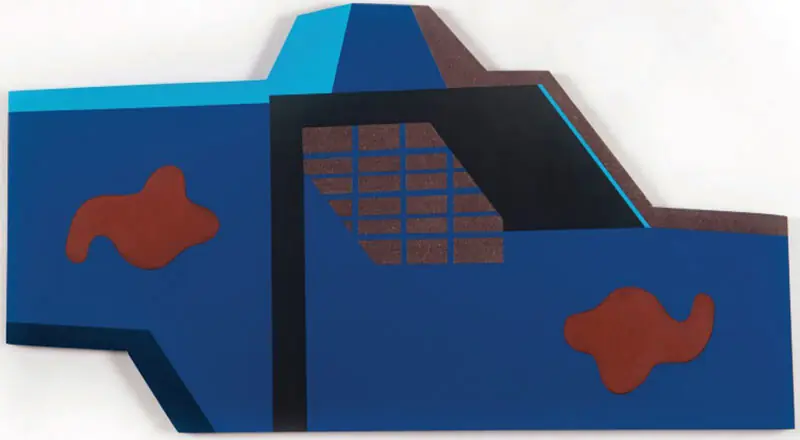
The paintings or cut-outs that Naveed calls her Blue Board works are unique in their materiality. The HDF has a compact solidity and an innate dark grey colour that reflects the belligerent aggression of the tactical response armoured vehicles that security personnel use to counter ‘insurgencies’ and mob violence. Naveed paints them the same blue as the personnel carriers owned by the Sindh police department.
Naveed’s extensive photography on the streets of the city and her in-depth research into the vehicles and ammunition used by security personnel led her to the Sindh Police Museum, much to the chagrin of the administration, who would rather nobody visit.
But the jokes write themselves when these symbols of violence are painted with symbols of camouflage. Meant to reflect the flora in rugged trenches and conceal and obfuscate, in urban battlegrounds the forms take on the absurdity of decoration — pretty, white, cloud-like amorphous amoeba, making the vehicles more conspicuous and discernible. The ludicrous part is, the personnel riding these armed vehicles are infinitely proud of their well-painted trucks and Naveed does not miss a beat in depicting the humour of the incongruity.
This is personal for Naveed, more than for all of us who belong to Karachi and have never known another home. As a youngster, her family relocated several times before settling down in Karachi when she was in her teens, and the sense of ownership and belonging became very real for Naveed since. But the insecurity in the city is no laughing matter. Naveed’s works are poignant and make us observe that insecurity more palpably.
Seher Naveed’s ‘D.H.I.’ was on display at Canvas Gallery,
Karachi from August 11-20, 2026
The author is an independent art writer and curator
Published in Dawn, EOS, August 30th, 2026