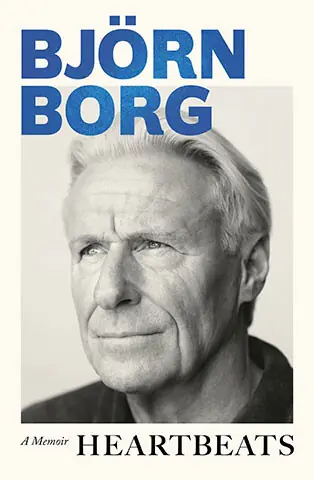
Heartbeats: A Memoir
By Björn Borg
Sphere Books
ISBN: 978-1408722329
304pp.
Some sporting legends become famous for what they achieve, while others become immortal for changing the way their sport is played. Björn Borg is one of those who transformed tennis in the 1970s, with his calm demeanour, two-handed backhand and strong baseline game.
For a time, he remained a mystery, speaking little and letting his racket do the talking. Now, in his bestselling book Heartbeats: A Memoir, the 11-time Grand Slam champion tells his story for the first time.
The book, narrated to his current wife Patricia Östfeldt and translated by Bradley Harmon, promises to reveal what lies behind the curtain of one of tennis’ greatest icons. It covers his childhood, his rise to fame, his famous rivalry with John McEnroe, his surprising retirement at 26 and the personal struggles that followed. Fortunately, the book delivers on that promise.
No one had ever played tennis like Borg, who dressed like a rock star and played like a man possessed, driven by a will to win. He started playing tennis professionally at the age of 15 and changed men’s tennis by winning 11 Grand Slams (only the French Open and Wimbledon) over the next 10 years.
Legendary tennis player Björn Borg opens up for the first time about his life in a memoir that is honest, reflective and intimate
There was a method to his not playing the Australian Open after 1974, as well as a ‘reason’ for never winning the US Open, which he explains in these pages. Even without two of the ‘Slams’, his record was so impressive that he easily makes the list of the greatest players in history.
A lot is revealed in this book that not many knew about, including Borg’s ardent fans. It was his father who gave him his first tennis racket, for winning a table tennis competition. Since the racket was too heavy for a child, the youngster had to hit his backhand with two hands. What began as a necessity became one of the most influential shots in tennis.
There are a few incidents from his later career that might interest readers, including his interest in both ice hockey and tennis, one he chose as a career and the other that helped him develop stamina on the court. He also talks about an American woman who tried to scam him by claiming to be his mistress and bringing a child with her who called Borg ‘daddy’. A threat to report her to the authorities stopped her from approaching after two attempts.
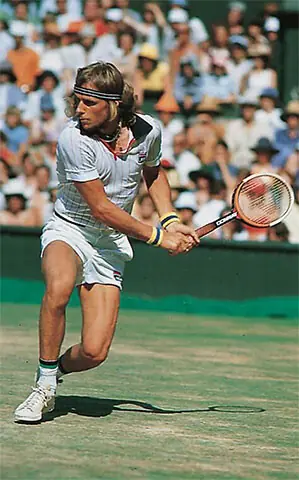
His rock star avatar might be the reason for his cult following but, for him, his training method was the key to his success. Unlike today’s professionals, who spend a lot of time in the gym and follow fitness plans, Borg says he never lifted weights or followed a complicated fitness programme. He simply practised a lot and played many matches, which helped him build the stamina that outlasted his opponents.
The book repeatedly returns to the theme of family. Borg says his parents were the centre of his life and his father was his closest friend. As a young player, he lost his temper on the court and was suspended. Because it disappointed his parents, he vowed never to show emotion on the court again, earning the nickname ‘Ice Borg.’
He also uses this memoir to thank everyone who supported him throughout his career. His coach, Percy Rosberg, recognised his potential and the legendary Lennart ‘Labbe’ Bergelin helped him become a great player. He also credits his practice partner, Vitas Gerulaitis, for keeping him company, and rival tennis star Jimmy Connors for starting the Senior tour, which saved and revived his career in the 1990s.
The book is full of stories about some of tennis’s biggest names. Borg remembers meeting John McEnroe long before their famous rivalry. At the time, Borg was a professional tennis player and McEnroe was the “useless ball boy who couldn’t throw the ball straight to me during my debut US Open match against Roy Emerson.” To me, that anecdote was as interesting as his victories over Arthur Ashe, his first-ever meetings with the legendary Rod Laver and his feelings upon winning his first Grand Slam title.
If you didn’t know that Borg started the trend of kissing the trophy in tennis or that there was a financial reason behind his decision to relocate to Monte Carlo early in his career, you definitely need to read this book. He not only discusses his wins, his rivalry with John McEnroe and the famous 1980 Wimbledon final, which many consider one of the greatest matches ever played, but also talks about his drug problems, which stemmed from his nightlife.
Don’t be surprised to learn from these pages that one of the wealthiest tennis stars was once on the verge of bankruptcy but, like in any tough tie-breaker, he came back to win the match. If naivety about his business ventures was one of his regrets, then missing the 1977 French Open was another, as it conflicted with World Team Tennis, a more profitable venture.
Borg’s life is fascinating beyond tennis, too. Although he claims never to have crossed paths with his Swedish compatriots in the music group ABBA, he boasts of friendships with singers Tina Turner and Mick Jagger and members of the band Pink Floyd. He even talks about acting as a peacemaker between John McEnroe and Jimmy Connors, who did not get along after they both became professional tennis players. There are also stories, such as how he survived a near-fatal travel scare, how he escaped a serious car accident, and how he met each of his wives and partners, and why some of these relationships couldn’t work out.
The book becomes more candid in discussing Borg’s struggles. He writes openly about his divorces, his fatherhood and the difficult times he faced in court. He also addresses one of the controversial acts he committed, posing with Israeli soldiers carrying weapons, and says he regrets it.
The chapters about his retirement are compelling as well, as he explains that the emotional toll of being at the top had become too much to bear. He also discusses his attempts to return to tennis in the early 1990s and his training with younger players Boris Becker and Goran Ivaniševi who, according to their coaches, had to take turns to match the veteran’s stamina.
The final chapters are quieter, as he reflects on the deaths of his parents, his long-time coach ‘Labbe’, and the sudden death of his friend Vitas Gerulaitis. He also provides an update on his son Leo’s tennis journey during this phase, while discussing his current marital status and his brush with prostate cancer, which is currently in remission.
Ultimately, this memoir is more than a story about winning Wimbledon or dominating the French Open. It is the story of a boy who changed the backhand, transformed tennis, struggled with fame, and discovered that life after tennis requires just as much courage as his playing days. The book is honest, reflective and intimate, making it a worthy memoir for one of tennis’ greatest icons.
The reviewer is a broadcast journalist who also writes on sports, film, television and popular culture. X: @omair78
Published in Dawn, Books & Authors, August 30th, 2026