As anticipated, Pakistan couldn’t make it to the last-eight round at the 2026 Hockey World Cup (Aug 15-30) held in Wavre, Belgium and Amsterdam, Netherlands. In such dire times, the mind goes back to the days when the record four-time world champions ruled the sport.
The year was 1978, the fourth World Cup was to be held in the Argentine capital of Buenos Aires. Pakistan had last won the World Cup in 1971 and the Olympics in 1968. Since then, Pakistan had finished fourth and second in the World Cups of 1973 and 1975, respectively, and second and third at the Olympics of 1972 and 1976. In those days, in fact since the 1948 Olympics when Pakistan debuted in international hockey, only the top of the podium was acceptable — even finishing second was considered a disaster.
Before the 1978 World Cup, Pakistan had played a four-Test series against India, with two matches in each country. The Green Shirts easily won the series 3-1. No sooner had the last Test in Lahore ended, a bombshell dropped. Pakistan’s legendary right-back Manzoorul Hassan’s arm was fractured towards the end of the match, and he was ruled out of the upcoming World Cup. Many then became doubtful about Pakistan’s chances.
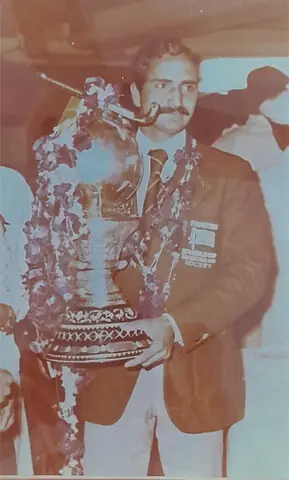
Rana Ehsanullah came in as his replacement. His international experience was limited to a tour of East Africa with the young Pakistan team way back in 1974. As it happened, Ehsanullah played in all the matches at the World Cup in Argentina. In the final, he scored Pakistan’s winning goal in a 3-2 victory over Holland to become a legendary figure in his nation’s sports lore.
Now 74 and living a retired life in Lahore, Ehsanullah tells his story from the beginning.
One of Pakistan Hockey’s yesteryear heroes, Rana Ehsanullah, recalls how he was drafted into the team at the very last minute and ended up helping Pakistan win the 1978 World Cup
“Born in Burewala, in district Vehari, I was obsessed with hockey since my childhood,” says Rana Ehsanullah. “I was still a teenager when I played my first national championship for the Multan division in 1971.” He was noticed and called to the national camp in 1973. “The following year, I toured Kenya and Tanzania with the young Pakistan side, the country’s second string.”
The rapid early strides made him optimistic of selection for the national team. “From then on, I was regularly called to national camps for international tournaments, but I was cut from the final selection. I was seen as a standby for some big events, including the 1976 Olympics and the 1975 Pre-Olympics. In 1976, the Pakistan Air Force [PAF] offered me to join them and I began representing them on the domestic circuit,” he recounts.
Manzoorul Hassan (right full-back) and Munawwaruz Zaman (left full-back) had been holding Pakistan’s deep defence since 1974. The pair is widely acknowledged as the finest in the country’s history. Therefore, the competition among the other full-backs was for the remaining reserve full-back slot. In those days, only two substitutions were allowed in a match. The reserves mostly remained on the bench, sometimes for the entire tournament.
“I had the feeling that 1978 was the last year I could win selection for the national team, as I was 26 by then. But Jamil Ahmed Khan was named the third full-back for the Indian series and the World Cup, and I was again a standby,” he says.
Then a dramatic turn of events gave birth to a remarkable fairy tale.
“Pakistan won the series 3-1. I watched the final Test in Lahore, and left for Burewala,” he recounts. “Not every home in small towns had a landline connection back in those days. My contact number was of a friend’s shop, which received a call from the Pakistan Hockey Federation [PHF] the next day. I got the message that I was to go to Karachi to join the World Cup squad. At the time, I wasn’t even aware of Manzoorul Hassan’s injury. Everyone in the household was overjoyed.
“In Karachi, the camp commandant, Olympic gold medallist Akhtar Hussain, took me to a tailor to stitch my Pakistan shirt, trousers and coat on an urgent basis. Then we went to the passport office to renew my expired passport.”
Pakistan arrived in Buenos Aires to face the lowly ranked Ireland in the opening match. Pakistan’s brilliant forward line — Islahuddin, Manzoor Jr, Shahnaz Sheikh, Hanif Khan and Samiullah — swept aside the Irish and scored at will. Pakistan’s other deep defender, the legendary Munawwaruz Zaman, was not only a world-class left full-back but also a renowned penalty corner specialist. But he couldn’t convert any of the three penalty corners.
When another penalty corner came Pakistan’s way towards the end, Ehsanullah was surprised to find his skipper Islahuddin calling him for the hit. “It was my first full international match and first penalty corner, and I scored! Our final scoreline was 9-0,” he smiles at the memory.
The second match against another minnow, Italy, followed a similar script. Pakistan won 7-0. Munawwar had regained his touch and converted two penalty corners. In the dying minutes, Ehsanullah also scored off a penalty corner.
A 3-1 victory over Holland, Pakistan’s toughest pool opponent, made the Green Shirts the tournament favourites. After an easy ride (3-0) against Malaysia, Spain proved to be a tough opponent but Pakistan overcame them 2-1. The last pool match was against hosts Argentina. Crowd support could not help. Pakistan beat them 7-0.
In the semi-final against the erstwhile West Germany, Pakistan sent down waves of attacks, only to be denied by the German deep defence. Pakistan’s raids were unabated in extra time. Finally, skipper Islahuddin, an inspiring force throughout, capped a fine move by flicking the ball over the onrushing goalie to carry his side into the final.
The other finalists were Holland, who Pakistan had beaten in the pool match. The Argentinians, who had been captivated by Pakistan’s dazzling game, had by then become great fans of the Green Shirts. They flocked to the stadium for both the semi-final and the final.
“During the final, Pakistan went ahead when Akhtar Rasool made no mistake from a penalty stroke,” recalls Ehsanullah. “The Dutch equalised in a similar manner. Early in the second half, Paul Litjens’ goal meant we went into arrears for the first time in the tournament. Once again, Islahuddin was our saviour. He made it 2-2 after a flowing move.
“We hadn’t been able to avail any of the penalty corners. Another came with just six minutes left. I was taken aback when Islah signalled for me to come over. Yes, I had scored two goals. But they were against teams that had finished 12th and 13th out of the 14 teams. Moreover, they were scored when we were already enjoying a big lead. Now, it was a crucial time — the dying moments of the World Cup final.”
Ehsanullah walked towards the Dutch circle carrying the weight of an entire nation’s expectations. Samiullah injected the ball, Akhtar Rasool stopped it and Ehsanullah’s hit to his favourite left side of the goal got deflected by an opponent’s stick into the net.
Pakistan became the World Champions and Rana Ehsanullah became a household name in the country. But the great success brought him something more.
“Each member of the victorious team was allotted a residential plot in Karachi by the Pakistan government. My rank in the PAF was Warrant Officer in the junior commissioned officers’ cadre. Soon after the World Cup, the PHF president Air Marshal [retd] Nur Khan got me released from the PAF. I was given employment in PIA [Pakistan Airlines], which then boasted the strongest domestic hockey team. Here, I was placed in group six in the managerial cadre.”
Ehsanullah continued to represent Pakistan till 1981. Once his playing days were over, he fully concentrated on his job. He had four-year stints each in Jeddah and Riyadh as PIA’s deputy station manager and station manager respectively before retiring in Group 8.
The writer is a freelance sports journalist based in Lahore.
X: @IjazChaudhry1 Email: ijaz62@hotmail.com
Published in Dawn, EOS, August 30th, 2026