‘Gidh’ explores family secrets, monotony, uneasy sisterhood
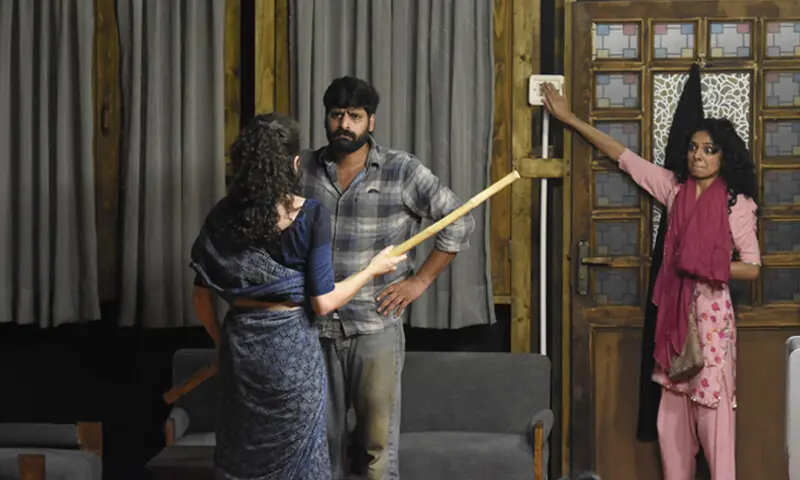

ISLAMABAD: Olomopolo Media presented Gidh, written and directed by Kanwal Khoosat, at the Pakistan National Council of the Arts. Originally produced as a theatre play for ZEE5, the production was brought to life by Rasti Farooq and Azariah Naseeb in a room constructed in the beautiful Baradari before an audience of some 200 people.
Kanwal welcomed the audience and set the house rules for the performance. The play revolves around three characters: Saleema, a schoolteacher and housewife in her thirties living in an urban city of Pakistan, played by Rasti Farooq; Salma, a younger woman, played by Azariah Naseeb, who arrives at Saleema’s apartment ostensibly in search of her estranged brother, Junaid; and Junaid, Saleema’s husband and possibly Salma’s brother.
Rasti Farooq and Azariah Naseeb draw on their considerable talent and experience in visual storytelling to take the audience through the suspense and dark comedy of complicated pasts and family secrets to the extremely banal day-to-day existence of a married schoolteacher.
Gidh, which translates as vulture, is a single-room play in which Saleema has an established routine of housework, marriage and teaching that is abruptly interrupted by the arrival of Salma, whose claims of family remain unsubstantiated throughout the day and until the end of the play.
Conceived differently from a typical stage play, the audience in Gidh was seated close to the performance space, so they were witnesses to the lives of the two women rather than distanced spectators.
The proximity to the action allowed them to experience, in claustrophobic detail, small gestures and nuances that could get lost on a large stage. Being present in the characters’ space makes it impossible to miss glances and gestures fraught with meaning. That said, the open stage affected audibility, and the lack of microphones, while remaining true to the tradition of theatre, affected the experience.
Staged in three scenes, the play begins by establishing Saleema’s painstakingly routine existence between her work as a schoolteacher and the endless duties of domestic life, until one Sunday, when Salma arrives at her door claiming to be Saleema’s sister-in-law. What begins as a tense and guarded encounter slowly turns into an uneasy intimacy, as the two women trade stories, test each other’s truths and recognise the fractures beneath their ordinary lives.
Throughout the interaction, the audience remains uncertain whether Salma is deceiving Saleema or whether there is a relationship between them. Salma’s arrival, though, is sufficient to break the monotony of Saleema’s existence. Saleema’s days are catalogued almost to the hour, with housework before dawn and homework marked past midnight, with only a slightly later start permitted on Sundays. Salma’s arrival changes the shape of the entire day. The women engage with each other much like vultures circling overhead, with half-truths, allusions and nuances.
The seeming sisterhood degenerates into violence when Saleema’s husband enters, bringing forward the dichotomy between sisterhood and a superficial alliance against an oppressor, between having a life and living out a life sentence of drudgery and domestic labour.
The next morning, however, when the flat is restored to spotless order and Saleema leaves for work as if nothing happened, the audience is left wondering whether they were kin or not. The play is an interesting commentary on the layers of relationships, from pretence to the intensely felt.
Published in Dawn, August 30th, 2026