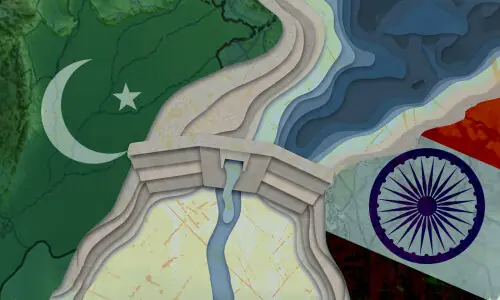
THE unanimous decision by the Permanent Court of Arbitration at The Hague is unambiguous: India’s unilateral withdrawal from the Indus Waters Treaty is invalid. This is a moral and legal victory for Pakistan, endorsed by a respected third party.
India has, however, said that it does not recognise the court, and “categorically” rejects the verdict. New Delhi’s response reflects its usual mix of arrogance and disregard for global conventions when matters do not go in its favour. The PCA has said that none of the grounds India has provided for abandoning the IWT “justify suspension or termination” of the treaty. The court has also called for suspending work on the Ratle hydropower project in occupied Kashmir.
With apparent reference to the developments, Prime Minister Shehbaz Sharif told the SCO summit in Bishkek on Tuesday that water cannot be weaponised, and that “treaties governing our shared waters are solemn”. The Hague award only strengthens Pakistan’s case, and the government must pursue all avenues to protect the country’s water rights. Pakistan has consistently been arguing that India’s suspension of the IWT last year, after the Pahalgam episode, is legally untenable.
Unfortunately, India picks and chooses which international laws it wishes to respect. It has recognised earlier PCA decisions, but in the present instance, it is attempting to engage in legal jugglery to escape its responsibility of restoring the IWT. India’s prime minister often lectures the international community about the need to uphold the ‘rules-based order’. Yet when the global system rules against it, India tramples these same standards underfoot. This is not a new phenomenon. New Delhi has been ignoring the UN resolution on the Kashmir plebiscite for nearly eight decades.
Foreign Minister Ishaq Dar has proposed a three-step process to resolve the IWT imbroglio. This includes respecting the treaty in “letter and spirit”; addressing all disputes through its mechanisms, and restoring “technical engagement … and data-sharing” between Pakistan and India. This is a logical roadmap towards restoring the IWT. Yet bellicosity and bluster have replaced rationality and statesmanship in New Delhi.
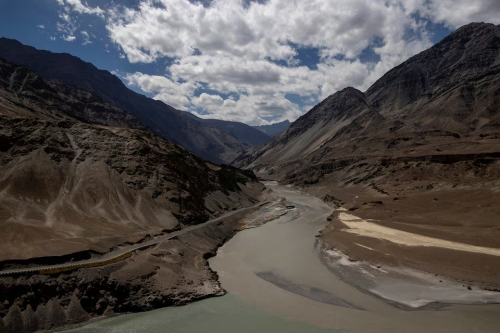
But Pakistan cannot afford to cede to India’s obduracy and give away its water rights. The IWT is a critical framework for protecting these rights, as the Indus and its tributaries are a lifeline for this country. India should engage constructively with Pakistan, and agree to restore the IWT. If it wants any changes to the treaty, let it discuss these with Pakistan at the negotiating table. The blockade of Pakistan’s rightful waters will not be accepted. If India goes ahead with its malign plans to deprive Pakistan of water, it will be sowing the seeds of renewed conflict.
Published in Dawn, September 2nd, 2026