WHILE diplomatic efforts are underway to restore dialogue with Taliban-ruled Afghanistan, as the Foreign Office has pointed out, talks can only succeed when there is a firm commitment from Kabul to end support for terrorist groups based on Afghan soil.
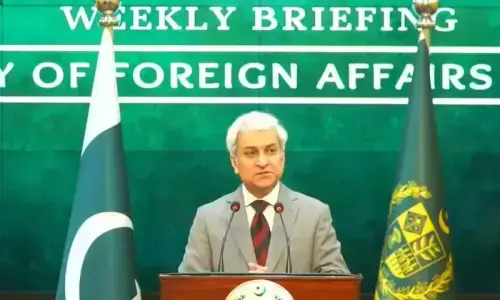
During a briefing on Wednesday, the FO welcomed China’s efforts to bridge the gap between Kabul and Islamabad, but cautioned that only firm action from the Taliban could take the process forward. Beijing’s envoy for Afghanistan was recently in Pakistan reportedly to restart the Urumqi process. The FO also downplayed the recent engagement of the Afghan ambassador to speak at the NDU as “not unusual”.
This may be true, but the fact that the Afghan diplomat spoke at the nation’s top defence university at a time when bilateral ties are near rock bottom is significant. But, despite these efforts, the fact remains that terrorist groups based in Afghanistan are the biggest obstacle to peace. The ISPR announced yesterday that several terrorists trying to infiltrate Pakistan at the Afghan border were eliminated. The military’s media wing highlighted that “the Afghan Taliban regime has consistently failed to ensure border management”.
The efforts by sincere friends like China are welcome. Beijing wants calm in the region to protect its investments in Afghanistan, as well as to neutralise anti-China militant groups such as ETIM based on Afghan soil. Yet, as the FO pointed out, these endeavours can only succeed when there is determination from Kabul to take action against terrorist groups. The Taliban regime has taken steps such as relocating TTP fighters and their families away from the common border, while the Taliban supreme leader has also reportedly asked the banned TTP to stop attacks on Pakistan. But these are cosmetic moves, and as the latest firefight at the border indicates, they have had a limited impact on the TTP and other terrorist groups.
If diplomatic efforts are to succeed, then the roadmap, as identified by the FO, must be followed. This entails “verifiable, written assurances” from the Afghan Taliban that their territory will not be used against Pakistan. If this apparently simple principle is followed, engagement and long-term peace are possible. It may be worth reviving the Urumqi process, but Kabul must affirm its resolve to act against anti-Pakistan terrorists.
While sustained hostilities are not good for either country, Pakistan has shown that it can defend itself against terrorist groups, as well as states that host them. Pakistan has said time and again that it is ready for dialogue if Afghanistan withdraws its support for violent groups. It is now up to Kabul to create a conducive atmosphere for talks, primarily by stopping all cross-border movement of terrorists.
Published in Dawn, September 4th, 2026