Analysis: How PCB’s most powerful men contradicted themselves after triggering a mid-series crisis

After Pakistan’s infamous loss at the hands of the United States in the 2024 T20 World Cup, Mohsin Naqvi, then the newly appointed chief of the country’s cricket board, promised a “surgery”.
Two and a half years into his tenure as Pakistan Cricket Board (PCB) chairman, a lot has taken place that indicates that the operation hasn’t really resulted in curing the ailing condition of the sport in the country.
What unfolded over the last week, however, arguably counts as the most dramatic procedure the surgeons have carried out.
In the middle of a Test series in England, seven players were called back home, the head coach and bowling coach — both former Pakistan stalwarts — were dismissed and replacements were dispatched to the UK.
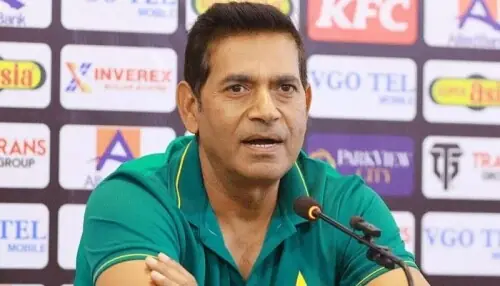
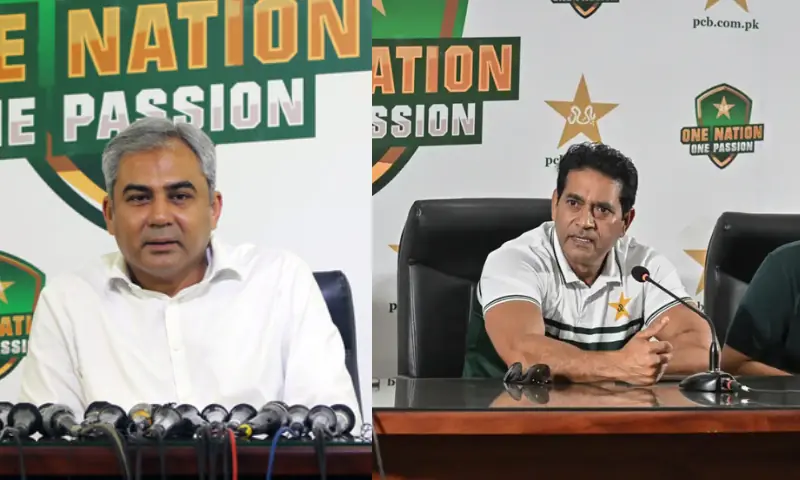
What followed was scathing criticism of the PCB’s move. The board, however, responded soon after. The response came from Naqvi himself and High Performance Director and national selector Aaqib Javed — considered the most and second-most powerful men in the board, respectively.
When the duo spoke — Aaqib appeared on a prime-time news show, and Naqvi addressed reporters in London — there were hardly any convincing or clear answers.
It was less a coherent defence of the mid-series intervention than a revealing study in institutional contradiction. Ownership was claimed in principle and redistributed in practice; selection was defended as rigorous and then abandoned as inadequate; confidence in players was asserted even as they were publicly discarded.
Dawn took a closer look at some of Aaqib and Naqvi’s comments.
Selection on merit versus the necessity of the purge
Aaqib Javed was unequivocal about the quality of the original squad.
“The 17-member team that was formed — I don’t think anyone had any doubt that these players had not gone there on the basis of performance or that there was some deficiency in them,” he said.
Players, he emphasised, are selected “on the basis of your previous performance and the kind of form you are in”. The selectors, he added, “are absolutely ready to take responsibility for that squad”.
Yet the same official justified the mid-series recall of seven of those players on the grounds that their form had collapsed and the side was no longer competitive.
“When you come on such a long tour, and your performance is simply not coming, and you are also not able to compete in that way, then making this kind of decision… can only improve your image,” he argued. “It cannot be that we wait until the end, until the series finishes.”
Elsewhere, he was more direct: “You get indications about how you are taking your game and how your performance is coming. So there is no harm in making a decision.”
The contradiction is structural.
If the squad was assembled on clear merit and previous performance, and if the selectors stand ready to own that selection, then the rapidity with which large parts of it were discarded raises questions about the robustness of the original criteria.
If non-performance mid-tour is sufficient grounds for removal, then the process that retained so many of the same names for a demanding overseas assignment requires closer scrutiny.
One cannot simultaneously insist that the selection was sound and that the selected players had become so deficient that emergency surgery was unavoidable.
Responsibility for the squad versus responsibility for combinations
Aaqib drew a careful distinction between the selectors’ role and that of the on-tour management.
“When we select a team, we make a squad together with the coach and captain, and we are absolutely ready to take responsibility for that squad.”
Once the tour begins, however, “decisions of that kind were not being made”.
He listed available options — pace bowler Ubaid Shah, a second wicketkeeper and an all-rounder — that were not utilised.
“I also spoke to the captain and the coach before this Test match and said that you should play your fast bowler, Ubaid… But when you are not able to make decisions, then somebody has to take action.”
The board, meanwhile, issued notices to selection committee members seeking explanations for the original inclusion of certain senior players.
The public narrative thus places primary responsibility for the non-competitive performances on the captain and coaches for failing to optimise the squad, while the institutional machinery simultaneously questions the selectors who assembled it.
Ownership is asserted at the level of principle and redistributed when explanation is required. The selectors own the squad until the squad fails; the management owns the combinations until the combinations fail; the board owns the results in the abstract while examining the decisions of those it appointed.
Confidence in players versus the public nature of their removal
Chairman Mohsin Naqvi struck a protective note regarding the players.
He said he would “not allow anyone to blame the players for the sake of it” and asked everyone “to stop demotivating the players. It is unfair”.
Confidence in them, he indicated, remained.
At the same time, he defended the scale of the changes without equivocation.
“Every match of a series is important for us, and we are not left with any option if a player is not performing but to look for his replacement. The purpose behind these changes is not to axe players from contention, but just to replace them.”
On Salman Ali Agha, he observed that he “is a very good player, but he could not click because of some reasons. He was spoken to about it.”
The tension here is immediate.
A board that publicly releases senior players mid-series, accompanies the move with pointed commentary about form and competitiveness, and allows its high performance director to question one player’s commitment over a muscle injury, cannot simultaneously claim to be shielding those players from demotivation or unfair blame.
The act of mid-tour removal on performance grounds is a form of public accountability. To perform that act while counselling against demotivation is to speak in two registers at once.
White-ball progress versus Test collapse
Naqvi sought to place the Test failures in a wider context of improvement.
“We have jumped to number five from eight in ODIs and won four of the six series since we have appointed the new coaching set-up… We were ninth in T20Is and now sit at sixth and our success rate has climbed to 73 per cent from 24. Yet, there is criticism that cricket is finished in the country.”
He asked pointedly: “Did cricket come to an end in South Africa and India after they lost to Namibia and Ireland?”
The metrics may be accurate, yet they sit uneasily beside the board’s own actions.
An administration that feels compelled to dismantle half its Test squad and coaching staff mid-series is not projecting institutional health. To cite white-ball ranking gains as evidence that “cricket is not finished” while treating the red-ball side’s performances as so deficient that emergency intervention is required is to advance two incompatible assessments of the same organisation’s overall condition.
Progress in one format does not cancel the implications of systemic failure in another, particularly when the board’s response to that failure has been so sweeping.
Accountability accepted versus criticism dismissed
Both officials accepted a measure of institutional answerability.
Aaqib stated that when results are poor, “every person’s responsibility and accountability is involved”.
Naqvi went further: “Sometimes there are mistakes made in selection as well. I am answerable for that, and we need to work on it.”
The board, he noted, is ultimately answerable for results.
Yet the framing of external criticism has been markedly different.
Naqvi declared that he has “never been afraid of criticism, and I never will be”, but added that it is “not acceptable for those [former] players who have not achieved anything in life to push this narrative”.
Many critics, he suggested, “want to get rid of me” rather than advance the interests of the game. For Naqvi, criticism is better suited coming from former players “who have made a name for themselves” and not those “who have done nothing in their lives.”
This selective legitimacy undercuts the claim of open accountability.
An institution that accepts answerability in principle while characterising substantial portions of the resulting scrutiny as the work of the unqualified or the personally motivated narrows the space in which that answerability can be tested.
The board invites examination of its decisions and then questions the standing of many of those who examine them.
Continuity invoked versus upheaval normalised
Running through the statements is an implicit claim to purposeful management.
Aaqib spoke of the need to manage resources effectively and of the long-term work of reviving academies after years of neglect. Naqvi rejected the idea that officials must be retained for fixed multi-year terms simply because they have been appointed.
Yet the current episode is only the latest in a sequence of coaching changes, selection-panel adjustments and leadership resets that have characterised the period since early 2024.
To present the latest upheaval as a necessary, almost inevitable response to non-performance, while presiding over an environment in which upheaval has become a recurring instrument of management, is to normalise instability even as stability is invoked as a virtue.
None of this is to argue that a side being systematically outplayed should be left untouched, or that non-performing players enjoy indefinite protection.
The principle of accountability is sound.
What is less convincing is the simultaneous assertion of several positions that cannot easily coexist: that the original selection was rigorous and merit-based; that the selected players had become so deficient that large-scale removal was unavoidable; that selectors own the squad while management owns the combinations; that players must be protected from demotivation even as they are publicly discarded; that white-ball metrics demonstrate institutional health while Test performances necessitate emergency surgery; and that the board accepts answerability while treating much of the resulting criticism as illegitimate.
The contradictions are not merely rhetorical.
They point to a deeper difficulty in the board’s public reasoning: an inability to offer a single, consistent account of why the side that travelled to the West Indies and England proved so non-competitive, and of where responsibility for that outcome ultimately lies.
Until those contradictions are resolved more convincingly, the mid-series upheaval risks being remembered less as a decisive turning point than as another episode in a familiar cycle of crisis, intervention and incomplete explanation.
Pakistan’s Test cricket requires a clearer diagnosis and more coherent accountability than the recent statements have supplied.