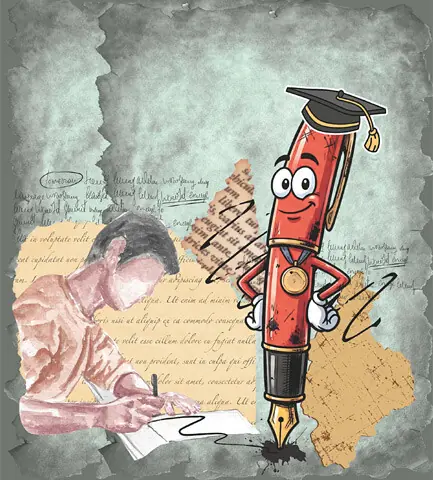
There is nothing quite like writing with your own hand with a real pen or a pencil that needs sharpening halfway down the page. Paper doesn’t autocorrect my spelling or make it neater than it is. My words stay the same, no matter how twisted, straight or tangled they look while I figure out what I actually want to convey.
Sometimes I press the pen down too hard when the words start flowing fast in my head and I don’t want to stop. And sometimes my letters get small and controlled when I’m trying to cover up my feelings. When I’m happy, my handwriting flows on the page with loops, slants and words just pouring down. A screen has never once known any of that about me. A screen never will.
That’s the beauty of handwriting. It’s a mirror. Hand someone a page you wrote by hand and, without meaning to, you’ve handed them a piece of that exact moment: your mood, your energy, maybe even the trembling of your hand in that situation. No two people on this entire earth write the same way. Not even close relatives. Not even twins. Your handwriting is yours, the way your voice is yours, the way your walk is yours.
When writing became optional
Somewhere in the last ten years, handwriting became optional. People just started skipping it and preferred typing. Assignments started to be handed in as soft copies. Projects got typed, printed or sent as PDFs.
During lectures or conferences, adults and youngsters alike, if allowed, started taking notes on their phones, not in notebooks. This was also the time when birthday cards and other occasion cards with deep or funny wishes started to disappear, replaced by messages and ecards on chat apps.
We stopped writing by hand. Then we started letting AI do the thinking. The pen’s disappearance is costing us more than we realise
This came as an advancement because typing was faster. Nobody had to face embarrassment due to spelling mistakes because autocorrect was doing quiet damage control in the background.
To top it all, AI chatbots showed up and made things even easier. Stuck on how to phrase something? Ask it. Need an essay outline? Ask it. Don’t know how to start a sentence? Ask it.
In my day, the blank page was the real problem — you’d stare at it and force your brain to come up with the ideas yourself, scribbling out a mind map, crossing things out, starting over. Now even the “mind map” is on screen, thinking for us and giving us ideas. In short, there’s a shortcut for every shortcut.
Which brings us to the real fact here. It’s not just that handwriting is disappearing. It’s the thought process while writing that is disappearing. Two skills going extinct together, and very few of us have actually understood the gravity of the situation.
Your brain notices the difference
In 2024, scientists at the Norwegian University of Science and Technology studied 36 university students using EEG (electroencephalogram) sensors, a 256-channel system that records brain activity.
The students were asked to either write words by hand or type them. The researchers found that handwriting produced more communication between different areas of the brain, while typing produced much less. The areas involved included regions linked to memory, attention and learning.
Compared to typing on any device, handwriting is slower and more effortful. When you write letters to make a word by hand, your brain simultaneously starts thinking about how the letters look and what the word means, and guides your hand accordingly. While typing, words are often autocorrected, forming letters requires much less physical effort and there is no need for the brain to guide the hand in the same way. That extra effort may be one reason handwriting can help us engage more deeply with what we are writing.
And this brings us to the age-old advice: “Write down the main points before an exam so you’ll remember them more easily.”
The sneaky part of AI!
AI chatbots have been stacked on top of a generation that’s already skipping the “think first” step, the same generation that had already put the pen down, stopped writing things out by hand and let typing quietly take over through messaging apps, symbols and short forms of words. Sadly, with handwriting being the first thing to go, it took a piece of thinking with it too.
Multiple studies are now finding a worrying pattern: the more people lean on AI, the more they offload their own thinking and the weaker their critical thinking gets over time. Writing gets forgotten in the same way — because now the device is doing both jobs, not us. We’re not even typing our own thoughts anymore; we’re asking AI to generate them for us, then just copying and pasting. And just like that, the whole thing is done.
That raises an uncomfortable question: what happens to the next generation if they stop thinking and stop writing at the same time?
The hidden talents of a pen
Handwriting has some genuinely strange, interesting sides that rarely make it into these conversations.
It solves crimes. Forensic document examiners study handwriting professionally. They catch forgeries, trace ransom notes and identify people from tiny, near-invisible habits in how they form letters. It’s real science, used in real investigations and it exists because no two people’s handwriting habits are exactly alike.
It builds your reading brain. Neuroscientists have found that the act of physically forming letters by hand activates parts of the brain tied to reading and language development, regions that typing simply doesn’t reach in the same way. This is part of why handwriting is still taught early in school, even in a world full of keyboards. Your hand is quietly teaching your brain to read.
The rebellion has already started. There are massive online communities obsessed with fountain pens, ink colours and analogue planning. Bullet journal communities, pen collectors, people who debate ink formulas the way others debate football teams are also growing in number and popularity.
Bring the pen back
The pen is not old-fashioned. Try putting your phone and laptop aside and write something. It could be anything: an idea, a name or some lines of your random thoughts. And then you will be surprised by your handwriting. It may be neat or it may look like a cockroach ran through wet ink. It doesn’t matter. The point is, your hand and brain are working together.
So pick up a pen once in a while. Your keyboard won’t be offended. After all, the pen is the mother of all our fancy keyboards, tablets and touchscreens.
Here are some tips worth remembering:
• Take notes by hand during lectures or in class. You can record the lecture on your phone at the same time if you want a backup, but keep writing alongside it.
• Let your hand get used to how the letters look, how much pressure they need, etc.
• Journal for five minutes with an actual pen or pencil. Keep your hand moving as you think.
• Before you ask an AI chatbot to write or solve something, wrestle with it yourself first — even for two minutes. That imperfect first attempt is actually your brain doing the job it’s slowly forgetting how to do.
• Start writing to-do lists or reminders by hand instead of typing them into your phone.
• Write an actual card to someone, either on their birthday or any other occasion. Nobody forgets a handwritten note; everybody forgets a text.
• Write down a quote, a song lyric or a line from a book you liked in a notebook once in a while. It costs two minutes and keeps the hand-eye-memory connection alive.
This all sounds quite funny to many of you at your age, but remember, these are the skills you may miss when you grow up. So don’t let your “figuring it out” muscle disappear completely. Once it’s gone, it’s not like autocorrect can bring it back for you.
So, is the pen really dead?
Not even close. It has simply been pushed aside by faster, more convenient tools. But that doesn’t mean you have to choose one over the other. My point is not to throw away your devices and go live like it’s the 1850s. Typing isn’t the enemy, and neither is AI. Both are genuinely useful. Just don’t let convenience do all the thinking and effort for you.
Handwriting styles decoded
Handwriting can actually be used to verify who wrote a document — because no two people’s natural style, even within the same style category like cursive or print, comes out identical.
Print (block letters): This is the style most people learn first as kids; each letter stands alone, not connecting. It’s the style used on official documents like exam papers and voting forms.
Cursive: In this, letters are connected together for speed and flow. Two of the most famous cursive styles are Spencerian and the Palmer Method. Did you know that the original Coca-Cola logo is written in Spencerian script?
Italic: This is basically a mix between print and cursive: a little slant, some letters joined, but still easy to read. It’s called “italic” because the style actually originated in Italy.
Calligraphy: This style of handwriting is not meant for everyday use; it’s an art of writing or writing as an art. The writers are called calligraphers and they use special pens or brushes and change pressure and stroke to make letters thick in some places and thin in others.
Manuscript: It is a more formal, structured version of print, usually the very first style taught to young kids; upright letters, no slant, no connections, meant to slow you down and get the shapes right before speed comes.
Platt Rogers Spencer is known as ‘the father of American handwriting.’ He loved penmanship since he was a child and made up his own style, Spencerian script, using the shapes he noticed in nature like leaves, tree branches, flowing water, etc. The style became so popular that it dominated American handwriting from the 1850s to 1900.
Austin Norman Palmer:
He started out as a janitor, working his way through a penmanship school. He thought Spencerian was too fancy, slow and tiring for the fast pace of modern business, so he created his own simpler, faster style called the Palmer Method.
It became so dominant that by the time he died in 1927, about 75% of American schools were teaching it — an entire country basically learnt to write his way.— B.R.
Published in Dawn, Young World, September 5th, 2026