Police charge sheet says building management at fault for Gul Plaza inferno
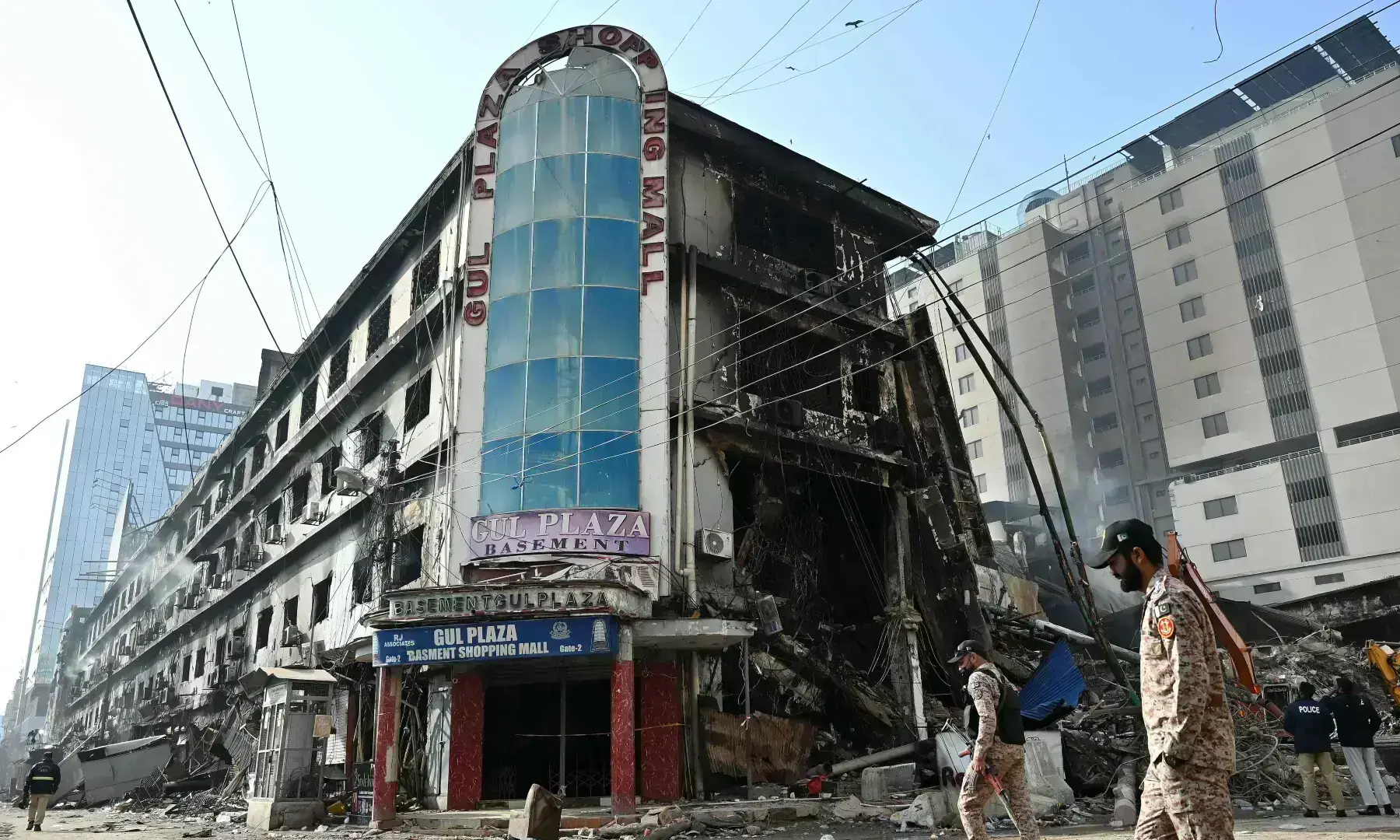

KARACHI: Police on Saturday submitted a charge sheet before the South judicial magistrate on the Gul Plaza fire, blaming the building management’s “negligence”.
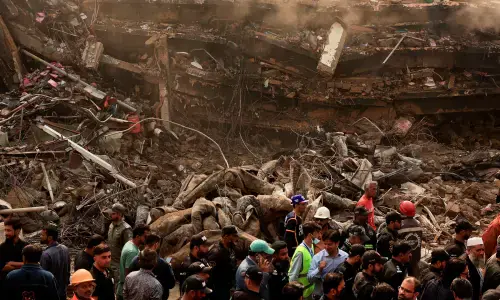
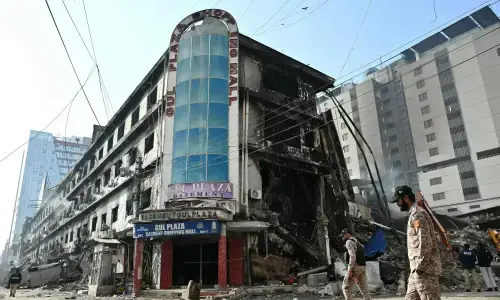
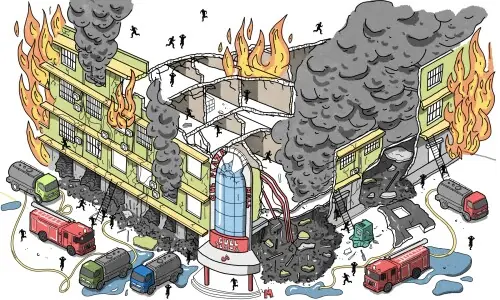
The deadly inferno, which erupted on the night of January 17 at the mall and took nearly two days to be fully extinguished, had claimed at least 73 lives and left over 1,100 shops in ruins.
A previous charge sheet submitted in July had named six people — including 11-year-old Huzaifa — as the accused. However, a judicial magistrate had rejected the document, noting that the investigating officer (IO) had not conducted a thorough and satisfactory probe.
The fresh charge sheet, dated September 3 and submitted by the Nabi Bux police, names four of those six as the accused sent for trial: Huzaifa’s father Naimatullah who owned an artificial flower shop; Gul Plaza Traders Association President Tanveer Pasta; and association members Ammar Ismail and Muhammad Ramzan.
Meanwhile, regarding the role of authorities, the charge sheet said the fire brigade, Rescue 1122, and Karachi Metropolitan Corporation (KMC) “used the resources they had with great efforts to put out the blaze”.
Listing the faults on the building management’s side, the document stated that the Gul Plaza administration lacked adequate tools to extinguish the fire, considering the scale of the building.
It added that there was “no alternative arrangement for emergency lights, due to which people faced difficulties leaving” the building.
It noted that during the investigation, the complainant in the case said only two of the building’s gates were open at the time of the fire. “People could not leave due to the locks on the iron gates,” the charge sheet read.
It went on to say that during the rescue operation, it was discovered that the iron gates on the third floor were padlocked, which “showed that the Gul Plaza administration had their guards close them”.
The document further pointed out that the building management had K-Electric switch off the power supply “despite knowing that they do not have any other alternative arrangement for lighting”.
The charge sheet said Faisal Ibrahim, the owner of Fire Works VIP Service, used to buy the fire safety equipment for the Gul Plaza union.
It added that during the investigation, the quantity of such equipment was found to be inadequate, and that the building management was responsible for repairing and replenishing it. This proved the “criminal negligence and carelessness” of the building management, the charge sheet declared.
It recalled that the findings of the Sindh government’s inquiry commission and the judicial commission also proved the Gul Plaza administration’s negligence. It noted that safety equipment and speakers were not used, while the exits were also found closed.
On the other hand, the charge sheet recalled the rescue operation and the death of a firefighter in the process.
It added, “Due to these reasons, the hard work of the rescue services cannot be doubted, and no concrete testimony emerged during the investigation that would show criminal negligence of rescue authorities.”
The charge sheet highlighted that neither the government inquiry body nor the judicial commission found rescue authorities at fault for any criminal negligence.
While departmental action was taken against Civil Defence Director Abdul Majeed Jagirani and Additional Controller Fatima Memon, “no criminal negligence of the institution was found”, the charge sheet said. It noted that Memon and technical instructor Mirza Mursalin Baig were dismissed from their jobs.
Similarly, the fire brigade’s Station Officer Zaheer Siddiqui was also dismissed from his role, the charge sheet said, adding that no “criminal negligence was found”.
In its report, the Gul Plaza Judicial Commission said the deadly inferno signified a systemic failure across successive provincial and local governments as the legal and administrative mechanisms have existed, but could not be implemented effectively.
Justice Agha Faisal of the Sindh High Court (SHC), who headed the commission, noted that the tragic incident was a grave indictment of the failure of municipal and provincial systems to translate legal duties concerning urban safety into effective protection on the ground.
It stated that the people not only lost their lives to flames, but also due to delay, darkness, locked exits and windows of the ill-fated building, absence of fire safety systems, unimplemented audits/inspections and fragmented authority.
Notably, the commission said KMC, including its fire brigade, Sindh Building Control Authority, Rescue 1122, civil defence department, district administration and others, bore institutional responsibilities for the failure, while material responsibility rested with the people acting as the de facto management of the building together with owners, occupants and commercial operators.
The report was handed over to the provincial government months ago but was released last month, apparently against the backdrop of a tragic hospital fire in Islamabad.