ENVIRONMENT: A CITY’S WASTE AND THE SEA
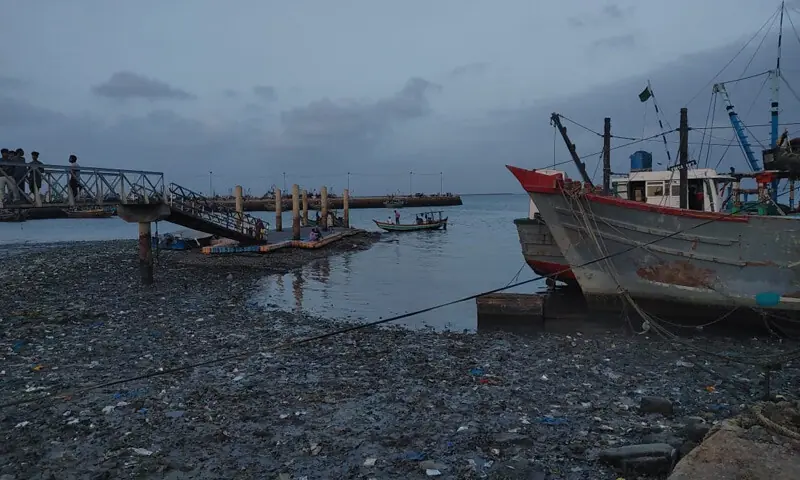

Before sunrise, while most of Karachi is still asleep, 45-year-old Haji Yousuf unties his weathered wooden boat from the jetty at Baba Island, a short distance from mainland Karachi.
He has followed this ritual for more than 40 years, just as his father and grandfather did before him. He learned to read the tides from the movement of waves, anticipate storms from the colour of the sky, and locate fish by observing currents and seabirds. These were lessons passed down through generations, long before satellite navigation and weather forecasts became commonplace.
Today, however, the greatest challenge facing fishermen like Yousuf does not come from the sea but the city behind it.
Long gone are the days when Yousuf’s nets returned heavy with pomfret, prawns and mullet. Now, they emerge often tangled with plastic bags, discarded clothing and foul-smelling sludge. Fish have retreated farther offshore, forcing fishermen to spend more time and fuel at sea before catching enough to earn a living. Every journey has become a gamble between rising costs and diminishing returns.
As Karachi’s rivers carry the city’s untreated waste to the coast, generations of fishing knowledge are running up against a crisis no tide chart can predict
Yousuf’s experience is shared by thousands of fishing families living along Karachi’s coastline. For them, environmental degradation is not an abstract discussion about climate change or sustainability. It is measured in empty nets, mounting debt, declining health and uncertainty about whether the next generation will be able to continue a way of life that has sustained these communities for centuries.
A CITY SHAPED BY WATER
Long before Karachi grew into Pakistan’s largest metropolis, it was shaped by water. The Lyari and Malir rivers carried freshwater from the inland hills to the Arabian Sea, creating fertile estuaries where freshwater mixed with saltwater.
These productive ecosystems supported mangrove forests, abundant fisheries, migratory birds and diverse marine life. Like many early settlements around the world, Karachi’s coastal communities flourished where reliable freshwater met the sea.
Fishing villages such as Mubarak Village, Kakapir, Rehri Goth, Ibrahim Hyderi, Chashma Goth, and the islands of Baba and Bhit developed around these estuaries. Home to indigenous Sindhi and Baloch communities, as well as migrants from the neighbouring Kutch coast, these settlements built livelihoods that depended on understanding rather than controlling nature.
Fishing, boat-building, net-weaving, fish-processing and maritime trade formed the backbone of local economies, while generations of observation produced an extraordinary body of ecological knowledge. These communities’ seasonal fishing practices allowed marine resources time to regenerate, while mangrove forests were recognised as natural barriers that protected villages from storms and served as nurseries for fish and shrimp.
This knowledge, passed orally from one generation to the next, enabled communities to live with the uncertainties of the coast while maintaining its ecological balance.
WHEN THE RIVERS TURN TOXIC
That balance has been steadily eroded by the rapid growth of Karachi. As the city expanded into a megacity of more than 20 million people, its infrastructure failed to keep pace with urbanisation and industrial development. The Lyari and Malir rivers, once lifelines for coastal ecosystems, gradually became the city’s principal drainage channels.
Every day, Karachi generates more than 472 million gallons of sewage, including nearly 100 million gallons of industrial wastewater. Much of it reaches the Lyari and Malir rivers untreated, before flowing directly into the Arabian Sea. What begins upstream as an urban sanitation problem ends downstream as an environmental crisis.
For fishermen, the evidence is impossible to ignore. Water near the harbour has become darker and carries the unmistakable smell of sewage. Floating debris, oily residues and household waste have become common sights, while fish stocks continue to decline. Mangrove forests, already under pressure from land reclamation and indiscriminate cutting, have been further damaged by polluted water and habitat degradation.
Fishermen also speak of changes that statistics alone cannot capture. Dolphins that once accompanied their boats have become rare, sea turtles are seldom seen and once abundant species are now found much farther offshore.
THE PRICE OF POISONED WATER
These ecological changes carry immediate economic consequences. Every additional kilometre travelled at sea requires more fuel, increases maintenance costs and exposes fishermen to greater risks from changing weather conditions. Yet, larger investments often produce smaller catches.
Combined with fluctuating fish prices and competition from industrial trawlers, declining fisheries have pushed many households into debt and financial insecurity. Some families are forced to borrow money simply to finance fishing trips, while others withdraw children from school to supplement household incomes.
Pollution has also become a public health crisis. Fishermen spend long hours in contaminated water while casting nets, unloading catches and repairing boats, exposing them to skin infections and other waterborne illnesses. Coastal settlements report worsening mosquito infestations, polluted mudflats, and limited access to safe drinking water.
During the monsoon, the Lyari rivers flush enormous quantities of urban waste into the Manora Channel, where floating debris obstructs navigation and increases maintenance costs for both fishermen and the Karachi Port Trust.
The impacts extend far beyond coastal villages. Karachi Harbour, Pakistan’s busiest maritime gateway, receives pollutants from municipal sewage, industrial effluents, commercial activities, fishing vessels and shipping operations. Corrosive contaminants accelerate the deterioration of port infrastructure, vessels and naval assets, increasing maintenance costs and reducing operational efficiency.
As far back as 2007, the navy informed a Senate committee that pollution in Karachi Harbour and the Naval Dockyard was estimated to cause nearly $1 billion in damage over the operational lifespan of Pakistan Navy vessels. Pollution, therefore, is not merely an environmental concern. It is an economic liability affecting national infrastructure and trade.
A SEA OF BROKEN PROMISES
Despite decades of environmental legislation, wastewater projects and coastal conservation programmes, meaningful progress remains limited. Responsibility for wastewater management, environmental regulation, urban planning and coastal development is divided among numerous institutions, whose mandates frequently overlap.
Treatment capacity remains insufficient, enforcement of environmental regulations is inconsistent and coordination between federal, provincial and local authorities is often weak. The result is a familiar cycle, in which plans are announced, pilot projects are launched, yet untreated wastewater continues to reach the sea.
Protecting Karachi’s coastline will require integrated management of the entire watershed, recognising that what enters the Lyari and Malir rivers eventually reaches the sea. Expanding wastewater treatment, enforcing industrial discharge standards, restoring mangrove forests and creating meaningful opportunities for fishing communities to participate in environmental decision-making are no longer optional — they are essential investments in the city’s future.
As another dawn breaks over Baba Island, Haji Yousuf prepares his boat for another day at sea. He still studies the wind before leaving the harbour. He still trusts the tides and the stars his father taught him to follow. What he no longer trusts is that the sea will continue to provide as it once did.
The writer is an academic and researcher on coastal communities and indigenous knowledge. She can be contacted at sarahkiran@gmail.com
Published in Dawn, EOS, September 6th, 2026