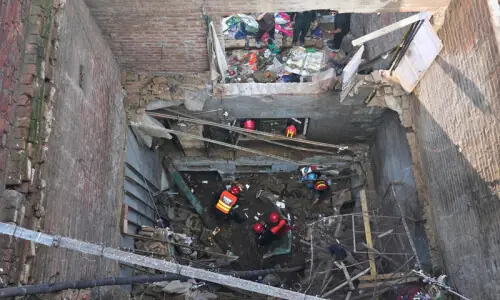
Muhammad Ali, 26, lives with his parents and two sisters in a three-bedroom flat in a three-storey apartment block near Shaheed-i-Millat Road in Karachi. At night, they share a single air-conditioned (AC) room.
“I need my privacy and to study for my exams in peace, not with my father scrolling through reels — with the volume on high — on his phone while awake and snoring loudly when he dozes off,” says Ali, a disgruntled dental resident.
“Even the AC is a source of negotiation — the cool air from the vent barely reaches the corner where I sleep,” he continues. “If I turn up the fan speed or change its direction, my mother and sisters complain.”
With a rapidly growing population — and a much-disputed census estimate of 20 million — Karachi is bursting at its seams. As the city struggles to accommodate its growing population, its skyline — dotted with highrises and multi-storey buildings — reflects a relentless push vertically.
Pakistan is increasingly touted as a country that has leapfrogged into solar energy, changing how households use electricity. But for millions living in Karachi’s highrise apartments, going solar is not so simple — splitting the city into those who can go off the grid and those stuck paying for what’s left of it
The 2023 Population and Housing Census by the Pakistan Bureau of Statistics counted 114,148 multi-storey structures nationwide, of which 64.38 percent were residential and 28.96 percent were used for both residential and economic purposes. Sindh accounted for nearly two-thirds — 64.84 percent — of the country’s multi-storey residential structures, with a majority probably in Karachi.
This congested city’s 170th ranking out of 173 cities in the Economist Intelligence Unit’s 2026 Global Liveability Index reflects the pressures of urban life. There simply aren’t enough basic amenities for its residents, including water, natural gas and electricity, with prolonged power outages making nights routinely sleepless. Ali’s family is among those living in one of Karachi’s rented apartments and grappling with these challenges daily.
“The high electricity bill, power outages at any time of the day and, most importantly, this lack of privacy is affecting my life,” Ali tells Eos. He is desperate for his household to transition to solar power. “But I don’t earn enough to have a say in decisions,” he adds.
Nevertheless, that has not stopped him from checking whether the rooftop has enough space and getting quotations from solar installation companies to determine the initial investment and how long it would take to recoup it.
The number of Karachi residents living in highrises is unclear. Karachi-based think tank The Knowledge Forum (TKF), which works with civil society on just energy transition — moving from fossil fuels like coal, oil and gas to cleaner energy in a way that is fair to everyone affected — estimates that 64 percent of the city’s population lives in high-density neighbourhoods, which include informal neighbourhoods. Apartment blocks and other multi-storey buildings, meanwhile, are found not only in high- and medium-density areas but are increasingly becoming a feature of informal settlements as well.
The estimate is based on declarations made by the city’s power utility, K-Electric, in its 2024 tariff determination, which was notified by the National Electric Power Regulatory Authority (Nepra). “The approximate 64 percent of the population also constitutes the high-loss areas [where electricity theft is rampant],” says Basil Andrews, lead researcher on just energy transition at TKF.
Rabia Babar, a data analyst at the Islamabad-based energy transition think tank Renewables First, says the current generation tariff or the national average purchase price determined by Nepra is Rs23.32 per kilowatt hour (kWh), while the uniform national average tariff charged to consumers is Rs33.38/kWh.
“This does not include the different taxes levied across consumer categories — commercial, industrial and the various domestic consumption tiers,” Babar tells Eos.
THE GREAT SOLAR DIVIDE
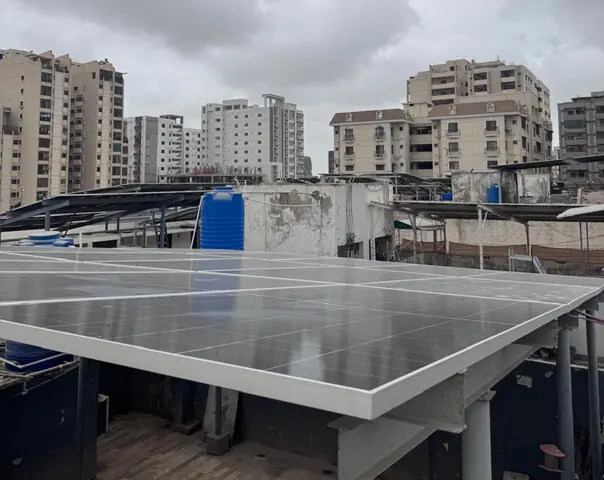
Just when Ali’s father gave in and all the apartment residents finally gave him permission to use the rooftop (since it’s a shared space) to install solar panels, Nepra introduced its prosumer regulations earlier this year, replacing “net-metering” with “net-billing.”
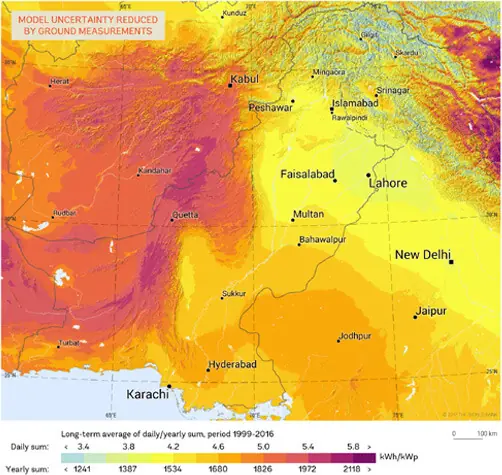
K-Electric’s most recently approved solar photovoltaic project, says Andrews, has logged that Karachi averages approximately 2,300 sun hours per year. This makes Karachi among Pakistan’s better-suited cities for solar energy, receiving abundant sunshine throughout the year. Net-metering allowed consumers to generate electricity and export surplus back to the grid, receiving credits on their electricity bills. But with net-metering replaced by net-billing (solar prosumers buy power from the grid at standard retail rates but sell excess solar energy back at a much lower rate), “it means I now have to invest in enough batteries to store the power, instead of selling it to the grid,” says Ali. It is a cost he had not anticipated.
The policy shift and what he called the government’s “volatile” decision-making have since put his plans on hold. “There isn’t enough space or ventilation inside our flat to install batteries and go completely off-grid, which would have been ideal,” Ali continues.
“I had calculated the initial cost of putting up the system without batteries to be around one million rupees for our rented premises, and it would have taken us about three years to enjoy the pay-off, under net-metering,” he says. In return, he says they would have been able to turn on a second AC by selling the extra power generated to K-Electric.
K-Electric has different rates for different users, but doing some quick back-of-the-envelope calculations, Hasan Jalisi, a regional sales manager for a company providing solar-related solutions, explains how the situation has changed.
If they had been under the previous net-metering regime, prosumers like Ali’s family who did not invest in batteries could sell excess solar power to the grid for around Rs25/kWh. “Under the new net-billing system, they would be selling their electricity for 10 rupees per kilowatt hour while continuing to pay between 45 to 50 rupees for the same when buying from the grid,” he says.
In fact, whether under the earlier net-metering system or the recent net-billing regime, Ali would never have been a beneficiary of either. That’s because he does not live on the top floor or own the rooftop space — even if the property owner and other residents gave him permission to install solar panels. The February 2026 prosumer regulations require the person to have ownership of the location where the solar panels are installed for them to be eligible for net-billing.
While there is greater awareness about the benefits of solar, the fluctuating government policies are creating new inequalities. Many don’t see Pakistan’s solar revolution as inclusive if the people who cannot afford solar — or, like many apartment dwellers, cannot access a rooftop — are left paying for the grid.
“Solar is not for everyone — just the privileged few,” says F.N. Ahmed, who lives on the ground floor in an apartment off Chaudhry Khaliquzzaman Road in Clifton. “Those of us who are forced to depend on the grid face load-shedding and exorbitant bills because we cannot access solar,” she tells Eos.
“It was never really an equal opening,” the analyst Rabia Babar agrees. Even in its early years, she says, the policy on solar largely benefitted people in a few affluent cities. “More than three-quarters of net-metering connections went to just three distribution companies — Lesco [Lahore Electric Supply Company], Iesco [Islamabad Electric Supply Company] and Mepco [Multan Electric Power Company] — serving mainly urban and industrial areas of Punjab, while the southern regions, including Sindh, barely benefitted.”
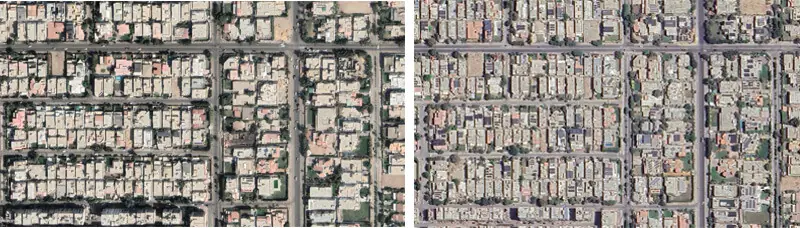
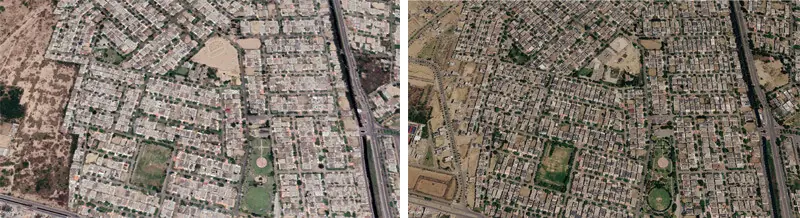
Using a Google Earth snapshot, Babar points to vast stretches of apartment buildings in Karachi largely left out of the country’s solar rush, compared to rooftops of nearby bungalows dotted with solar panels.
THE HIDDEN BARRIERS
But not all barriers are due to government policy.
Who owns the roof, who controls it, and who gets to use it? These are the basic questions that need to be answered before any installer agrees to do the work.
“In my experience, people living in penthouses often own the rooftop and, if that is the case, our work is pretty straightforward, like solarising a bungalow,” says Jalisi. In the last six months, the company he works for has installed solar systems in approximately 300 homes, but only 60 apartments.
“Getting an apartment’s file moved from one K-Electric department to another takes forever, compared with a bungalow’s,” he says. “There are just too many clauses that need to be adhered to,” Jalisi adds.
Structural constraints are another major roadblock, says TKF’s Andrews. “Not all apartment blocks will be able to fully utilise solar because rooftop and balcony space cannot expand as buildings become taller and denser,” he asserts.
As more people move into the same building, he adds, electricity demand rises, but the building’s physical infrastructure may not be able to accommodate it.
“The biggest issue in my apartment block is the building’s design — it’s an old structure and may not be able to support large photovoltaic panels on the rooftop,” explains F.N. Ahmed. Then there’s the question of who pays, she continues.
“Not everyone owns an apartment — some are tenants. People are also unsure whether the system would be properly maintained once installed,” she points out. “Keeping the panels clean is itself a challenge.”
The shift to net-billing has added another hurdle: batteries. “People now have to invest in storage and figure out how to share the cost,” Ahmed says. Ahmed would go solar, but only if her building’s residents agree to invest collectively.
For now, says Jalisi, most apartment blocks embracing solar are using it for common areas — powering water pumps, lifts and corridor lighting — to contain rising building maintenance costs.
Jalisi does not recommend small individual systems on sun-facing balconies, citing safety concerns.
“What if the panel is blown off by high-velocity winds?” he asks. Solarising individual apartments also poses practical challenges, including drilling and boring, running cables through common areas, and finding a properly ventilated space for inverters and batteries.
GRID UNDER PRESSURE
Four years ago, Ahsan Haider, a top-floor resident of an apartment block in a housing society in Scheme 33, took the plunge, installing a 7kW rooftop solar system and a 5kWh battery in his lounge. “I took permission from my landlord to use the space,” he says. It is worth noting that even then, apartment dwellers could not sell excess electricity to the grid through net-metering.
Once he had access to the rooftop, the sun did the rest for Haider. “When you use solar, you begin to use energy without guilt.”
The payoff has been a 70 percent cut in the family’s electricity bill. They’ve also learnt to make the most of their solar system. The seven-member household now runs three ACs from 9am to 5pm, then switches to battery power. By midnight, when the battery runs dry and peak electricity tariff time ends, they return to the grid — but use the ACs more sparingly.
For households that can make the switch, solar has brought both savings and greater control over when and how they use electricity.
But that shift is also putting pressure on the traditional grid-based model.
Babar says the government’s recent policy shift has been from “help people get solar” to “protect what’s left of grid revenue.” When net-metering was introduced in 2015 with attractive buyback rates, the state sought to spur rooftop solar. Falling panel prices helped drive the uptake in the years that followed, she says.
“These policy changes have unsettled the economics of rooftop solar and, for many consumers, the decision of whether to make the transition,” agrees Jalisi.
BATTERY RUSH
But this year’s shift to net-billing is changing how consumers approach solar. “In a strange way, net-billing is tightening the door for the smaller, visible slice of adopters,” says Babar. However, she adds that the much larger wave keeps happening “completely outside anyone’s control or planning.”
Even K-Electric admits the increased solar generation trend is reshaping the utility’s load profile. “It has reduced daytime demand from the grid, particularly among good paying residential and commercial users,” says the company’s spokesperson. “Consumers still rely on the grid in the late evening, when solar generation falls and batteries run down,” the spokesperson adds.
But this nighttime reliance may change too, for many.
When the prosumers regulation was put in place, many had warned that net-billing would push consumers toward a total grid defection. Member of National Assembly Dr Nafisa Shah had warned of a “battery rush”, which is now happening.
Until recently, there was little incentive for solar users to invest in batteries, says Babar. Between 2018 and 2023, battery energy storage system (BESS) imports remained relatively low, ranging from 0.2 to 0.5 gigawatt-hour (GWh). But in 2025, imports surged by 220 percent to 4.6 GWh. “Storage has already moved from a niche add-on to a necessity,” she says.
Jalisi’s company is advising new and old clients living in bungalows in Karachi’s Defence, Clifton and now Scheme 33 to invest in batteries and opt for hybrid systems. Scheme 33, where Haider lives, experiences prolonged power outages due to kundas [illegal electricity connections] used by nearby goths [villages] and informal settlements. “The PMTs [pole-mounted transformers] are already at capacity, particularly in Defence, and cannot safely accommodate much more generation from rooftop solar,” says Jalisi.
THE SOLAR CHALLENGE
But the rush to batteries also raises a bigger debate on who can afford to make the switch.
For low-income, off-grid households, says Jalisi, even a small, battery-free system could power a few fans, lights, mobile charging and other essentials.
The affordability aspect is also true for some grid-connected households. Grid consumers using between 300 to 400 units could benefit from going solar. “A household using 350 units pays 37.99 rupees per kilowatt-hour from the grid, compared to an estimated 10 to 12 rupees from a solar system without batteries,” says Andrews.
Despite rising poverty and economic instability and so much policy change on solar energy, Pakistan is experiencing one of the world’s fastest solar revolutions. According to Ember, a global energy think tank, rising electricity demand between 2023 and 2025 was increasingly met by solar rather than the grid.
Distributed solar generation (solar power generated at or near the point of use) more than tripled, from 15 terawatt-hour (TWh) hour to 51 TWh, while grid generation fell by three percent.
The numbers point to a solar revolution largely beyond the formal system: by end-2025, Pakistan had imported roughly 51 GW of solar panels, against just 8.3 GW of licensed net-metering capacity. “A huge amount of solar in Pakistan was never even inside the regulatory system to begin with,” points out Babar.
As government policies push more consumers towards self-generation, solar’s share of the country’s electricity mix has jumped from 10 percent in 2023 to 28 percent in 2025.
From homes to agriculture and factories, Ember identifies transport as “the next frontier of electrification” — a shift that is already beginning to unfold in Pakistan.
Still, for millions living in apartments, the transition is not happening fast enough — not for lack of sunlight, but because access to rooftop space, ownership and, of course, money remains limited.
The writer is a freelance journalist
based in Karachi. X: @zofeen28
Published in Dawn, EOS, September 6th, 2026