It was in the mid-1990s that I watched The Bodyguard on VHS and fell in love with Whitney Houston’s rendition of ‘I Will Always Love You.’ Like millions of listeners, I associated the song entirely with Houston and that extraordinary voice.
It was only much later that I discovered that she had not written it: it was a Dolly Parton song.
That discovery sent me looking for Parton herself. In those days, discovering music required rather more effort than typing a name into a search box. In Karachi, there was a Radio City shop at Awami Markaz on Sharae Faisal, which I used to visit with my wife and little daughters. While the girls enjoyed their toys in the play area, I browsed through the Ferozsons Bookshop and Radio City. On one of those visits, I bought an audio cassette of Parton.
I heard her original ‘I Will Always Love You’ — so different from Houston’s soaring interpretation — and then worked my way through her other songs. Before long, many became favourites. More than three decades later, news of Parton’s death took me back not only to a singer but to a vanished Karachi of cassette shops, young children and music discovered by accident.
Dolly Rebecca Parton’s journey began far from Karachi, in rural Tennessee, where she was born in 1946, the fourth of 12 children. Her father was a farmer and construction labourer who could neither read nor write. She began writing songs as a child, appeared on local television at 10 and, after finishing school, headed for Nashville.
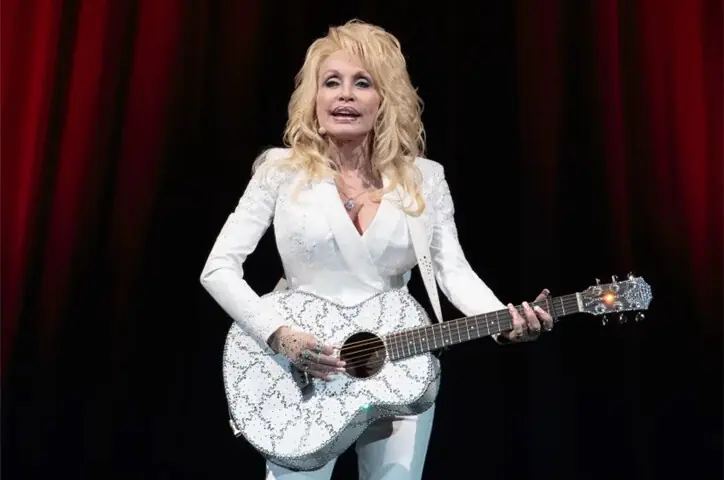
Singer, songwriter, actress, entrepreneur and philanthropist Dolly Parton, who died on August 25 aged 80, turned extraordinary success into an equally remarkable legacy of giving
What followed was one of popular music’s more improbable careers. ‘Jolene’, ‘I Will Always Love You’, ‘9 to 5’ and ‘Islands in the Stream’ escaped the boundaries of country music. Take, for example, the lines in the song ‘9 to 5’ — “Workin’ 9 to 5, what a way to make a livin’.”
The song depicts an ordinary office worker trapped in a system in which employees do the work while employers reap the benefits. Its major ideas are low pay, lack of recognition, workplace hierarchy, frustrated ambition and the exploitation of workers. That is why ‘9 to 5’ became much more than a catchy country-pop song: it functioned as a cheerful-sounding working-class protest song.
The song ‘Islands in the Stream’ is essentially about two lovers whose relationship gives them security in an uncertain world. An interesting point is that Parton did not write it. It was written by the Bee Gees and became a huge hit when Parton and Kenny Rogers recorded it in 1983.
The title itself was taken from Ernest Hemingway’s posthumously published novel Islands in the Stream (1970). Kenny Rogers and Parton formed one of country-pop music’s best-known duet partnerships, although they were never a romantic couple.
Parton became an actress, entrepreneur and television personality as well as a gifted songwriter. ‘I Will Always Love You’ was written in 1973 as a farewell to her professional partner Porter Wagoner. Almost two decades later, Houston transformed it for The Bodyguard. The two recordings reveal something fascinating about popular music. Houston turned the song into a vocal monument; Parton’s quieter original sounds almost conversational, exposing the vulnerability of the words.
Parton reportedly earned millions from Houston’s recording. What she did with some of the money revealed another side of her character. She invested royalties in property in a predominantly Black neighbourhood of Nashville and later delighted in describing the investment as something made possible by Houston’s money. Sentiment had become something tangible.
This helps explain why the Communist Party USA, in its tribute, described her as a “working class woman.” Parton was no communist and generally avoided partisan identification. Yet, the description catches something important. Her politics were less ideological than instinctive. She repeatedly sided with people getting a raw deal.
That included gender and racial minorities. She supported Black Lives Matter and opposed gender-based discrimination. Her achievement was to express inclusion without making political identity the centre of her public personality. Her most consequential composition may therefore have been not a song but an institution.
In 1995, she established the Imagination Library in her home county, inspired partly by her father’s illiteracy. It sent children a free, age-appropriate book every month from birth until five. The programme eventually expanded beyond the US to Britain, Canada, Australia and Ireland, distributing hundreds of millions of books. Its genius lay in its simplicity: a book arrived at home bearing the child’s own name.
As an educationist, I find this part of Parton’s life particularly moving. Governments across South Asia spend fortunes debating curricula, examinations and educational reform, while neglecting one of learning’s simplest foundations: putting attractive books into children’s hands early enough for reading to become pleasure rather than punishment. Parton understood something education ministries often forget. Literacy begins before examinations, and curiosity before classrooms.
Her philanthropy was similarly practical elsewhere. After the devastating Tennessee wildfires in 2016, her foundation provided direct assistance to affected families. In 2020, she donated one million dollars to the Vanderbilt University Medical Centre for coronavirus research, helping support research connected with the Moderna vaccine.
She also contributed to hospitals and other causes. There is a lesson here for South Asia, where celebrity philanthropy can sometimes mean little more than appearing at charity dinners. Yet, the region also has honourable counter-examples.
Pakistan’s Nazia Hassan is perhaps the most poignant. Like Parton, she crossed cultural boundaries through popular music while refusing to treat fame as an end in itself. Hassan supported charitable causes, worked with children and campaigned against drugs. Her death from cancer in 2000, aged only 35, deprived Pakistan of an artist whose humanitarian role might have become even larger.
Shehzad Roy provides an even closer institutional comparison. Through Zindagi Trust, he moved beyond occasional charity towards public-school reform, teacher development, child protection and educational policy. Like Parton’s Imagination Library, his work demonstrates that celebrity becomes socially valuable when it creates institutions that continue functioning after the concert has ended.
Across the border, Lata Mangeshkar and her family supported medical philanthropy associated with Pune’s Deenanath Mangeshkar Hospital. In Bangladesh, Runa Laila raised money for cancer treatment and served as a SAARC goodwill ambassador for HIV/AIDS. South Asian music has its own tradition of artists looking beyond the stage.
But Parton’s example raises the bar. Pakistani singers can learn from her that philanthropy should be systematic rather than episodic. A benefit concert helps once; an institution can help for generations.
They can also learn to connect philanthropy with lived experience. Parton remembered her father’s inability to read and built a literacy programme. Shehzad Roy turned towards education and Abrar-ul-Haq towards health. The most durable philanthropy often begins with a problem its benefactor understands.
There is an economic lesson too. Parton did not apologise for becoming rich. She built businesses, protected her songwriting rights and understood the commercial value of her image. But wealth acquired a social obligation.
That matters in South Asia, where artists rightly complain about piracy, weak copyright protection and exploitation. Artists should own the fruits of their creativity: ownership provides both independence and the means to give something back.
The writer is a columnist, educator and film critic. He can be reached at mnazir1964@yahoo.co.uk
Published in Dawn, ICON, September 6th, 2026