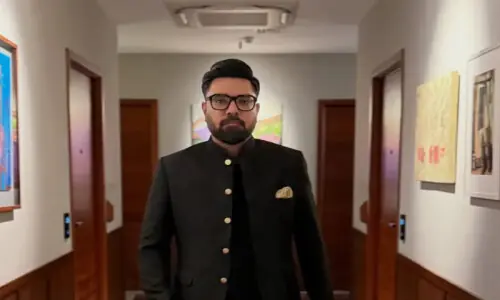
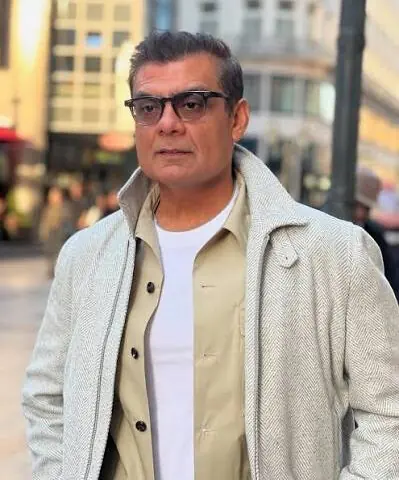
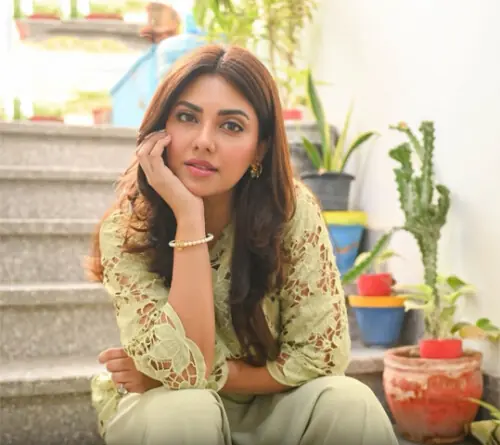
“Do you really enjoy playing jackasses?” I ask British-Pakistani actor Ahsan Khan, off the bat, as we sit down for this interview at a quiet café in Karachi. I actually use a much ruder slang word that would perhaps be inappropriate to print here.
It feels like an appropriate way to begin a conversation about the actor who has spent much of his career deliberately moving away from the conventional good-looking hero.
For a millisecond, he appears shocked, then lets out a big belly laugh. “Playing a typical ‘good guy’ or a typical hero is kind of monotonous,” he explains. “It’s not interesting anymore.”
Khan has played those kind of heroes, of course. But, over the years, he has become increasingly interested in characters with contradictions — men who can be loving and cruel, vulnerable and selfish or sympathetic and infuriating.
From the disturbing Imtiaz in 2016’s Udaari to the deeply flawed Tabish in Aap Ki Izzat currently on air, the actor has spent years deliberately stepping away from the conventional screen hero. Why, after more than two decades in the industry, does he now gravitate to problematic, contradictory and, sometimes, downright cruel characters?
His latest role, as Tabish in Aap Ki Izzat, sits squarely in that territory. Written by Umera Ahmed and directed by Saife Hassan, the drama follows Tabish and Beena (Urwa Hocane), a married couple whose relationship gradually deteriorates. What makes the story particularly uncomfortable is that it does not begin with a bad marriage. It begins with love.
“We’ve seen so many dramas where the couple tries very hard to get married, and then the story is over,” Khan says. “It’s presumed they live happily ever after.”
Aap Ki Izzat begins where those stories usually end. “The gradual deterioration of relationships and how it’s the little things that really matter… That’s the reality,” he adds.
I’ve interviewed Khan several times and each time I find him to be very open, easy to talk to, curious about life and as excited about his family life as he is about his work. While he takes his work seriously, he doesn’t seem to take himself seriously.
He’s grown up on screen. In person, you can spot laugh lines around his eyes that seem to add character. I tried scanning his face for tell-tale signs of aesthetic enhancements — a little filler here and there — and, to my shock, found none.
For those living under a rock, Khan is an actor, producer and television host whose career spans more than two decades. From early film roles to acclaimed television performances in Dastaan, Udaari and Alif, Khan has steadily moved beyond the conventional leading-man mould to embrace more complex, morally ambiguous characters.
His role in Aap Ki Izzat has once again put his acting range in the spotlight, with the drama’s exploration of marriage, masculinity, emotional neglect and men suffering the consequences of their actions resonating strongly with audiences.
NOT BLACK OR WHITE
Khan is quick to point out that he does not see Tabish as an outright villain.
“I like grey characters,” he says. “As an actor, I want to explore all that I’ve not done and still prove to the audiences, myself and people around me that I’m much better than what you think.”
For Khan, the problem with conventional heroes and villains is that they are often too obvious. “In Asia, when they write a character, they go to an extreme. A villain will look like a villain, laugh like a villain, give expressions like a villain and the hero is a hero pro max. An angel. All that’s left is attaching wings to him.”
Real people, he argues, are rarely so straightforward. “Grey characters move me because I feel like there is more of a margin. You can give different shades. And that’s how to tell how deep that character is.”
Tabish certainly has shades. He is selfish and emotionally neglectful, but he is also affectionate towards his children and deeply attached to his mother. He can be cruel to Beena and then crumble with regret.
“He is an idiot,” Khan says, laughing. “Aur foran nazar aa jata hai. [“And you can see it immediately.”] He wanted the audience to see that side of him early on.
“I had to define at the start how badtameez [rude] this guy is. So badtameez that he compels his wife to leave the house. But his regret also shows that he’s sensitive. He’s a bit of a crybaby as well.”
“Really?” I ask him.
“Bohat rota hai, yaar [He cries a lot, man],” says Ahsan. “I’ve never seen a man who cries so much. He does stupid things and then cries [at the consequences of his own actions].”
How television portrays men, marriage and masculinity is changing, and that contradiction is what Khan believes makes Tabish interesting.
MEN, MARRIAGE AND MASCULINITY
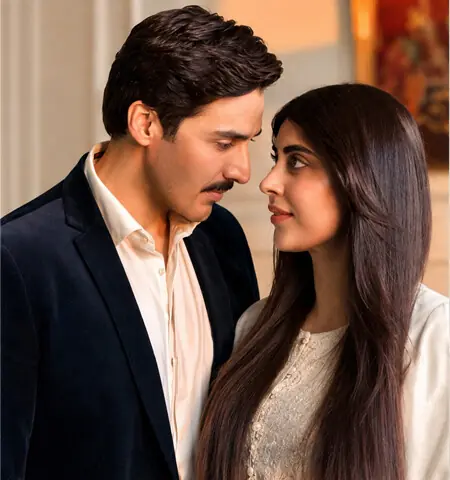
The drama has generated considerable discussion because Tabish’s behaviour is recognisable. He is not an extraordinary monster. He is a man who has convinced himself that fulfilling his conventional duties — particularly providing financially — is enough and that leaves him to do whatever he wants — including cheating on his wife, something he seems to deeply regret when the consequences of his actions catch up with him.
“He’s taken Beena completely for granted,” Khan says. “He thinks she’s there. And her duty is defined.”
Tabish has grown beyond the life he and Beena began with. His ambitions have changed, as have his ideas about the kind of woman who belongs in his new world. “He’s expecting to live his life the way he wants, get into politics, find a new, educated woman. In his new world, his old wife doesn’t fit in.”
But there is another irony: Tabish has grown while Beena has not had the same opportunity. “Tabish has grown a lot from the time he first met Beena. His wife hasn’t been able to grow the same way as him. She’s been busy doing so much more.”
Khan believes a marriage requires both people to evolve together.
“I’ve spoken before about the importance of taking your partner with you on your journey of growth.” That is where he sees Tabish’s greatest failure. “He just left his wife, didn’t encourage her growth, essentially discarded her. She didn’t see it coming.”
Playing the character made Khan reflect on his own marriage. When Tabish calls Beena fat, for example, Khan says the scene stayed with him.
“Our society cracks these kinds of jokes all the time, not realising that not everyone can take it or how damaging it is. It forced me to introspect: had I ever said anything like that to my wife? What must she have been going through?”
He believes Pakistani society remains too attached to rigid gender roles. “We’ve defined gender roles very strictly in our society. And no matter how hard you try to fulfil those roles, they don’t necessarily make you a good companion.”
Those roles, he says, belonged to a different era. “Now people are more aware. They want more from life. Our expectations have changed. Now we question each other more. Being emotionally intelligent, having a spiritual connection, fostering an understanding between each other — that’s what makes true companionship.”
FROM HERO TO VILLAIN
It is a philosophy that has shaped Khan’s career. In 2016, he took on one of his biggest departures from the conventional leading man in Udaari, playing Imtiaz, a predatory man in a drama that confronted child sexual abuse. The role was disturbing precisely because Khan had been so strongly associated with romantic heroes.
“At the time, I was getting a lot of roles where I was the young hero,” he says. “And there were other really good-looking heroes coming out as well. How would I stand out?”
His answer was to challenge the image audiences had of him. “I wanted to show diversity in my acting portfolio, so people would stop focusing on just my looks and talk about my craft.”
Some people thought Udaari might damage his career. “A lot of people felt back then that I’d ruined my career by playing a villain,” he recalls. Instead, it became a turning point.
Then came projects such as Alif, Umera Ahmed’s spiritual drama, in which Khan played Taha Abdul Aala and, more recently, Zanjeerain. Khan considers Udaari, Alif and Aap Ki Izzat among the projects that have affected him personally.
“The script of Alif gave me goosebumps,” he admits. “The dialogues are so spiritual. In Aap Ki Izzat, there are little things that force me to introspect about my own behaviour. I’ve always tried to play meaningful roles, jo meray liye screen pe dikhanay ke qaabil hon [that I think are worth being shown on screen]. It doesn’t have to be a social issue or cause-based. It can also be purely for entertainment, but they should be pivotal roles.”
AGEING WITHOUT APOLOGY
Khan is also increasingly comfortable with something the Pakistani entertainment industry has not always been particularly good at: letting actors grow older.
In Aap Ki Izzat, he and Hocane play parents of older children. Their roles are shockingly age-appropriate. The drama also moves between their present-day lives and their younger selves.
Khan points out that Pakistani television has done this before. He recalls classic PTV productions, including Tanhaiyaan, Andhera Ujala, Guest House and Sona Chandi, in which mature characters were central to the stories rather than peripheral figures.
“We speak from selective memory,” he says. “We form our perceptions based on what’s happening now.” He admits, however, that much of contemporary television remains youth-focused.
When it comes to his appearance, Khan appears less interested in fighting the passage of time. “Actors are generally insecure. It is so stupid of actors to believe that they will always look the same,” he says. “When you’re younger, you’re a little dumb. Don’t you love growing and evolving your mindset?”
For the younger versions of Tabish and Beena, wardrobe, hairstyles and attitudes were changed. For their older versions, make-up, lighting and camera angles were used to convey their age. He is delighted by the process.
The answer to the question, ‘How do you age gracefully on screen?’, for him, seems to be: allow yourself to age.
LIVING OUTSIDE THE BUBBLE
Despite decades in the public eye, Khan does not appear particularly interested in living like a celebrity.
His old “here and there” interview — in which he described his life between Pakistan and the UK — became a meme years after it was recorded. Rather than becoming defensive, Khan embraced it.
“I gave such a legendary line to the world,” he laughs. Friends sent him “here and there” T-shirts, caps and even a car. He wore them and took photographs. “If my civic sense is good, I haven’t morally done anything wrong with anyone, why should I be embarrassed?” he asks.
The same thick skin appears to extend to criticism of his appearance, although he admits that being an actor means constantly negotiating the camera. “I’m a foodie. I love food, so my weight does fluctuate,” he confesses.
Exercise and diet have therefore become part of the job. He is also aware that people’s attitudes towards him can change with his appearance. Yet, his family provides a useful counterbalance to the artificial glitz and glamour world of celebrity. His wife and children do not treat him like a star.
“She keeps me grounded,” he says about his wife, “and that’s how my kids are also trained to be. They sometimes laugh at me when they see me on screen: ‘Baba yeh kya hai?’ [Dad, what is this?]
“I go through hell at home!” he laughs. It’s the kind of hell that sounds quite wholesome. “It’s healthy, so all of this doesn’t get to my head. Otherwise, you start living in this artificial bubble. Acting is my work, it’s not all of me. My identity as an actor is for everyone, but the rest is for my family and me and I want to enjoy that too.”
THE ANXIETY OF GETTING IT RIGHT
There is something almost paradoxical about an actor with so many years of experience still describing himself as anxious before a new role.
“I’m leaving for another shoot in two days and I’m still jittery, unsure, lost about it.”
Even on the morning of our interview, he had been thinking about how he needed to look for his next character. “I’ll wake up and my first thought will be: how do I look like that character? How do I play this role? Okay, I’ll practise in the mirror later.” He laughs. “Am I mad?”
Perhaps that anxiety is part of what keeps him from becoming complacent.
“What scares me more?” he repeats when asked whether he fears playing a role badly or repeating himself. “Playing a role badly. It’s the worst fear.”
The acclaim for Aap Ki Izzat has only increased that pressure. “The praise I’ve been getting is making me so anxious about how I’m going to act in my next project. But I know, once I’m on set, I’ll somehow know what to do.”
That instinct has carried him from the romantic hero of his early career to Imtiaz in Udaari, the spiritual world of Alif, and now the flawed, infuriating and strangely vulnerable Tabish.
Is there still a version of Khan audiences haven’t seen? “Of course,” he says. “So many.” Then, with the confidence of someone who knows he has no intention of stopping, he adds, “They haven’t seen anything yet. There’s a lot more to come.”
For now, there is Tabish — flawed, infuriating, sensitive, selfish, sometimes tender, frequently foolish. A man who believes that providing is enough until life forces him to discover everything he has failed to provide.
And perhaps that is what Khan finds most compelling about acting: not becoming someone completely different, but observing the world closely enough to find all the different ways a human being can be. His advice to younger actors reflects the same philosophy. “Focus on your craft and stop over-expecting. Always have a plan B and C. Think of the best but always prepare for the worst.”
Most importantly, he says, avoid comparison. “It’s going to destroy your life. It stops showing you what you have. You’ll stop counting your blessings.” It is advice that sounds less like a celebrity’s career prescription and more like the lesson of someone who has spent a long time learning how not to be trapped by his own image.
Ahsan Khan, after all, has already played the hero. He is much more interested in finding out who else he can be.
The writer is a journalist, an award-winning documentary filmmaker and a radio correspondent.
She can be reached at syed.madeeha@gmail.com
Published in Dawn, ICON, September 6th, 2026