Pyramids and Xixia imperial tombs link ancient civilisations
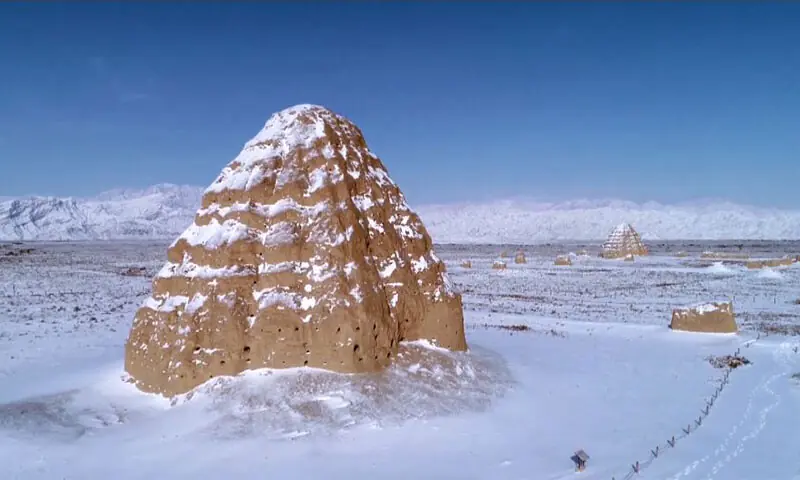

AS China and Egypt mark 70 years of diplomatic ties, the two ancient civilisations are building on a relationship with roots stretching back to the ancient Silk Road.
Egypt’s pyramids and China’s Xixia imperial tombs offer distinct windows into their respective histories and cultures. Today, the two countries are bringing these cultural legacies into closer dialogue and expanding exchanges between their civilisations.
The Xixia imperial tombs, west of Yinchuan, Ningxia, cover 40 km² with nine imperial mausoleums and 271 satellite tombs. Dating from 1038 to 1227, they blend Central Plains symmetry with distinctive northwestern innovations. Listed in 2025 as China’s 60th World Heritage site, they highlight Silk Road-era cultural exchange and architectural creativity.
The tombs are a crucial witness to the cultural fusion and innovation that characterised the Xixia Dynasty. As a distribution center on the Silk Roads during the 11th to 13th centuries, the dynasty served as a melting pot of diverse ethnic groups, modes of livelihoods, and cultures.
The tombs stand as a testament to the dynasty’s ability to assimilate external influences while preserving its unique identity. The inscription of the tombs as a World Heritage site signifies their outstanding universal value, reflecting the shared historical memory of the Chinese nation and the collective creativity of China’s ethnic groups.
Preservation efforts have been ongoing since the 1970s, with significant progress achieved in recent decades. China’s National Cultural Heritage Administration and local governments have implemented comprehensive protective systems and rules to ensure the site’s authenticity and integrity. Conservation experts have contributed advanced techniques for protecting the earthen sites, addressing challenges such as erosion, water damage, and structural instability. Collaborative efforts with institutions like the Dunhuang Academy have led to successful restoration methods, such as complementing eroded bases with materials that mimic ancient construction techniques.
Published in Dawn, September 7th, 2026