International law prevails


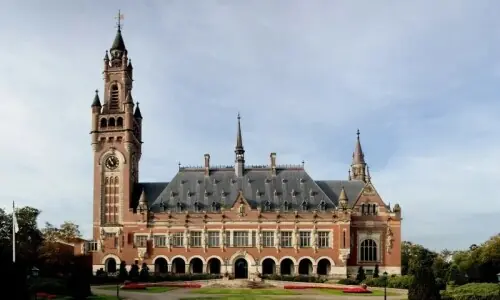
IN its recent press release on ‘The Indus Waters Western Rivers Arbitration (Pakistan vs India), PCA Case No. 2023-01’, the Permanent Court of Arbitration has delivered an award in favour of Pakistan. The award, issued on Aug 31, 2026, strongly vindicates Pakistan’s position, which it has consistently maintained in diplomatic forums and in the international media. It illustrates that the principles of international law firmly support Pakistan’s case. Established in 1899, The Hague-based PCA is one of the world’s oldest institutions for the peaceful resolution of international disputes. It has earned considerable international standing for the integrity of its proceedings, the quality of its decisions and the calibre of the jurists who serve on its tribunals. It shares its premises with the International Court of Justice (ICJ).
Those who authored this verdict — the details of which will be made public soon — were selected under the procedure prescribed in Annexure G (Court of Arbitration) to the Indus Waters Treaty (IWT), which requires arbitrators to be well versed in international law. Accordingly, the PCA is chaired by Prof Sean D. Murphy (US), a prominent international law scholar and practitioner. He sits alongside Prof Wouter Buytaert (Belgium), a specialist in hydrology and water resources; Prof Jeffrey P. Minear (US), an experienced legal practitioner; Judge Awn Shawkat Al-Khasawneh (Jordan), a former ICJ judge; and Dr Donald Blackmore (Australia), an expert in water-resource management and policy.
Pakistan had initiated proceedings, saying, “Look, the continued construction of two Indian hydropower projects violates the engineering requirements laid down in Annexes D and E of the IWT”. These requirements had been designed to ensure that water flowing to the lower riparian was not obstructed by engineering deviations in upstream projects. The concern, therefore, was that the construction by India, the upper riparian, in territory it controversially controls and occupies, could interfere with the flow of water intended to continue downstream to Pakistan. India had sidestepped this allegation by controverting the jurisdiction of the PCA and maintaining that the matter should only be brought before a neutral expert under Annexure F as it concerns “technical differences” rather than a “legal dispute”. Notwithstanding these objections, the court continued the hearing regarding the controversial hydroelectric projects.
The Permanent Court of Arbitration’s award in favour of Pakistan vindicates this country’s position.
Then on April 23, 2025, following the Pahalgam attack, India announced that the IWT would henceforth be held in abeyance. At this juncture, the PCA, seeking to satisfy itself that it possessed the requisite jurisdiction, invited both parties to make submissions. India, however, again chose to stay away. In contrast, Pakistan has always opted to participate in strategic litigation of this nature. In both the Kulbhushan Jadhav and Republic of the Marshall Islands cases before the ICJ, Pakistan overcame its initial hesitation. It chose to participate in the proceedings — a consequential decision that ensured its legal position was represented and defended before the court. The reasoning for this rests on an age-old law: if a party wishes to challenge a court’s jurisdiction, it must appear before that very court and object.
Even though Indian officials unleashed venom against the PCA and its proceedings, the court’s procedural wheels continued to turn. Eventually, it gave the present award, which destroyed New Delhi’s political basis for holding the IWT in abeyance.
The court approached the matter with considerable care. Rather than treating India’s refusal to participate as an opportunity to proceed on Pakistan’s case alone, it independently examined the legal arguments and factual circumstances that might have supported India’s position on placing the IWT in abeyance. The court went so far as to consider material available in the public domain, including statements by Indian officials explaining the reasons advanced for India’s decision.
The PCA then turned to the possible legal grounds on which India might seek to justify placing the treaty in abeyance. It examined whether the circumstances surrounding the IWT had fundamentally changed since 1960, taking into account demographic shifts, India’s growing demand for clean energy, advances in dam technology, and the effects of climate change. None, in the court’s view, met the demanding threshold required under international law to justify suspending or terminating a treaty. The PCA also considered India’s allegation that Pakistan’s frequent invocation of the dispute-resolution process constituted a material breach. Here too, the argument did not hold, and India could not establish a material breach on these grounds. The court held that this type of treaty couldn’t be treated as suspended even during armed conflict. Most importantly, it found that the IWT was intact and remained binding on both sides.
Allegations of cross-border terrorism against Pakistan have long occupied a prominent place in India’s political discourse. India expressly relied upon it in its April 2025 communication placing the IWT in abeyance, and alleging that Pakistan’s support for terrorism had undermined the basis on which the IWT could continue to operate. The PCA press release states that the court took this allegation extremely seriously, yet came to the conclusion that the act of terrorism was extraneous to the IWT and did not pertain to the treaty framework. The PCA went on to say that even if terrorism allegations against Pakistan were true, they would not be valid grounds for breaching the IWT. This was a very significant finding from Pakistan’s perspective, and it exposed the absurdity of Indian arguments against Pakistan, based on the latter’s unproved responsibility for the acts of terrorism.
The court’s interim measures effectively halt further construction and concreting by India while the neutral expert continues his examination of technical issues. Until that process is completed, India is expected to stop any work that could prejudice the proceedings or alter the position on the ground. We can discuss the consequences of any failure to comply — as well as the wider implications of the ruling — once the detailed award is released.
After the PCA’s verdict, the legal position is very clear: if you try to bring in political issues or issues extraneous to the IWT — which is a technical treaty — and such objections are taken up by any objective forum, defeat will be the writing on the wall — and that is what has happened with the Indian side.
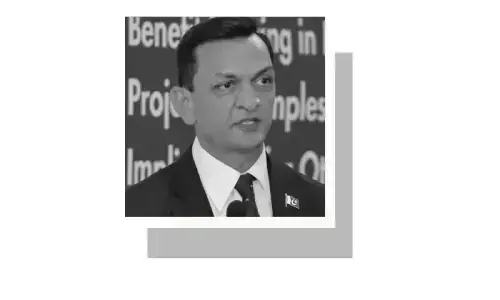
The writer is a former caretaker law minister.
Published in Dawn, September 7th, 2026