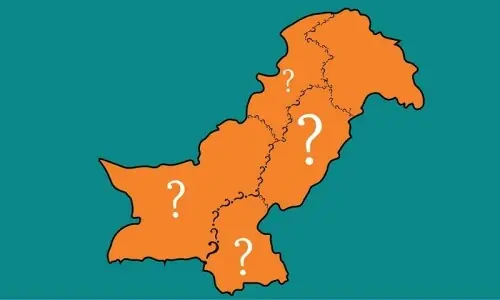
IT has been quite something to watch a whisper become, in a matter of weeks, the state’s new “number one priority”. The trigger was the interior minister’s surprising admission at the Pakistan Economic Summit in late July that the present system had “collapsed”, and that new provinces and administrative reform were therefore urgently needed.
The political earthquake was immediate. For the PPP, already fuming over the AJK election, it was an insult added to injury. The president’s abrupt departure for London has since fed a good deal of speculation. Some believe that he went to press his allies in government to drop the idea altogether. Others have pointed out that his exit echoes another, years ago, when the PPP was being asked to make choices it considered political suicide. What can be said with certainty, however, is that an impasse has been reached.
The president had met the interior minister in London. Their interaction was recorded and shown in the media. It does not seem to have gone fruitfully. On his return, the minister doubled down on the need for new administrative units. The PPP answered with a Sindh Assembly resolution rejecting new provinces, and with speeches declaring “no compromise” on the province’s geographical unity.
The Sindh Assembly resolution deserves much more attention than it received given the implications for the drive for more provinces. Under Article 239(4) of the Constitution, the limits of a province cannot be altered unless the amendment is first passed by that province’s own assembly by a two-thirds majority. Sindh seems to have made its position plain by, at least symbolically, vetoing the proposal before it arrived at its door.
Before the country is dragged through another ugly crisis, those pushing for new provinces must explain how they intend to clear the bar set by the Constitution. They should also share what the new assemblies, secretariats and offices will cost, and where the money is to come from when citizens’ own pockets are already empty. There is no question that Pakistan needs better administrative management, but the stated end of restructuring — ie, better service delivery at the grassroots — is already provided for in Article 140A, and could be achieved far more cheaply by reviving, resourcing and actually holding elections for local governments.
Here, the political parties also share blame. They have spent decades hollowing out the LG system and alienating the citizenry. Any party that is unwilling to empower even a district council should not be arguing that the province is the only unit that matters. Therefore, though the LG system remains a less politically toxic option, it will only be considered an option if the political parties themselves make a renewed commitment to it. This is something they, too, must understand.
Published in Dawn, September 8th, 2026