Vaccination of 100pc children against polio in KP still big challenge
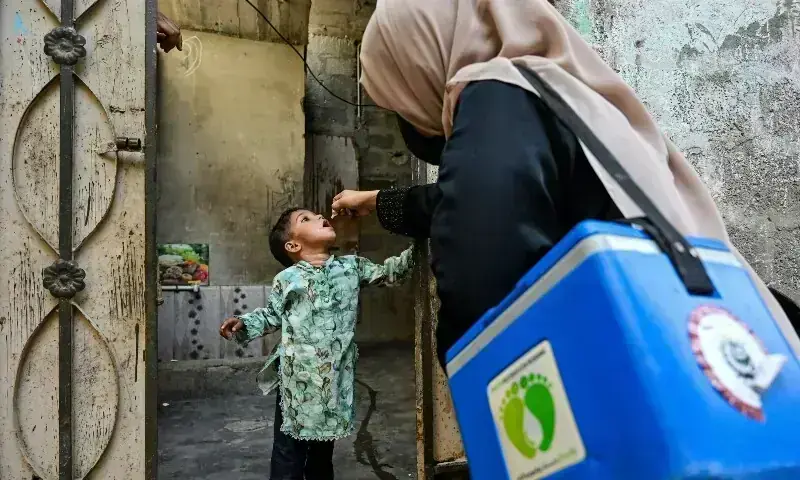

PESHAWAR: Emergency Operation Centre Khyber Pakhtunkhwa has planned to accord priority to high-risk districts in the upcoming nationwide polio vaccination campaign due to consistent emergence of positive environmental samples from Peshawar which is frequented by people from those areas.
Some districts bordering Peshawar may not have polio cases or positive samples for a long time but since the provincial capital is positive most of the times, so its bordering areas have also been bracketed as priority districts, according to experts.
World Health Organisation collects samples from 34 sites in Khyber Pakhtunkhwa monthly or bimonthly to see if the virus exists. Reports about Peshawar from March to July have been positive due to which authorities are focusing more on the adjacent districts.
Samples are taken from six sites in Peshawar. Of these, two each turned positive in March, April and June and one each in May and July.
High-risk districts to remain under focus in upcoming campaign
Bannu is another district where poliovirus is in circulation as per the result of environmental sample since October last year to March 2026. Positivity from environmental samples means that live poliovirus has been found in community sewage or wastewater, showing that the virus is actively circulating in the area.
Therefore, experts argue, it serves as warning that virus can spread and can infect children. “If no case is recorded from any area but samples are positive, it serves as wakeup call and warrants immunisation,” they add.
Pakistan has recorded three polio cases in 2026 so far, which include two from Khyber Pakhtunkhwa and one from Sindh. Bannu and North Waziristan districts in KP have one case each. In 2025, a total 31 polio cases were reported in the country including 20 in KP, nine in Sindh and one each in Gilgit-Baltistan and Punjab.
Of the total 22 districts identified as priority areas in the September 22 drive, some face security situation, which is hampering smooth-sailing of the campaign.
Recently, a high-level meeting of deputy commissioners, presided over by Chief Secretary Shahab Ali Shah, was meant to ensure foolproof security for vaccinators to ensure quality vaccination in areas where law and order situation was blamed for poor immunisation in the past.
In security-compromised districts, vaccinators often faced issues due to which they couldn’t reach children. In many of such districts, vaccinators were forced to register children as being vaccinated without giving them drops.
Data shows that a total of 93 people have been killed by alleged terrorists in KP since 2012, including 61 policemen, 27 health workers and five civilians. Also, 173 people, including 124 policemen, 28 health workers and 21 civilians, have been injured in attacks on polio teams.
During this period, 32 health workers, three civilians and one policeman were kidnapped during vaccination campaigns.
Of the people who were subjected to violence in the shape of death, injuries and kidnapping, 283 were men and 18 were women, according to an official report.
Pakistan and Afghanistan are the last two countries in the world where polio remains endemic. Challenges such as security issues, vaccine hesitancy, and misinformation have slowed the progress of eradication efforts. In every campaign, health workers reach above 97 per cent children but less than 3 per cent of them miss the drops due to refusal by their parents or inaccessibility.
WHO and Unicef, the main supporters of anti-polio campaign, have been able to provide quality vaccine and reduce refusals but the challenge is to ensure vaccination of 100 per cent children to be able to make the province polio-free. It is possible by improving security and creating demand for the vaccine.
Experts say that priority districts include Bajaur, Bannu, Charsadda, Dera Ismail Khan, Dir Lower and Upper, Hangu, Karak, Khyber, Kohat, Kurram, Lakki Marwat, Mansehra, Mardan, Mohmand, North Waziristan, Orakzai, Peshawar, South Waziristan Lower, South Waziristan Upper, Tank and Torghar. These districts will remain under special focus during the upcoming drive.
Published in Dawn, September 9th, 2026