Sindh Assembly forms 11-member body to examine amendments to local govt law

• Seven lawmakers belonging to ruling PPP, four from opposition parties tasked to submit report within a week
• Proposed changes to allow outgoing mayors, chairmen to continue as administrators until next elections
• Sharjeel says govt has taken several steps to improve transport sector
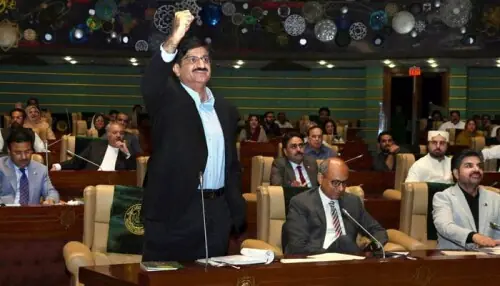
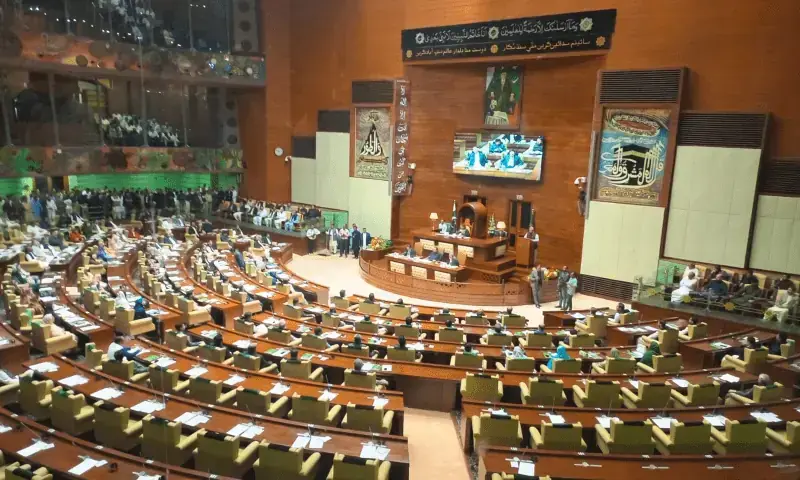
KARACHI: The Sindh Assembly on Wednesday constituted an 11-member special committee to examine the Sindh Local Government (Amendment) Bill, 2026 that proposed major changes to the local government law of 2013, including continuation of outgoing mayors and chairmen as administrators after expiry of their terms.
The committee is comprised of members from the both sides of the aisle with an overwhelming majority of the ruling Pakistan Peoples Party members.
The special committee members are Law and Parliamentary Affairs Minister Ziaul Hasan Lanjar, Jameel Soomro, Jam Khan Shoro, Qasim Soomoro, Saleem Baloch, Sumeta Afzal and Saeed Ghani of the PPP; Iftikhar Alam and Taha Ahmed of the Muttahida Qaumi Movement-Pakistan; Muhammad Shabbir Qureshi of the Pakistan Tehreek-i-Insaf and Jamaat-i-Islami’s Muhammad Farooq.
The bill, tabled by Mr Lanjar, also allows councils to establish institutions independently or through public-private partnerships.
Under the proposed amendment to Section 21, the government will be required to request the Election Commission of Pakistan 120 days before the expiry of a council’s term to hold fresh elections within 120 days.
Crucially, the bill provides that on expiry of a council’s term, the outgoing mayor or chairman will continue to exercise powers and perform functions of the council as “Administrator” until the newly elected head assumes office.
It also empowers the government to entrust the duties of a deputy mayor or vice-chairman to another member if the officeholder is absent from Pakistan or unable to perform functions.
The bill proposes insertion of a new Chapter VII-A to establish “Reconciliation Forums” in every union council, union committee, town committee and municipal committee.
Each forum will consist of a panel of three conciliators, nominated by the council from among residents “known for integrity, sound judgement, and respected standing”.
The forum will be tasked with amicable settlement of local disputes in accordance with prescribed procedures. Conciliators will hold office for the term of the council and can be removed for “consistent partiality or malpractice”.
Two new entries have been added to Schedule-IX. UCs will now be responsible for identifying solid waste management issues and building control violations and unauthorised constructions within their jurisdiction, and for sharing information with relevant authorities for action.
Other amendments include addition of detailed maps of public service infrastructure to documents.
The speaker referred the bill to the special committee, which has been tasked to submit its report within a week.
The house also passed the Sindh Motor Vehicle (Amendment) Bill, 2026.
Excise Minister Mukesh Kumar Chawla said that the amendment relates to car dealers.
“Earlier, a penalty was imposed if a vehicle was not registered within a month. Now, no penalty will be imposed for six months if the vehicle remains at the showroom,” he said.
Call attention notices
Responding to a call attention notice given by MQM-P’s Qurat-ul Ain Khan, Senior Minister Sharjeel Inam Memon said that the provincial government had taken several steps over the last two to three years to improve the transport sector and provide citizens with safe and modern travel facilities.
He said that the government had banned the use of CNG and LPG kits in small wagons and vans to prevent accidents. “These vehicles are used not only for inter-district and intra-city travel but also for transporting school-going children. Their safety is the government’s top priority,” he said.
Mr Memon said that fitness certificates had been made mandatory for all relevant vehicles, and the fitness and route permit system had been digitalised over the past year.
“In the past, records were maintained manually and there was no complete record of route permits and other documents,” he added.
The minister said that Sindh was the first province in the country where the process of digitalising the transport fitness and route permit system had been initiated.
He said that strict action was being taken against vehicles with incomplete documents or drivers without valid licences, and that unfit vehicles were being taken into custody.
Mr Memon said that the provincial government had also introduced a third-party liability insurance system to ensure timely compensation to victims in case of accidents.
He said traffic safety measures and vehicle checking were ongoing, especially around Eid and other festivals, and that violators were being fined. “Fire safety arrangements have also been made mandatory for relevant vehicles,” he added.
Referring to traffic congestion in Karachi, Mr Memon said that bus routes from the inner city to Taj Complex, Saddar and Cantt had been changed to reduce pressure. “For the convenience of passengers, a free shuttle service has been started from Taj Complex, Cantt and other locations,” he added.
The senior minister said that the free shuttle service was an expensive arrangement, but it was aimed at providing convenience to the people of Karachi and across Pakistan.
‘Water shortage can’t be resolved until K-IV completion’
In reply to a call attention notice by MQM-P’s Abdul Waseem on water shortages, Parliamentary Secretary for Local Government Qasim Soomro said that the problem in Karachi would not be resolved until the K-IV project was completed.
On open storm drains in Shah Faisal and Green Town raised by JI’s Muhammad Farooq, Mr Soomro said it was the responsibility of the KMC and repair work would be carried out on remaining portions.
MQM-P’s Aamir Siddiqui said that garbage had been lying in front of Jamia Binoria seminary. “It is claimed that the 18th Amendment brought great benefits. The ‘benefit’ we got is that assembly members now have to beg to get garbage lifted,” he remarked.
He said that members wrote letters to the Sindh Solid Waste Management Board, but no notice was taken. “To get the garbage removed, we are forced to bring call attention notices to the house,” he said.
Published in Dawn, September 10th, 2026