FO says Makkah defence pact 'defensive' in nature, expansion currently 'not on the cards'

The Foreign Office (FO) said on Thursday that the Makkah Defence Alliance between Pakistan, Saudi Arabia and Turkiye was “defensive” in nature, adding that expansion of the pact was currently “not on the cards”.
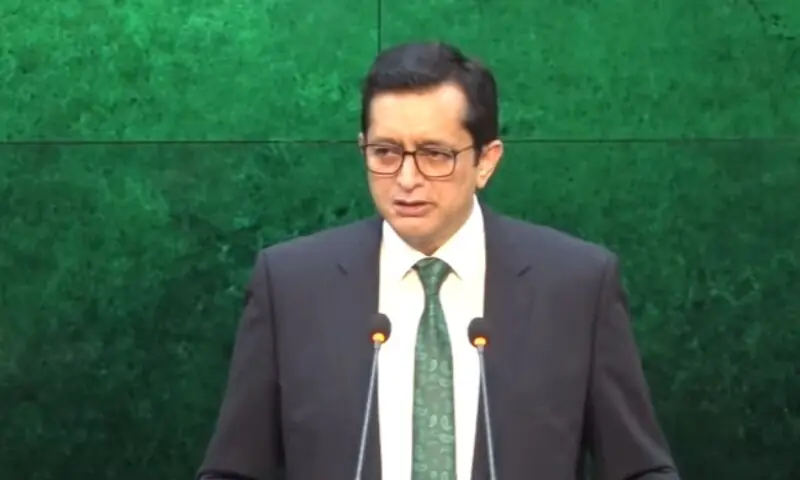
FO spokesperson Sajjad Haider Khan made the remarks while addressing a weekly press briefing. He said that the pact was primarily a “defensive alliance to ensure regional security primarily through deterrence”.
He said that expansion of the pact was currently “not on the cards”, adding that “Pakistan, Saudi Arabia and Turkiye must first further consolidate their organisation and cooperation”.
He said that following the consolidation, the agreement will be “open to all countries that share similar stances and perspectives”.
The spokesperson said that the three member states were holding consultations at various levels under the framework.
He reiterated that the states will make a decision on the agreement’s expansion at a later stage.
“At this stage, there are no discussions regarding the expansion of the Makkah agreement,” he said.
He said information on future meetings will be shared “on an ongoing basis”, adding that exact timing was not yet known.
Khan said the pact was in the initial stage of formation and detailed consultations on “its structure, procedures and other matters” will be held.
“Significant work lies ahead to finalise the organisation’s structure, mechanisms, and procedures,” he said, adding that any future developments will become clear in due course.
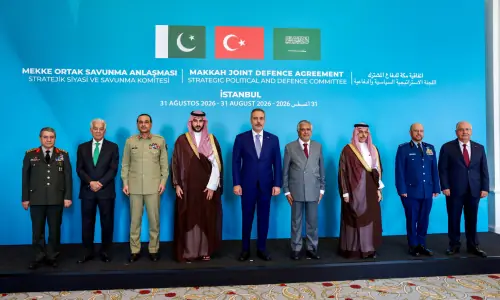
The defence pact, signed on Aug 7, aims to strengthen collective deterrence and empower its signatory states to treat an attack against one of them as an attack against all of them.
Its inaugural meeting was held on August 31 in Istanbul, where it was decided that a secretariat headed by a secretary general will be established in Saudi Arabia to support the alliance’s work under the agreement. The secretariat will initially be headed by a secretary general from Pakistan for a period of three years.
‘State-sanctioned’ demolition of Muslim worship sites in India condemned
The FO spokesperson also condemned what he described as the “systematic” and “state-sanctioned” demolition of Muslim worship sites in India.
In response to a question about how Pakistan planned to build more pressure on the Indian government regarding the issue of demolition of worship sites, given the demolition of a mosque in India’s Saharanpur on September 5, the spokesperson said, “Pakistan expresses deep concern and condemns the systematic state-sanctioned demolition of Islamic holy places in India under different pretexts”.
Khan held that the demolitions were in breach of the Liaquat-Nehru Pact signed in 1950, which the spokesperson said guaranteed the security and rights of religious minorities.
He noted that the ongoing repression also breached India’s own laws, particularly the Places of Worship Special Provisions Act, 1991, which he said mandated the maintenance of the religious character of places of worship “as it existed on August 15, 1947”.
Referring to the recent demolition of a mosque in Uttar Pradesh, he noted: “The Hindu-driven Islamophobic campaign has resulted in an imminent threat and the destruction of centuries-old heritage sites and places of worship, including the Akhonji, Ajgaib Shaeed Mosque, the Saharanapur Collectorate mosque, as well as the 1,000-year-old mosque, Ganj Shahida mosque, which has recently received notices from the court.”
He recalled that the 1992 demolition of the Babri mosque remained a “dreadful memory of this ideology of religious intolerance, prejudice, and hatred”.
Explaining what steps Pakistan planned to take towards the issue, Khan said, “Pakistan calls upon the international community to take immediate notice of this systematic persecution in India against Muslims and continued desecration and destruction of their places of worship”.
In the weekly briefing, Khan also issued a categorical rejection of a statement made by the Indian Ministry of External Affairs over a Hindu temple in Narowal.
“Contrary to India’s claim, the temple’s structure was damaged in torrential rain,” he said.
Yasin Malik’s decision to forgo defence ‘damning indictment’ of Indian judicial system
The spokesperson was also asked about the recent implication of the Jammu Kashmir Liberation Front (JKLF)’s incarcerated chairman, Muhammad Yasin Malik, in a case from 1990.
Malik was named in June by India’s State Investigation Agency (SIA) as one of five men charged with the killing of Sarla Bhat. However, he submitted an affidavit stating that he had decided not to contest the trial and that his decision should not be treated as an admission of guilt or acceptance of the prosecution’s allegations.
Referring to Malik’s action, the FO said, “The stance taken by Yasin Malik is beyond an act of heroism. It is a damning indictment of the Indian judicial system, which has acted as a convenient tool in the hands of the Indian government, suppressing the Kashmiri people and depriving them of any recourse to justice”.
Khan held that in repudiating the right to defence, Malik has “struck a stinging blow to the judicial sham that the Indian government wanted to stage in its sinister campaign to malign the Kashmiri leadership”.
The spokesperson also expressed concern at Malik’s deteriorating health.
“The international community must not allow the Indian design to mortgage his life and well-being to advance its oppressive occupation of the IIOK,” he said, adding that Pakistan condemned the prosecution of Malik.
The FO spokesperson urged the UN and other humanitarian bodies to take note of Malik’s situation.