BRICS summit opens in India amid deep divisions

• Pezeshkian makes first presidential visit to India
• Xi returns to New Delhi after seven years as ties ease; Saudi Arabia, UAE, Egypt leaders also set to attend
• Putin, Modi hold talks on energy, defence, Ukraine; Indian PM warns against engaging ‘unvirtuous’
NEW DELHI: The leaders of Russia and Iran arrived in India on Friday for talks ahead of a BRICS summit that will draw together heads of state including China’s Xi Jinping, with wars, trade and energy expected to dominate the agenda.
The 11-nation summit was founded in 2009 to give major emerging economies a stronger voice in institutions long dominated by western powers.
But this year’s gathering arrives at a moment of unusual strain, with member states pulling in sharply different directions over the conflicts convulsing the Middle East.
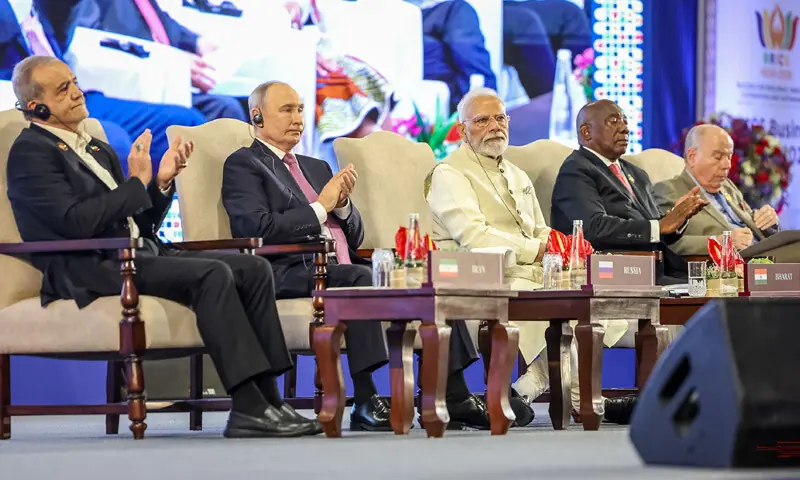
Speaking at a forum in New Delhi ahead of Saturday’s main proceedings, Iran’s president, Masoud Pezeshkian, described the current moment as one of “unprecedented complexity”, and said BRICS had been founded precisely to push back against unilateral power.
He also held talks with India’s prime minister, Narendra Modi, in what is his first visit to the country since taking office.
Xi’s participation, when the summit formally opens on Saturday, is likely to draw particular attention. It will be his first trip to India since 2019, and comes amid a cautious warming of ties between the two nuclear-armed neighbours, seven years after a deadly border clash in the Himalayas.
Flights, visas and diplomatic contacts have gradually resumed in recent months. Even so, the visit has not gone unopposed as dozens of Tibetan protesters gathered in the Indian capital on Friday holding placards against Xi’s presence.
Meanwhile, the presence of Iran, Saudi Arabia and the United Arab Emirates highlights the challenge facing BRICS as members hold sharply different positions on conflicts involving the Middle East.
“The Gulf conflict is going to be the central fault line this time during the BRICS summit,” said Harsh V. Pant of India’s Observer Research Foundation. “What was seen until last year as an achievement — the expansion of BRICS — today looks like a big constraint on BRICS.”
Other leaders expected at the summit include UAE President Mohamed bin Zayed Al Nahyan, Saudi Foreign Minister Prince Faisal bin Farhan and Egyptian President Abdel Fattah al-Sisi.
“The war in Iran will provide a stern test of the group’s cohesion,” said Shilan Shah of Capital Economics.
India-Russia partnership
For India, the summit comes as Modi’s government attempts to maintain relationships with competing global powers, including Russia, the United States, Gulf states, Iran and Israel. Modi and Russian President Vladimir Putin held talks on Friday covering energy, defence and international conflicts. India described the relationship as a long-standing strategic partnership, with Moscow remaining one of New Delhi’s largest defence suppliers.
“One should engage in debate and friendship only with the virtuous, and nothing whatsoever with the unvirtuous,” Modi wrote on Friday in a social media message to welcome leaders to the 11-nation summit.
Modi and Putin “shared perspectives on ... the conflicts in West Asia and the Black Sea region which have impacted maritime trade and the safety and security of Indian seafarers,” a statement from India’s foreign ministry said.
With more than 320,000 seafarers, India makes up a major part of the global merchant shipping workforce.
Published in Dawn, September 12th, 2026