On July 20, 1969, we took our first steps on the Moon. During NASA’s Apollo 11 mission, Neil Armstrong became the first person to walk on the Moon. His famous words were, “One small step for man, one giant leap for mankind.”
Since then, only 12 astronauts have walked on the Moon. For a very long time, that achievement stood as both a success and a challenge. We did not return to the Moon for decades, leaving many of us wondering whether humans would ever go back.
That question finally has an answer in the form of the Artemis programme. Recently, Artemis II made history as the first crewed mission to travel around the Moon in more than 50 years. We had finally returned to deep space, and here is how it happened.
Artemis II built on the information collected by Artemis I, which tested the Orion spacecraft without anyone on board in 2022. The spacecraft travelled around the Moon and returned safely to Earth.
More than 50 years after humans last travelled to the Moon, Artemis II took four astronauts around the Moon and back, opening a new chapter in space exploration
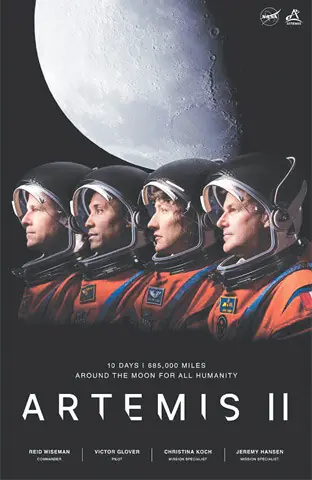
Unlike Artemis I, Artemis II had astronauts on board. The crew included Reid Wiseman, Victor Glover, Christina Koch and Jeremy Hansen. The crew was significant because it included the first woman, first person of colour and first Canadian to travel to the Moon on a lunar mission. They all had years of experience and training.
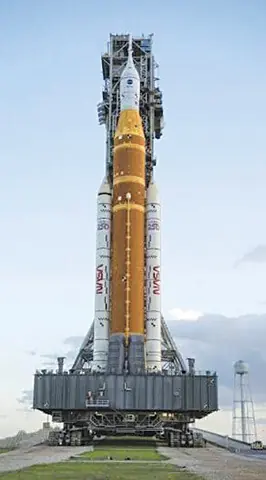
On launch day, April 1, everyone was excited, especially the scientists and engineers who had worked for years to make the mission possible. Artemis II climbed into the sky, carrying the crew and the hopes of people around the world.
The rocket ascended as its stages separated in sequence. The solid rocket boosters fell away, followed by the core stage, allowing the Orion spacecraft to continue its journey.
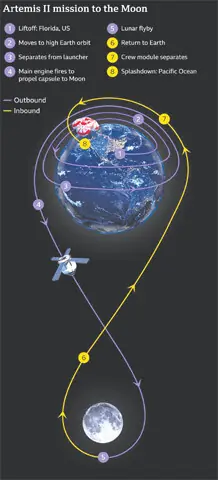
Once in orbit, the mission entered the translunar injection phase. An engine burn put Orion on a trajectory towards the Moon, taking the spacecraft beyond Earth’s orbit and into deep space.
When Orion approached the Moon, the crew had a clear view of the lunar surface, with its craters and shadows stretching below them. Artemis II did not land on the Moon. Instead, the spacecraft flew around it, using the Moon’s gravity to help it begin its journey back to Earth.
During the flyby, the astronauts captured images and collected data. They also witnessed views of Earth from the vicinity of the Moon, giving them a new perspective on our planet against the vastness of space.
The return journey gave Wiseman, Glover, Koch and Hansen a chance to reflect on what they had experienced. They had travelled farther from Earth than any humans before them, breaking the previous record for the farthest human spaceflight. Along with scientific data, they brought back stories and memories from their journey around the Moon.
As Orion approached Earth, it entered the re-entry phase, passing through the atmosphere under intense heat before beginning its descent. Its parachutes opened as it slowed, guiding the capsule towards the Pacific Ocean. Orion then splashed down, bringing the mission to an end. Recovery teams moved in to secure the spacecraft and assist the astronauts.
Artemis II had completed its mission, sending humans beyond Earth orbit and bringing them safely home. But its significance went beyond that. It was a bridge between eras, connecting the achievements of Apollo with Nasa’s plans for future space exploration.
The Artemis programme aims to establish a long-term human presence on the Moon and use what we learn there to prepare for missions to Mars and beyond.
What makes this mission special is the passion behind it. It was driven by curiosity and determination. These qualities have always pushed people to explore, from the earliest explorers to the pioneers of space travel. We have always wanted to go farther and understand the unknown.
Artemis II reminds us that exploration is not just about reaching new places. It is about expanding what is possible. It inspires students to pursue science, engineers to innovate and dreamers to imagine a future where humans live and work beyond Earth.
Artemis II is only the beginning. With future Artemis missions, humanity hopes to return to the lunar surface and take another giant step into the future.
Published in Dawn, Young World, September 12th, 2026