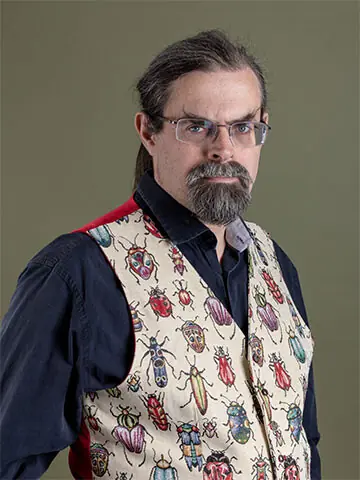
Adrian Tchaikovsky is a British science-fiction and fantasy writer known for a wide-variety of work, including the Children of Time, Final Architecture, Dogs of War, Tyrant Philosophers and Shadows of the Apt series, as well as standalone books such as Shroud, Alien Clay, Service Model and many others.
Children of Time and its sequels has won the Arthur C. Clarke and BSFA (British Science Fiction Association) awards, and his other works have won the British Fantasy, British Science Fiction and Sidewise awards.
Eos got the chance to interview him over email.
Q: Your novels often challenge what intelligence means. Why are you drawn to minds that are different from our own?
AT: I’ve always been fascinated with the ‘other’ — both in nature and in fiction. It’s a natural use of science fiction/fantasy to inhabit the perspectives of other creatures — as much as one ever can. This also gives me the opportunity to explore regions of the idea-landscape that other writers haven’t touched. After all, fiction is full of humans!
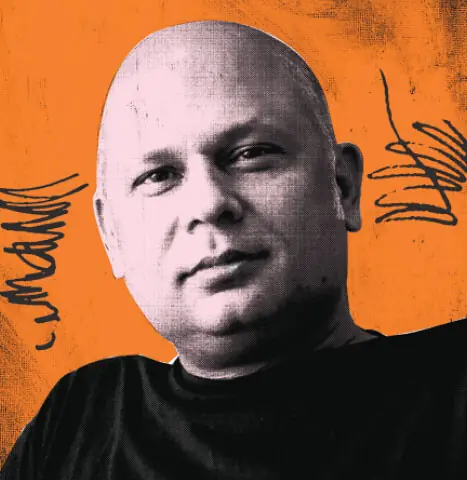
Celebrated British sci-fi and fantasy author Adrian Tchaikovsky’s work often deals with themes of artificial intelligence and alienness. He discusses science fiction, AI and the ideas that shape his fiction with Pakistani sci-fi writer Muhammad Omar Iftikhar
Q: The Children of Time trilogy shows that survival belongs to those who adapt. Do you think that is also true of societies today?
AT: I think a failure to adapt in any circumstances is going to cause you problems — whether as an individual or a society or a species. Obviously there’s a wide range of ways one can respond to environment and circumstance, and some of these are going to be beneficial, and others problematic, especially long term. We are seeing a lot of violent change for short term gain that will only lead to long term problems, right now, and I don’t feel that sort of thing is likely to count as a useful survival adaptation.
Q: Many of your stories suggest that understanding the unknown is harder than defeating it. Why does that idea matter today?
AT: There are some schools of storytelling that are very big on the easy resolution, which usually comes from violence. A non-violent solution is always more difficult to write because it leaves formerly opposed factions still standing, and having to negotiate a new status quo between them. A story that ends with one party dead is easier, but it’s also misleading. In the real world a ‘defeat’ is much harder to define, and conflicts are very seldom over just because one side won — or at any rate claims victory — in a war.
Q: In Service Model, a robot continues to follow its purpose long after the world has changed. What inspired you to tell this story, and what does it say about the way we live today?
AT: I started by wanting to write from the point of view of a robot that might not even have a fully intelligent point of view, and the story grew out of that. The story has a lot of resonance with the way that modern societies work, the priorities we choose and what that says about us. It’s not so much a story about modern AI, which is rather devoid of interesting stories honestly, but about the choices people make, and the tragedy of a robot class created for a role it can no longer fulfill. Also, comedy!
Q: Whether you’re writing about alien worlds or future societies, your stories often reflect today’s social and political challenges. Is science fiction your way of understanding the world we live in?
AT: It’s my only leverage on the world, really. It’s either write about it or shout at people out of the window. I think all writing, in one way or the other, reflects the social and political challenges, either to criticise, explore or reinforce.
Q: For readers in Pakistan discovering your work for the first time, which of your books would you recommend, and why?
AT: I generally point people at Dogs of War as a good starter for my science fiction work. It’s a shorter book, set in the near future, and I particularly like the way the main character — Rex, a bioengineered dog — is also the main concept, so everything ties together very neatly. For fantasy, I would say City of Last Chances, the first of my current series, which has some of my absolute best writing in it.
The interviewer is a science fiction author
Published in Dawn, Books & Authors, September 13th, 2026