Château Rouge
By Amit Chaudhuri,
Faber & Faber
ISBN: 978-0571394937
195pp.
In Château Rouge, Amit Chaudhuri takes us to Paris — a Paris starkly different from the one portrayed by tourists posing with the Eiffel Tower and other iconic Paris sites in the background.
The novel wanders inside the unnamed narrator’s thoughts as well as the nooks and crannies of Paris that are avoided by tourists. What we get in less than 200 pages is not a plot-driven story of characters leading to a climax but granular details of everyday life and what goes on in the narrator’s mind.
Amit Chaudhuri is not the Annie Ernaux of Paris. Nobel Prize winner Ernaux is an insider who has observed and written about Paris and its suburbs for over half a century with the candour and passion that few can match. Chaudhuri’s protagonist, in contrast, is an outsider who uses Google Translate to communicate with his building manager.
While Ernaux could differentiate Parisian accents in public places such as line-ups at the supermarket to place people on a social spectrum, Chaudhuri’s narrator can do the same but only about undocumented Bangladeshi street hawkers — for their Bengali accents are so different from those of a middle-class Kolkata resident.
Amit Chaudhuri’s latest novel is a quiet, intimate portrait of Paris seen through the eyes of an outsider, where overlooked streets, everyday encounters and the elusive workings of memory become a way of understanding the city — and oneself
Amit Chaudhuri is a novelist and essayist, but he is also an accomplished classical khayaal vocalist. The discipline, training and patience that one needs with vocal cords to render a raga is what Chaudhuri also does with the pen (or the keyboard). This gives us slim novels such as Château Rouge, where the words zero in on small details like the paint peeling off apartment walls, where locks on the front door do not latch properly, and where people eat ready-made meals rather than fine cheeses with a baguette.
His Paris is a city where “bookshops are like bookmarks now, intended for display rather than use.” It requires a certain taste and temperament to listen to khayaal gaeki [singing], and the same is true for Chaudhuri’s fiction. You read it to feel the granular details of the surroundings and the inner thoughts that go on in the minds of Chaudhuri’s characters.
Adventure and flamboyance are not what one will come across in these pages. What you will find is looking at and living in the city as an outsider for an extended period of time — in this case, about half a year — “where the sex workers sit like mothers waiting for children to emerge from school.”
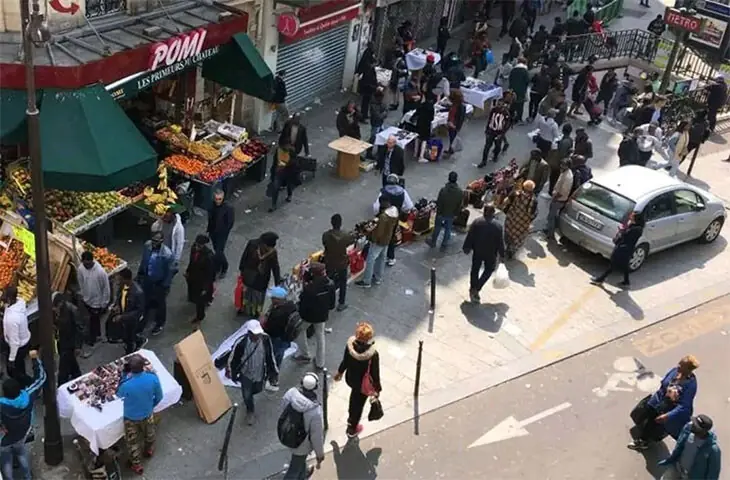
The plot, if there is one, is quite simple. A writer of Bengali origin goes to Paris for an eight-month writing fellowship, where he is periodically joined by his academic wife and daughter. Nothing dramatic or tragic happens in these 200 pages. No relationships, no sudden break-ups, and no life-altering experiences. Interestingly, all other characters have names except for these three. But we see and experience Paris through the wandering academic and, in the process, get to know not only a bit about the city but the protagonist too.
What does it mean to live in a new city? And what if that city is Paris? New cities make our author nervous and Paris is no exception. And the Château Rouge neighbourhood in which he resides is a place where everything is unimpressive, “except maybe, its name.”
“No one knows they are living in history.” This sentence from the book opens up reflections on a host of issues. The sentence reminds me of Orhan Pamuk’s opening lines in The Museum of Innocence: “It was the happiest moment of my life, though I didn’t know it.” For questions such as if one is living in history or experiencing the happiest moment in life, we get the answer halfway through the book, with the help of Jean-Paul Sartre, that quintessential Parisian writer, who in Nausea said “for the most commonplace event to become an adventure, you must — and this is all that is necessary — start recounting it.”
In Château Rouge, not all commonplace events become adventures when the protagonist recounts them. But descriptions of the mundane and the role of memory become recurrent themes, as the narrator looks at the city and wanders in his own thoughts. In an age when we turn to ChatGPT and Google for everything, many feel there is little need to remember. But this slim novel makes us rethink how we find answers to our present and past through ChatGPT and Google.
“Remembering, when it becomes longing (a longing without any overt sense of loss, but still deep and animating),” writes Chaudhuri, “dismantles whatever distinguishes the factual from fictive, the past from the present. You encounter what you remember.” To convey this point, the protagonist turns to filmmaker Woody Allen who, in several of his movies, deploys a technique in which the past and present take place at the same time on screen. For example, in 2011’s Midnight in Paris, the main character walks into bars where writers and artists of pre-war Paris are arguing.
Whether it is a city or our relations, what we make of them is how we remember and recount them. And that necessarily brings us to the importance of the word, be it spoken or as a soliloquy. Arundhati Roy, in Mother Mary Comes to Me, calls this hunting down her language-animal. She says, “I knew that if I could describe my river, if I could describe the rain, if I could describe feelings in a way that could see it, smell it, touch it, then I would consider myself a writer.”
Amit Chaudhuri has been doing this for more than three decades now and Château Rouge is no exception.
The reviewer teaches at IBA, Karachi.
He can be reached at hnizamani@hotmail.com
Published in Dawn, Books & Authors, September 13th, 2026