Prime Minister Shahbaz Sharif has approved the Automotive and Auto Parts Manufacturing Policy 2026-31. The report will now be forwarded to the International Monetary Fund (IMF) for review, as it opposes preferential treatment for the auto sector and supports reduced tariff rates on auto parts imports.
While the prime minister has approved the final version of the five-year Auto Industry Development Policy (AIDEP) 2026–31, stakeholders remain at odds over the facilities to be provided to various segments of the sector.
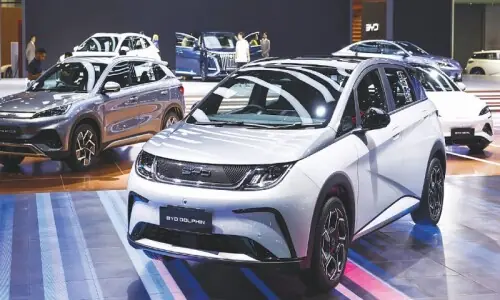
One key policy thrust is to promote electric vehicles (EVs) across all categories, focusing on environmental gains and fuel savings. The new policy provides equal treatment to battery electric vehicles, range-extended electric vehicles and plug-in hybrid electric vehicles, in line with the New Energy Vehicles Policy. It also continues the one per cent sales tax on new energy vehicles (NEVs), including completely knocked down kits, parts, inputs and raw materials, while exempting NEVs from federal excise duty, capital-value tax and withholding tax.
The credit limit for NEVs has been enhanced from Rs3 million to Rs10m, while the tenor has been extended from three years to five. Hybrids will be treated on par with conventional vehicles for tariff and sales tax purposes.
Stakeholders remain at odds over the facilities to be provided to various segments of the sector
The policy proposes a 1pc customs duty on imports of charging stations. It stresses improving quality and lowering prices, with competition expected to drive innovation, technology and vehicle features.
However, some stakeholders dispute the reduction in tariffs for completely built units and sales tax for internal combustion engine (ICE) vehicles as well as NEVs.
The policy has suggested mandatory export targets for cars, jeeps, SUVs, tractors, bikes, rickshaws and auto parts, amounting to $4.41bn during 2026-31. It hopes that local value addition will lead to substantial foreign exchange savings across all categories, estimated at $38.75bn. At the same time, the document proposes zero duties on imports of parts used for exports. However, AIDEP31 has drawn strong reactions from officials across departments.
Sources say the Federal Board of Revenue opposed granting concessions to two-wheeler and four-wheeler electric vehicles, arguing that many companies could take advantage of the tax relief and sell imported vehicles and parts without establishing a local base.
These opposing views have been echoed by Haroon Akhtar Khan, adviser to the prime minister on industries and production, who called for making Pakistan an attractive market by offering competitive tax relief compared to regional markets.
Similarly, the Engineering Development Board (EDB) and the Pakistan Standards & Quality Control Authority (PSQCA) are competing over powers to check the quality standards of auto parts manufactured in the country. The policy proposes fully digitising the EDB’s approval process. Meanwhile, the Ministry of Industries will establish a new entity, the Pakistan Auto Testing Institute, to conduct essential vehicle tests, mainly for exports.
The Ministry of Science and Technology, however, continues to contest this, arguing that its attached department, PSQCA, is the globally recognised body for ensuring quality standards in accordance with the International Organisation of Standardisation.
Similarly, the IMF has called for lower import tariffs on auto parts, arguing that this would make locally manufactured parts more price competitive. At the same time, auto parts makers have opposed this version of the policy, claiming that it would damage the auto sector.
The Pakistan Association of Automobile Parts and Accessories Manufacturers (PAAPAM) has formally written to the government, warning that excessive concessions for New Energy Vehicles (NEVs) and lower tariffs on imported parts risk completely dismantling decades of progress in local engineering. The association has argued that the policy gives too many concessions to NEVs, including by reducing local value-addition targets.
PAAPAM has maintained that the current level of local content in conventional vehicles stands at over 50pc and called on the government to increase it to 70pc.
The association has pointed out that, apart from batteries, motors and controllers, NEVs utilise the same structural, interior and exterior components already produced locally for conventional vehicles, such as seats, tyres, glass, lights, bumpers, steel bodies, plastic parts and wiring. It argues that there is no justification for encouraging low-value “assembly-only” operations when established parts-manufacturing facilities already exist in the country.
Former PAAPAM chairman Aamir Allawala said the National Tariff Policy (NTP) promotes an unrealistic narrative. He equated the NTP with the nationalisation policies of the 1970s, adding that Pakistan has a complex economy.
“Pakistan’s high ranking on the global terrorism index heavily deters export-oriented Foreign Direct Investment (FDI). Foreign buyers and investors representing global value chains do not visit Pakistan due to travel advisories, special security requirements and high travel insurance costs,” he said. “Why would they buy from a factory that they cannot visit? And our policymakers compare conditions in Pakistan with others, including Thailand.”
He also pointed out that setting export targets without government support was not possible. Auto parts exported from Pakistan face 25-30pc tariffs in most African countries, while the same auto parts made in South Africa are imported at zero per cent tariff under free trade agreements signed with almost all countries in East and West Africa.
Systemic cost inefficiencies, such as high energy costs, high interest rates, predatory taxation and a lack of scale, inherent to the domestic economy, continue to drag down Pakistan’s export capacity.
Built on false assumptions and flawed data, the National Tariff Policy will inevitably mirror the destructive legacy of nationalisation, leading to the systematic decimation of Pakistan’s industrial sector. According to a recent poll conducted by PAAPAM, 80pc of its members will consider “shutting down” following the full implementation of the NTP.
The writer is a Dawn staffer
Published in Dawn, The Business and Finance Weekly, September 14th, 2026