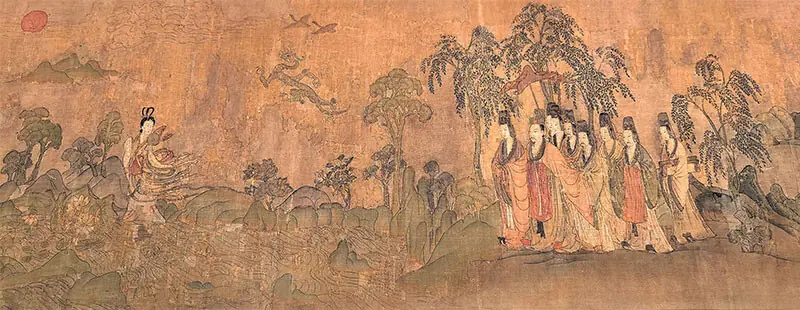
“LIGHT as a startled swan, graceful as a swimming dragon.”
That was how Cao Zhi (192-232 CE), a gifted poet and a frustrated prince, described his imagined rendezvous with the Goddess Luoshen beside a river in the 3rd-century literary classic Luoshen Fu, or The Ode to the Goddess Luoshen.
More than a century later, celebrated painter Gu Kaizhi (348-409 CE) transformed Cao’s poetic vision into a timeless masterpiece on a silk scroll. He gave vivid form to the ideal beauty imagined by Cao, inspiring generations of artists to create copies in homage to the work.
Time has obscured the whereabouts of the original. But when a Song Dynasty (960-1279 CE) copy appeared in a new exhibition at the Hall of Literary Brilliance of the Palace Museum in Beijing, visitors marveled at the extraordinary refinement and antiquity of its brushwork. It is elegant, subtle and mesmerizing.
The Tang (618-907 CE) and Song dynasties are widely regarded as two of the great cultural peaks of ancient Chinese history, and their calligraphy and paintings offer an especially vivid window into the spirit of those eras.
After two years of preparation, Defining the Classics: A Journey to Tang and Song Calligraphy and Paintings opened to the public last week. Running through Nov 1, the exhibition presents 107 rare works in two phases, spanning calligraphy, landscape, figure, and bird-and-flower paintings. Together, they offer a systematic overview of the development and maturation of artistic standards in Tang and Song painting and calligraphy.
“The exhibition shows how the master artists established models and paradigms that exerted a lasting influence, providing foundations for generations of artistic innovation,” says Wang Zhongxu, curator of the exhibition.
Luoshen Fu, for example, is generally considered to have established a figure-painting technique known as “a portrayal like spinning silk”. Characterized by thin lines defining figures and fluttering ribbons on their clothes, this technique was later emulated by generations of artists as a form of admiration for antiquity. The late art historian Jin Weinuo (1924-2018) praised this Song facsimile as the closest in style to the work of Gu Kaizhi’s time.
There is a Chinese saying that “a piece of paper is blessed with a thousand-year life”.
Visiting the exhibition is, in many ways, like meditation — or a journey through time, tracing the evolution of Chinese art.
Published in Dawn, September 14th, 2026