KP Assembly speaker hints at legislation for public execution of child rapists, killers
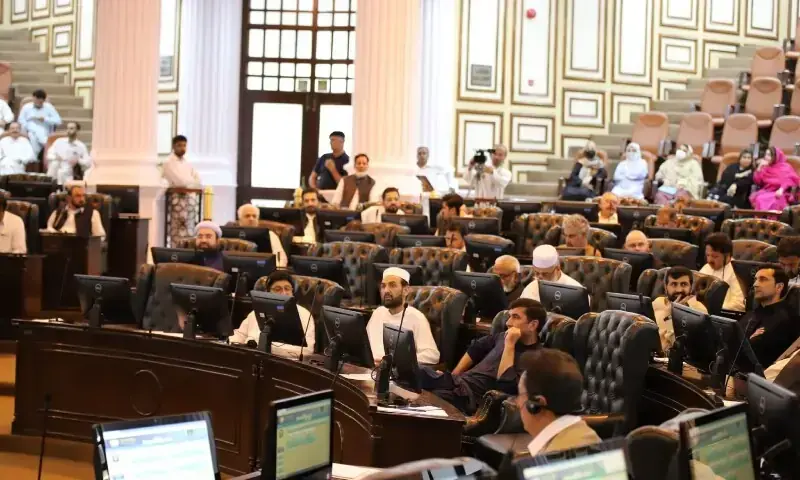

PESHAWAR: Speaker of the Khyber Pakhtunkhwa Assembly Babar Saleem Swati on Monday hinted at legislating to publicly execute convicted child rapists and killers in the province.
Chairing a session of the assembly here, the speaker said the KP Child Protection Act would be named after five-year-old Ayat Noor who was kidnapped, sexually assaulted and killed in Haripur last month.
He said the Ayat Noor Protection Act would introduce stricter punishment for violence against minors and ensure speedy justice through special courts.
“We will introduce the maximum possible punishment in child rape and murder cases, including death by hanging, and that, too, in public,” he said.
Says Ayat Noor Protection Act will ensure speedy justice through special courts
Mr Swati noted that two such cases were reported in Haripur and Swat, with the police successfully tracing culprits, while four suspected gang rapists were gunned down in Peshawar by their own associates.
His remarks came after treasury member from Swat Sharafat Ali complained that a child in his area was sexually assaulted before being murdered.
The lawmaker said he didn’t want to raise the matter on the assembly floor but changed his mind after an opposition member brought it up.
He said he earlier didn’t make details public to protect the privacy of the rape victim and her family.
Mr Ali said a committee headed by a special prosecutor had been formed to look into the case.
He said the culprit(s) would be made an example of to prevent such incidents in the future.
Also, the speaker took exception to a recent statement of Punjab Chief Minister Maryam Nawaz on militancy and insisted that she hurt the sentiments of KP and Balochistan residents.
“Remember, we don’t follow those who say everything is fair in love and war. As Muslims, we follow the teachings of our faith only,” he said.
Mr Swati said lawmakers could criticise the policies of the Punjab chief minister, the prime minister and their alignment with the military establishment but neither Islam nor Pakhtun traditions allow attacks on anyone’s character.
“We [Pakhtuns] have been protecting you [Punjabis] for the last 250 years. We are a buffer zone and this is the reason why there is no law and order situation in Punjab,” he said.
The speaker added that every family in KP had members who laid down their lives for the motherland, so political leaders should think before making reckless statements about KP.
He urged the Punjab chief minister to acknowledge and appreciate KP’s sacrifices for the country.
During the question hour, member of the opposition PML-N Shehla Bano complained that the education department had responded to her question by “copying and pasting” old data.
Opposition PPP lawmaker Ehsanullah Khan said he had sought data of the public schools closed in the province and was provided with incomplete details.
He said the department’s reply showed that 30 per cent of schools for girls in his Dera Ismail Khan constituency were closed, while the data of such schools for boys hadn’t been shared.
Parliamentary secretary Rajab Ali Abbasi said some schools were ready and functional, while work on others was in the final phase.
MPA Adnan Khan of the opposition JUI-F said the Government High School Bannu City-II was built in 1932, with rooms donated by members of the Hindu community, but it was demolished in 2022 despite having 3,000 students enrolled.
He questioned the rationale for demolition.
Parliamentary secretary Abbasi said the school building was demolished as it was in such a bad condition that it could collapse anytime.
Opposition ANP member Mohammad Nisar wondered why 1,685 posts for male teachers and 701 for female teachers were vacant in government schools of Bajaur tribal district.
He complained that Bajaur’s total population was 1.8 million but it had only one higher secondary school for girls.
Another lawmaker from the party, Arbab Usman, highlighted the issue of wheat production and supply in the province, saying flour is a basic necessity.
He said annual flour consumption in KP totalled 124kg per person but wheat production in the province was 760kg per acre compared with 1,200kg in Balochistan and 1,440kg in Punjab.
Special assistant to the chief minister for food Mohammad Israr informed the house that Mr Usman’s question had been answered but if there was any issue with the figures, a detailed discussion would be held with him.
He said that Punjab produced 20 million metric tonnes of wheat and utilised around 15 million tonnes, sending the surplus to Sindh and KP.
Mr Israr said the Punjab chief minister had imposed a ban on the transportation of wheat to KP.
Meanwhile, MPA Naik Mohammad Wazir from North Waziristan questioned the repeated imposition of curfew in his area and complained that the law and order situation in the district was fast worsening.
He said the issue was repeatedly highlighted in the assembly but corrective measures were elusive.
The lawmaker complained that internally displaced persons in Tirah Valley had received compensation but those from his district had long been awaiting basic amenities.
The chair later put off the sitting until today (Tuesday) afternoon.
Published in Dawn, September 15th, 2026