EDUCATION: REBUILDING A DREAM

There was a time when Happy Dale School was counted among Karachi’s respected educational institutions. This happened soon after it was established in 1951 by educationist Amina Mumtaz, who came from a family of trailblazing women — her siblings included women’s rights pioneer Hajrah Begum, actor and singer Zohra Sehgal, and theatre artist Uzra Butt.
Mrs Mumtaz also served as the school’s principal. I remember her fondly from my time there until my matriculation in 1971. At that time, the school had side-by-side campuses for boys and girls.
The teachers, at least in the boys’ sections, were stern but fair, and would sometimes even resort to forms of punishment that would shock parents today. The education was rigorous but engaging and, under Mrs Mumtaz’s supervision, the school produced graduates who went on to serve the country in a wide range of professions, from diplomacy to law, medicine, engineering and the judiciary.
The nationalisation of private schools and colleges in 1972 brought major changes to Pakistan’s education system. The transition initially retained much of the existing teaching and non-teaching staff, but standards and management gradually deteriorated. Parents lost trust in government schools, with even those having limited financial means looking toward private education.
How a group of former students turned around a failing government school in Nazimabad, into one with triple its enrolment and a 100 percent exam pass rate…
Happy Dale School became one of the casualties of this wider decline. The boys’ school was shifted to a different location and, over the years, the girls’ school was reduced to offering secondary education only.
RECOGNISING THE DEBT
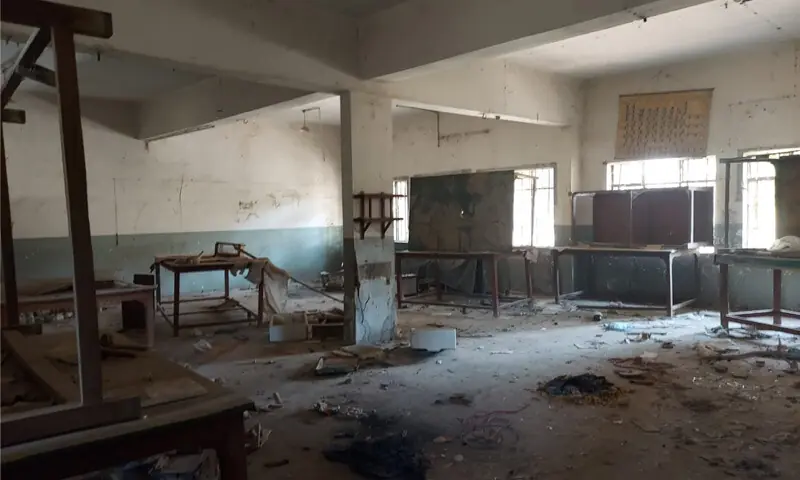
In 2021, I was part of an alumni group that visited the school — now the Happy Dale Government Girls Secondary School. The conditions we encountered were deplorable.
The classrooms lacked furniture, the blackboards were barely hanging in place, and only a handful of classrooms had fixtures and fans. The windows were broken, the doors were crumbling and the bathrooms were not operational.
At the time, the school had 33 students. A handful of them had taken that year’s matriculation exam, and the clearance rate was deplorable. There were also concerns about security, irregular attendance, poor admissions, weak academic results and a lack of motivation among some members of the teaching staff.
For those of us who took part in the visit, the condition of the school was not a reason to give up. It was a reason to act. We agreed that the school could be transformed once again into a place where children could receive quality education.
We set up the Happy Dale School Alumni Foundation (HDSAF) and applied for the school under Sindh Education Foundation’s school adoption policy. In 2022, we were entrusted with the school.
The foundation had two immediate challenges: repair the school and rebuild its culture of learning. An administrator was appointed to oversee the day-to-day running of the institution. Infrastructure improvements began, while members of the alumni foundation worked with teachers and staff to improve academic standards.
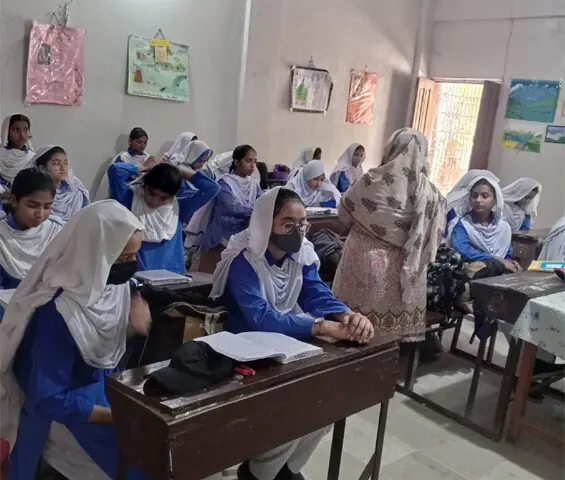
BEYOND PAINT AND BUILDINGS
The revival of Happy Dale was never intended to be simply a renovation project.
It included curriculum development, teacher training and monitoring of classroom performance. Extra classes were introduced after school hours.
Gradually, the emphasis shifted from simply having a functioning school to creating an environment where students could actually learn.
One of the most striking aspects of the transformation has been the introduction of facilities that are often missing from government schools. A science laboratory and improved playground facilities are part of the renewed school environment. A bank donated 30 computers for a computer lab.
But, perhaps, even more unusual are the daycare centre and medical clinic. The daycare centre was created to support young teachers who have small children. The idea was practical: young children accompanying their mothers could otherwise disrupt classroom teaching. By providing a dedicated space, the school could support its teachers while protecting the learning environment.
The clinic provides day-to-day medical assistance and regular check-ups. It has also hosted a thalassaemia screening programme, through which six students were identified as carrying the relevant genes and were provided with counselling.
Another important initiative has been the introduction of early childhood education, or ECE, within the boundary of the school. ECE carries particular importance because of the school’s location in Nazimabad, close to an underprivileged community from which many of its students come.
The response from families has been encouraging: enrolment in the ECE programme has exceeded expectations. The school has even celebrated its first graduation ceremony for children completing KG2 — a small ceremony perhaps, but a significant symbol of a new beginning.
MEASURING SUCCESS
The strongest evidence of an institution’s transformation is not its freshly repaired walls or new equipment. It is the improvement in enrollment and student retention — the secondary school now boasts 100 students.
It is also in the results of students who sit for their examinations. Sixteen girls appeared for this year’s matric exams and every one of them passed. This is a 100 percent success rate. Even more remarkably, five of the girls secured more than 80 percent marks — an uncommon achievement for a government school.
One of our high-achievers has already been hired for ECE teaching. Like the majority of our students, she hails from a family of extremely limited means — her father earns minimum wage, while her mother works as house help. By keeping her engaged with the project, the foundation hopes to help the girl with further education. It is a pathway that the school plans to create for other students as well.
This success has been made possible by the combined effort of students, teachers and administrators, who worked to rebuild the academic culture of the institution. For an institution that had once struggled with absenteeism, poor facilities, declining admissions and weak academic performance, the result represents far more than an examination statistic. It represents a restoration of confidence.
The story of Happy Dale is ultimately not only about one school. It raises a larger question about the future of government education in Pakistan. The decline of public schools is often discussed in terms of budgets, buildings and staffing. All of these matter. But Happy Dale suggests that community involvement, committed management, teacher development and accountability can also make a difference.
The transformation did not happen overnight. It required infrastructure investment, administrative oversight, academic monitoring and, above all, people willing to take responsibility for a school they cared about.
The alumni who returned to Happy Dale could have simply remembered it as the institution it once was. Instead, they chose to help rebuild it. That decision has given a new generation of girls something that every child deserves: a school in which they can learn, dream and believe that their circumstances do not have to determine their future.
The writer is a board member of the Happy Dale School Alumni Foundation. He can be contacted at asghar.naqvi1955@gmail.com
Published in Dawn, EOS, September 20th, 2026