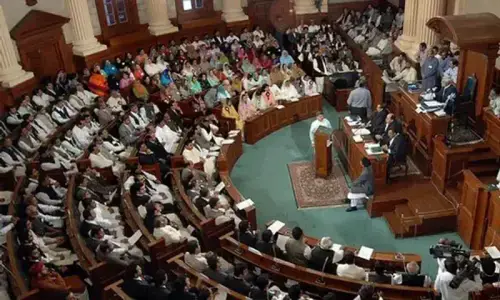
LAHORE: The Punjab Assembly has begun parliamentary evaluation of artificial intelligence and digital governance, with its Special Committee No. 13 examining the use of AI in public services and the safeguards needed to protect citizens’ rights.
Chaired by Speaker Malik Muhammad Ahmad Khan, the committee held its inaugural meeting on Thursday.
It is the first parliamentary committee in Pakistan and the South Asian region with a dedicated mandate covering artificial intelligence and digital governance.
The meeting followed a three-day workshop for committee members, held in Islamabad from Sept 2 to 4 by UNDP Pakistan and the United Kingdom’s international development organisation. The workshop examined artificial intelligence and digital technologies, their potential benefits and risks, and the principles of responsible governance.
The committee considered an initial programme of parliamentary inquiry into the use of AI in Punjab, focusing on transparency, accountability, citizens’ rights, data security, effective remedies and meaningful human oversight.
Two provincial public service systems were identified for initial examination. The first is the Punjab Safe Cities Authority’s AI-assisted e-challan system.
The committee will examine the accuracy of violation detection, human validation of violations, citizens’ access to evidence, mechanisms for challenging and reviewing decisions, and the handling of related data.
The second relates to welfare assistance linked to the Punjab Socio-Economic Registry (PSER). The committee will examine registration and accessibility, data accuracy, eligibility assessments, explanations for adverse decisions, correction of inaccurate information and opportunities for reconsideration.
Importantly, the committee said it would establish through evidence how eligibility was actually determined — whether through manual assessment, fixed rules, statistical scoring, machine learning or a combination of these methods — rather than assuming that AI was involved.
The committee also discussed the constitutional and legal implications of emerging digital technologies, including digital harms, deepfakes, threats to democratic trust, risks to women and vulnerable groups, data governance and institutional capacity.