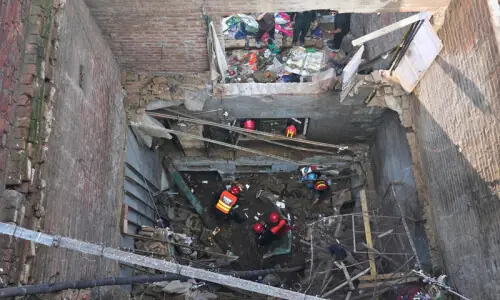
For several years now, images and videos of devastation in Gaza, the West Bank, Yemen, Syria and Ukraine have become a constant presence online, as war and political upheaval have continued to leave behind scenes of ruined homes and fractured landscapes. For those watching from a distance, these images have become almost impossible to escape, appearing repeatedly across news reports and social media feeds.
Hence, upon stepping into Canvas Gallery and encountering Nausheen Saeed’s solo exhibition ‘Elsewhere, Perhaps’, the first response is an unsettling sense of recognition.
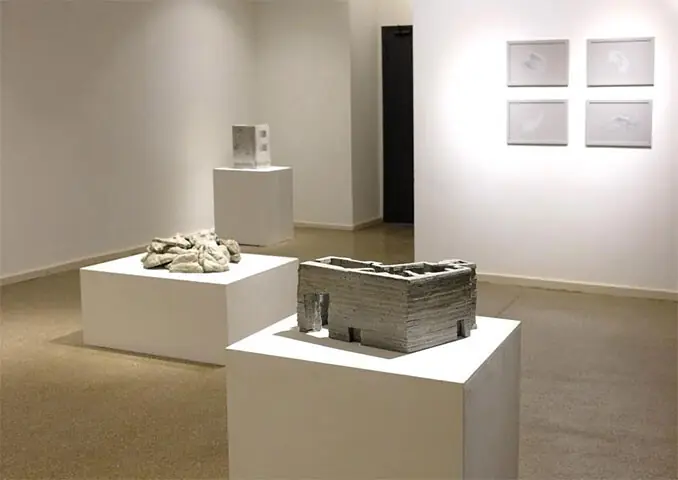
Saeed’s bare concrete structures, roofless and hollow, some appearing partially eroded, immediately recall the gutted remains of buildings seen in images from conflict zones. They resemble not specific places but the familiar visual language of destruction that has become increasingly difficult to look away from.
Untitled II serves as a prominent example: a partially eroded cement structure that mimics the skeletal remnants of a home, its empty window cavities staring back at the viewer like hollow eyes. Untitled V carries that same heavy atmosphere of a terrible aftermath, reinforcing the digital imagery of destruction we encounter daily.
Through stark architectural forms and shifting cartographies, a recent exhibition in Karachi transformed the visual language of devastation into an unsettling meditation on the act of witnessing
Yet, these sculptural reminiscences of conflict stand entirely on their own, conspicuously stripped of the rubble, dust and scattered detritus typical of real disaster sites. This absence of debris carries a subtle accusation, illustrating how, over time, we have become desensitised to the suffering around us. The thought of a shared sorrow stays with us only fleetingly before being swept away and replaced by something else.
In stark contrast stands Untitled IX, a sculpture crafted from smooth, polished marble. With its double-reinforced walls and lack of windows, it conveys an intentional, calculated disconnect from the outside world. Marble as a material inherently carries connotations of luxury, class and social or financial superiority. In Untitled IX, this material choice highlights the stark divide between those exposed to the perils of geo-political uncertainty and those insulated within fortified privilege.
Across all these sculptural pieces, what remains most haunting is the clear absence of the human presence, which actually gives life to an otherwise lifeless piece of infrastructure.
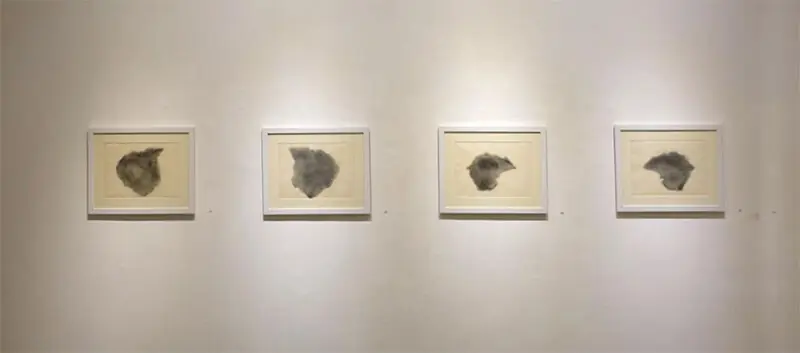
Saeed’s exploration of geography and spatial limits extends on to paper. Her drawings depict contemporary, contested borders not as sharp, fixed lines but through soft charcoal powder and dry pigment that seem to float across the surface. They evoke both delicate clouds and the smoke rising after a missile strike, introducing vulnerability into the idea of the border.
This tension continues in Untitled VIII, a heap of 15 nebulous forms in reinforced concrete, derived from the mapped shapes of different republics. Piled unevenly and appearing to melt into one another, they suggest the shapeless, shifting nature of geopolitics. States that appear firmly defined on a map are, in reality, bound by relationships that can be volatile and uncertain.
In the American poet Joseph Fasano’s poem Rumi, the question “What can I do if I can’t change it?” is answered with a simple instruction: “Witness it.” Saeed uses these lines as the artist statement for ‘Elsewhere, Perhaps’, offering a way into the exhibition. Her works ask us not to change what has happened but to remain present before it. Here, looking becomes an act of witnessing.
While these works remind us of the critical importance of bearing witness, the exhibition also leaves us with lingering questions. If witnessing is an assignment rather than a passive act, where does observation end and complicity begin? How do we bridge the gap between the fleeting empathy inspired by an art gallery and the lasting solidarity required by real-world conflict?
Perhaps the first responsibility is simply to keep looking, and to refuse to let what we have witnessed become another image we learn to forget.
‘Elsewhere, Perhaps’ was on display at Canvas Gallery in Karachi from August 25-September 3, 2026
The writer is a university student with an interest in art, culture and urban history. He can be contacted at pakistaniumer04@gmail.com
Published in Dawn, EOS, September 20th, 2026