Pakistan ‘prefers dialogue over coercion’ to address Houthi threat

• FO terms situation around the Red Sea chokepoint ‘exceptionally serious’
• Says Strategic Mutual Defence Agreement with Riyadh ‘is operational’, some forces already deployed
• Indicates openness to foreign-led mediation efforts with Kabul, provided Afghanistan makes requisite anti-terror commitments
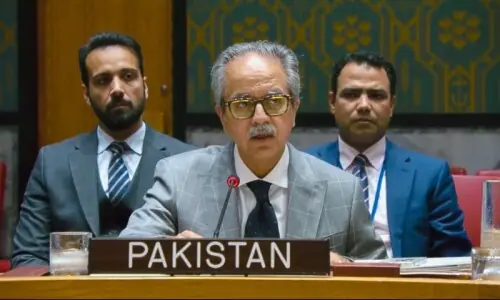
ISLAMABAD: Pakistan on Thursday expressed concern over the “exceptionally serious” situation around the Bab al-Mandab Strait and reaffirmed its commitments to Saudi Arabia’s security, but stressed that the Houthi conflict should be addressed through dialogue and diplomacy rather than through coercive means.
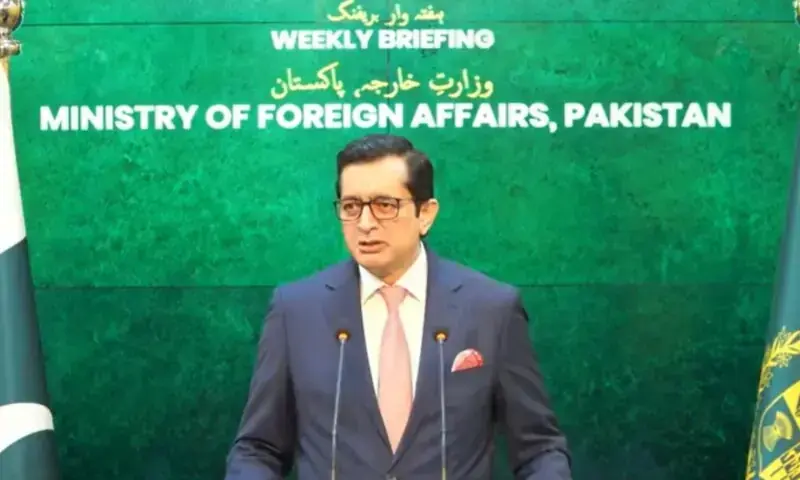
Speaking at the weekly media briefing, Foreign Office spokesperson Sajjad Haider Khan said Islamabad was concerned about the widening conflict and the threat it posed to regional stability and maritime security.
“The situation in the Bab al-Mandab is exceptionally serious and a matter of concern, and we need to bring peace to the entire region,” he said.
His comments came as fighting between Saudi Arabia and Yemen’s Houthis has intensified, with the group making gains along Yemen’s Red Sea coast near the strategic waterway and launching missile and drone attacks on Saudi territory, while Riyadh stepped up airstrikes against Houthi positions.
The escalation has raised wider concerns because Bab al-Mandab is a major maritime chokepoint connecting the Red Sea with the Gulf of Aden and is critical to commercial shipping and energy supplies.
Mr Khan suggested that Pakistan’s approach to the conflict was to seek an end to hostilities rather than become part of an expanding military confrontation.
“The Houthis must also stop their activities, and in this regard, our discussions basically revolve around bringing peace and stability through dialogue and diplomacy, and not through coercive measures,” he said.
These remarks were particularly significant in view of Pakistan’s growing defence commitments to Saudi Arabia especially the Strategic Mutual Defence Agreement (SMDA) and the recently signed Makkah Joint Defence Agreement, which besides Pakistan and Saudi Arabia also involved Turkiye.
Pakistan and Saudi Arabia signed the SMDA in September 2025, under which aggression against either country is to be treated as aggression against both.
The Makkah agreement, signed by the three countries in August this year, similarly provides for collective defence while being presented by its signatories as a defensive arrangement aimed at strengthening regional security and deterrence.
Asked how Islamabad viewed its commitments under the two agreements amid the Houthi attacks, Mr Khan said Pakistan remained committed to both arrangements. “Pakistan is committed, in intent and spirit, to implementing the SMDA as well as the Makkah Joint Defence Agreement,” he said.
He nevertheless declined to disclose how Pakistan might respond operationally, saying such decisions involved matters of confidentiality.
“However, when, how, where, and what force will be used against which objectives, in which modes, and other matters involving operational confidentiality require us to maintain some discretion at this stage,” he said.
Pakistan has already maintained military personnel and defence assets in Saudi Arabia, with the two countries having long standing military cooperation that predates the SMDA. Mr Khan confirmed that some deployments had taken place under the bilateral agreement but declined to provide details.
“On the SMDA, there were some deployments of forces, and since it is an operational matter, I would not comment beyond that,” he said. “SMDA is operational, and the two countries are working at their respective competent levels.”
About the Makkah Agreement, the spokesperson said, “Makkah Joint Defence Agreement is a Mutual Defence Agreement aimed at strengthening regional peace and stability.” “The Makkah Accord, in essence, formalises and further strengthens many aspects of the ongoing cooperation and existing long-term bilateral cooperation among these three countries.”
Assurances needed from Kabul
Talking about Afghanistan, the FO spokesperson stressed the need for verifiable assurances that its territory would not be used for terrorism against Pakistan, recalling that previous mediation efforts involving China, Turkiye and Qatar had failed to produce the desired results because of Kabul’s reluctance to cooperate.
“Pakistan is keen to resolve all our issues through peaceful means, of course, through dialogue and diplomacy. We have clearly mentioned our red line, and now it is for Afghanistan to see how it can stop terrorism, because you cannot continuously allow terrorists to flow from the Afghan side and then expect a different outcome from Pakistan’s side,” Mr Khan said at the briefing.
He was responding to questions about recent visits by senior Turkish and Qatari security officials to Afghanistan and the subsequent arrival in Islamabad of Turkiye’s intelligence chief Ibrahim Kalin.
The visits have been viewed as a renewed effort to ease tensions between Pakistan and Afghanistan, although Islamabad officially said it was not aware of the background or specific purpose of the latest initiative.
“We are not aware of the background in which this visit is taking place,” Mr Khan said, while acknowledging the previous role played by the two countries in mediating between Islamabad and Kabul.
Qatar and Turkiye had previously hosted separate rounds of Pakistan-Afghanistan talks, including meetings in Doha and Istanbul, as the two sides then sought to contain hostilities between the two over cross-border militancy, border closures and trade disruptions.
“If you remember, last year, we engaged with Afghanistan twice through these mediatory platforms once in Qatar and, secondly, in Istanbul,” Mr Khan said.
Mr Khan said the problem with previous initiatives had been Kabul’s failure to provide the assurances Islamabad was seeking.
“So, for Pakistan, it is very important that this assurance is provided.” He also recalled the Urumqi process, through which China brought Pakistan and Afghanistan together in an effort to facilitate dialogue and improve relations.
Mr Khan nevertheless indicated that Islamabad was prepared to move quickly toward normal relations if the security issue was resolved. “If they cooperate on terrorism, there is no reason for Pakistan to continue with this process,” he said.
Published in Dawn, September 18th, 2026