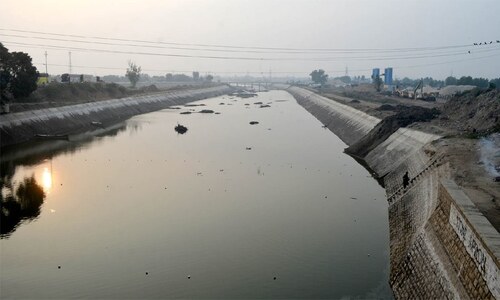
HYDERABAD: University teachers, farmers, fishermen community leaders and civil society activists coming from Hyderabad, Jamshoro, Thatta and Badin districts held a protest demonstration near Kotri Barrage in Jamshoro on Friday against operation of the Jamshoro Coal Power Plant — funded by the Asian Development Bank.
“The plant is socially disruptive, environmentally damaging and financially burdensome, said Prof Ismail Kumbhar of the Sindh Agriculture university (SAU) while speaking to them at the demonstration, organised by the Indus Climate Forum.
He said that air pollution, land degradation and water contamination associated with the plant were seriously threatening livelihoods of nearby farming and fishing communities, besides contributing to respiratory health problems.
Others who joined in the protest included Aliya Bakhshal Thallu of the Women Democratic Front, Mustafa Mirani of the Pakistan Fisherfolk Forum, Prof Aman Mahar of the Sindh University’s Environmental Sciences department, Kamal Palari, an environmentalist from Jhimpir and Jamzadi Mallah, a representative of Jamshoro fishermen community.
Activists say environmental degradation poses serious threat to livelihood, health of local communities
They urged ADB to convert its outstanding loan into financing for repurposing the plant as a renewable energy project.
They highlighted social, environmental and financial impacts of the plant, and said that the communities living around it largely depended on agriculture, livestock grazing and fishing. “Environmental degradation has reduced agricultural productivity, diminished grazing land and contributed to declining fish populations and varieties. These impacts are forcing locals to seek alternative sources of income somewhere else,” said Aliya Bakhshal Thallu.
The activists claimed that the ADB did not adequately apply its own social and environmental safeguards in financing this project.
Acknowledging that some risks were identified in ADB’s project documentation, Prof Aman Mahar said that their cumulative impacts had not been adequately addressed.
The protesters expressed their concern over disposal of fly ash through water-based slurry and storage in an ash pond, describing the method as potentially unsafe. They argued that impacts of the plant on water resources, ecosystems and the Indus delta had also not been adequately assessed.
“The disposal and storage of fly ash through water-based slurry and ash ponds raises serious concerns about environmental safety, particularly its potential impacts on water resources, ecosystems and the Indus Delta,” said Rabia Jamali.
The activists observed that despite ADB’s consideration of a ‘no project option’, viable renewable-energy alternatives, particularly solar power, were not properly considered when the project was planned. They also questioned the plant’s coal supply chain as another matter of serious concern.
“Renewable-energy alternatives, particularly solar power, should have been properly considered when the project was planned. Pakistan has significant potential for renewable energy, and such alternatives could have reduced the social and environmental risks associated with coal,” said Mustafa Mirani. He added that the proposed railway network has raised concerns about displacement of communities in Tharparkar and Umerkot districts.
According to the activists, the plant was designed to use 80pc imported sub-bituminous coal and 20pc Thar lignite. They said that the government’s planned Thar coal railway connectivity project to transport local lignite could create additional social and environmental impacts. They urged ADB and the Pakistan government to prioritise an early and just retirement of coal plant and redirect financial resources towards renewable energy while protecting affected communities and their livelihoods.
The government has set-up coal plant on the premises of the Jamshoro Thermal Power Station under ADB’s $900m funding after being conceived in 2013 to meet growing energy demands, reduce circular debt through cheaper fuel, and catalyse industrial growth.
This project has two 660MW units each. “One unit had started operations in May 2025, contributing electricity as per demand of the national grid, according to, Ashraf Bhatti, the spokesman for the plant’s management.
The thermal power plant has four units — three Chinese and one Japanese.
Published in Dawn, September 19th, 2026