Govt eyes Pakpattan’s millennia-old locality, terms 72 acres land dangerous

SAHIWAL: Pakpattan, historically known as Ajodhan, carries within its heart a millennia-old mound, locally called Dhakki.
According to some sources, Dhakki is not a natural plateau but a man-made mound dating back to periods when populations lived at elevated sites near rivers such as Tela Qabola, Harappa, Depalpur, and Ajodhan. About 700 years ago, the first known Punjabi poet Baba Farid settled here. His Punjabi ashloks, later collected by Baba Nanak into the Granth, are remembered by indigenous communities across generations.
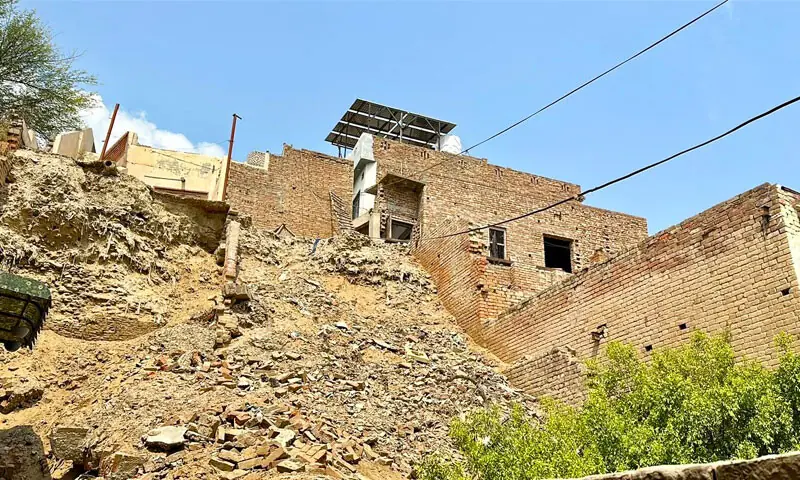
This ancient Dhakki, once home to communities living around Baba Farid’s shrine or settled here two to three millennia ago, now has a dense population of more than 3,400 residents spread over 72 acres of the mound area. For over a decade, the local district administration has repeatedly warned that these buildings rest on loose soil strata with no solid foundations.
“There is strong evidence-based public perception soil can collapse any time, causing a great human tragedy,” Deputy Commissioner Asif Raza claims while speaking to Dawn. This concern is widely shared among local residents and parliamentarians who remain deeply sensitive to the matter. Concerns about Dhakki’s soil strata first emerged in 2015 when district authorities and community activists observed that the mound’s bearing capacity was diminishing. Differential settlement had already caused cracks in the buildings and 32 structures were declared dangerous and demolished over the past few years.
Dhakki near Baba Farid’s shrine has 3,400 residents; govt will either relocate them or ‘preserve the land’ to promote religious tourism
Six months ago, DC Raza ordered a ban on new construction at Dhakki, fearing that the unstable soil could not support any further load. To determine the ‘safety of the existing population’, the district administration engaged the National Engineering Services Pakistan (NESPAK) and Bahauddin Zakariya University (BZU), Multan, for a geotechnical study. A group of professors from BZU visited the site but a formal report is yet to be released.
Early findings during renovation at Baba Farid’s shrine and construction of a grand mosque adjacent to it years back had revealed loose strata with no hard foundation, forcing engineers to adopt pile casting instead of traditional raft foundations.
Masood Khalid, the local practitioner and director of Sanjh, a civil society organisation, recalls how drinking water was once carried to Dhakki residents in mashkeezas.
“Even in my childhood, I saw water carriers climbing the mound,” he says. “But when pipelines were laid, water seeped into the soil, weakening foundations. The laying of sewerage lines further complicated the problem, and now there are fears any building could collapse. Evidence shows collapses during heavy monsoon rains, worsened by climate change and intense rainfall,” adds Khalid.
It was against this backdrop that local PMLN parliamentarians raised the issue with the chief minister. Responding to their concerns, the CM directed Najamus Saqib, director general of the Walled City Authority Lahore, to examine whether Dhakki could be preserved or whether its population must be shifted to avert a catastrophe.
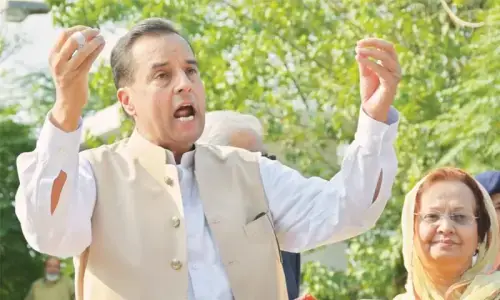
Speaking to Dawn, Chaudhry Javed, PMLN MPA from Pakpattan, says they are pressing to involve the archaeology department, NESPAK, tourism department, and the WCLA in preparing a conservation plan. “We want preservation of Dhakki and promotion of religious tourism,” he says, noting Baba Farid’s devotees include the Muslims, Sikhs and Hindus who visit annually for his Urs.
DC Asif Raza said all stakeholders must develop a comprehensive plan addressing both conservation and seepage issues while factoring in future climate change threats. Sources have confirmed that the WCLA now faces two options: conserve Dhakki as a heritage site or relocate its residents to safer ground.
Najamus Saqib, accompanied by senior district officials and parliamentarians, inspected the site and emphasized the urgency of conserving the mound while protecting lives.
A detailed conservation plan involving all stakeholders is under-preparation for submission to the district administration, aiming to safeguard Dhakki’s legacy as a part of Pakpattan’s cultural heritage. For the people of Pakpattan, the decision will determine whether Dhakki continues to stand as a living monument of history—or whether its residents must move to ensure safety against the silent threat beneath their feet.
Published in Dawn, September 21st, 2026