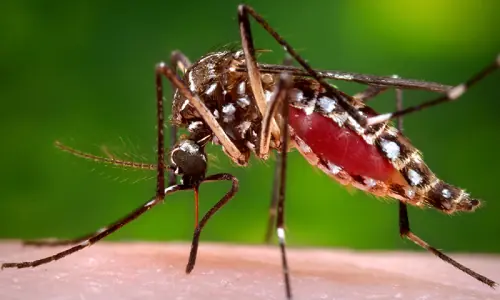
PESHAWAR: The Khyber Pakhtunkhwa health department has declared a dengue outbreak in Kohat as the district recorded most cases of the mosquito-borne disease in the province last week.
Kohat has reported 788 dengue cases this year, including 72 this week, according to a report issued by the Integrated Diseases Surveillance and Response System of the Directorate General Health Services, Khyber Pakhtunkhwa, on Tuesday.
It said the tally of dengue cases in the province had reached 1,327 this year.
The report said five of 19 samples tested at the Public Health Reference Lab at Khyber Medical University were confirmed positive for dengue, providing evidence of an outbreak in Kohat.
District records most cases in province last week
It said a rapid response team deployed by the health department had also detected mosquito larvae in Gulshanabad, identified as the district’s main urban hotspot.
The report said Peshawar, once the province’s main dengue hotspot, ranks second with 251 cases, followed by Bannu with 79, Haripur 35, Nowshera 20, Abbottabad 17, Charsadda 14, Swabi and Lakki Marwat 13 each, Khyber 12, Mansehra 11 and Swat and Bajaur 10 each.
It added that the remaining 24 endemic districts had reported cases in single digits, while teams had detected and eliminated larvae in 11 districts.
Health department sources warned that the dengue-related situation in Kohat could snowball into a major public health problem, so the local administration was asked a month ago to level the sites of refugee camps demolished several months ago.
However, debris remains at the site, with ditches becoming stagnant pools to provide breeding grounds for mosquitoes that transmit dengue.
The sources also said rapid response teams detected larvae in houses near the former camps, which continued to pose a threat to the population.
Last year, Charsadda recorded the highest number of cases in the province because of outbreaks in a few union councils caused by standing water. The same situation is emerging in Kohat, according to officials.
They said dengue had been endemic in the province but Peshawar reported the bulk of cases every year except last year and this year.
The officials said fewer reported cases in Peshawar compared to previous years could be attributed to a lacklustre response to the health department’s requests to medical teaching institutions to share a line list of patients so that a comprehensive strategy could be adopted.
They said Peshawar had many areas with high dengue prevalence, so the department wanted MTIs to provide details of patients so that response activities could be launched.
The officials said widespread dengue cases were reported in many localities of the provincial capital but the department didn’t have accurate information about them.
They said other issues faced by the department included people’s carelessness in taking preventive measures against dengue.
Referring to the IDS&RS report, the officials said that last week, health teams held 65,751 community sessions where health education was provided to 259,321 women and 64,031 men, in addition to eliminating larvae from 1,028 houses, 1,597 containers and 321 outdoor sites.
They, however, said public awareness and cooperation remained key to preventing the disease and that health teams could not visit every house.
The officials said that for the last 15 years, they had been urging people to avoid storing water in uncovered pots at home, change the water in air coolers every three days and eliminate stagnant water in neighbourhoods.
They added that those measures were very important.
Published in Dawn, September 23rd, 2026